Crestview, Los Angeles
Updated · 9,930 residents
Crestview is a dense, energetic neighborhood in West Los Angeles known for its collection of historic 1930s and 1940s Spanish-style homes. The area offers high walkability and strong community health insurance coverage, though residents contend with significant road traffic noise and limited private outdoor space.
Key Highlights
About Crestview
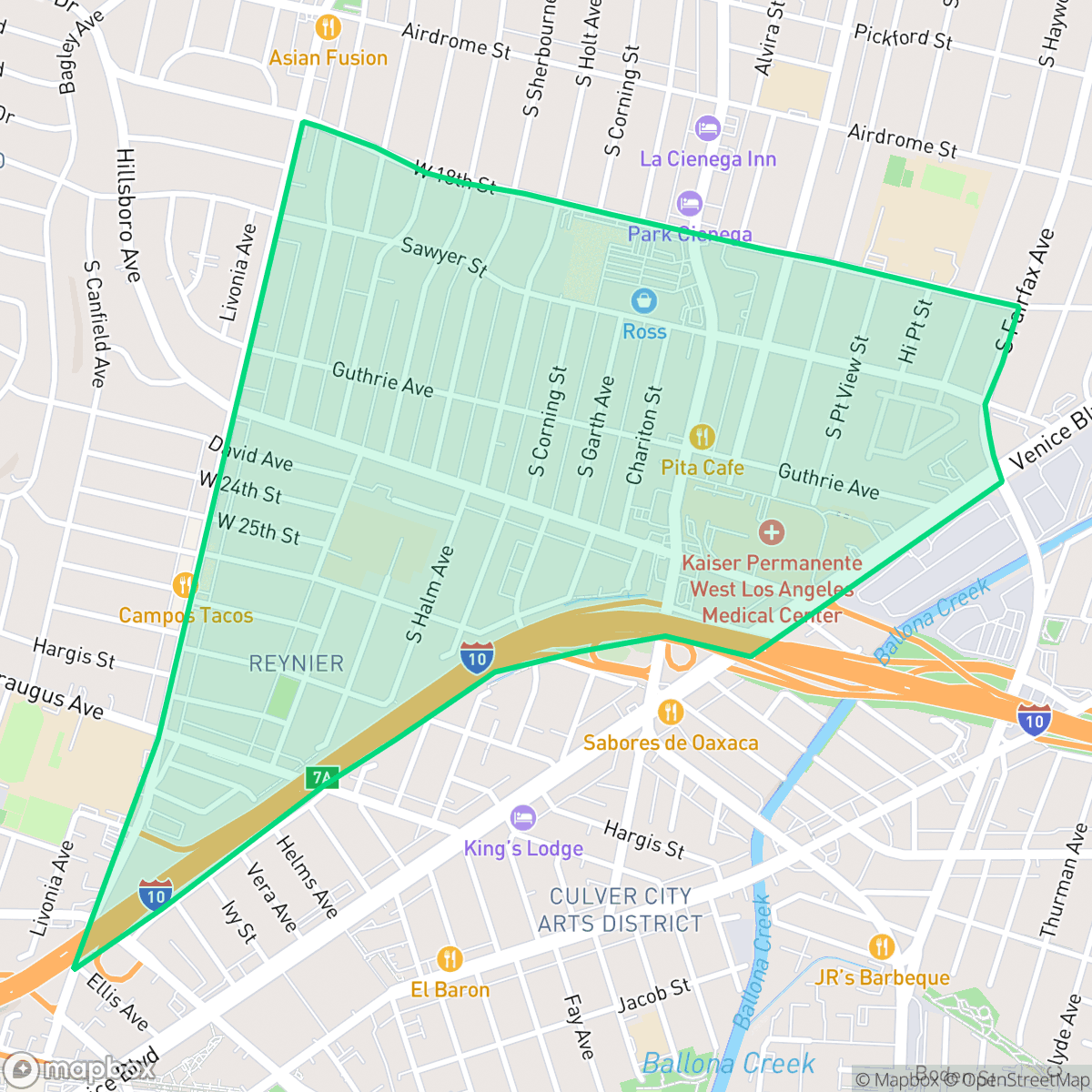
Crestview, a residential neighborhood in the Mid-City area of Los Angeles, was originally composed of grazing lands and bean fields farmed by Japanese immigrants before its annexation to the city in 1915. Suburban development took off in the late 1920s and 1930s, marked by the establishment of Pickford Avenue—possibly named after actress Mary Pickford. During the 1930s and 1940s, prominent developer Elwain Steinkamp constructed many of Crestview's signature Spanish-style homes, characterized by tile roofs, courtyards, and leaded glass windows. By the late 20th century, the neighborhood, bounded by Robertson and La Cienega Boulevards, evolved into a diverse hub of ethnic integration, famously described as a cultural intersection where traditional Black Los Angeles meets the Westside.
Located in the Mid-City region of Los Angeles, this neighborhood is defined by its high-density urban character and central location near major commercial corridors. It features a distinct architectural identity, with many of its homes built during the 1930s and 1940s by developers Elwain Steinkamp and William T. Richardson, often showcasing signature Spanish-style designs. The area’s grid-based street layout supports a lively, social atmosphere, providing residents with convenient access to local dining and services within the broader Westside urban fabric.
Living in this area involves balancing urban convenience with the realities of a bustling city environment. While the neighborhood is highly walkable, it is characterized by closely packed housing that offers limited privacy and significant noise pollution from nearby major thoroughfares. It lacks large public parks, making it best suited for individuals or professionals who prioritize an energetic, central lifestyle over quiet, secluded surroundings. Prospective residents should also note the district’s strong health insurance coverage and its role as a diverse, well-connected residential enclave.
Neighborhood Scores Across 15 Qualities
Residential structures are closely packed with limited buffers between neighboring properties. This level of density is slightly higher than the Los Angeles average, meaning some houses may have shared driveways or minimal distance between windows.
A dense grid of sidewalks and clear crosswalks facilitates easy movement throughout the residential areas, though the massive freeway interchange acts as a significant barrier for pedestrians. According to iHuus data, the walkability of this area is slightly below the Los Angeles average.
Large, well-maintained homes with private pools and spacious driveways characterize much of the area. This level of visual amenity and property scale is roughly in line with the Los Angeles average.
Limited public parks and narrow sidewalk verges make finding open green space difficult for pet owners. According to iHuus data, the availability of accessible walking areas for dogs is below the Los Angeles average.
Residential streets and green spaces are found in roughly equal measure, mirroring the broader Los Angeles urban-rural balance. According to iHuus data, the area features a transition between low-rise housing and larger commercial structures.
A varied mix of lively commercial districts and quiet suburban blocks creates a sense of activity that is more vibrant than the Los Angeles average. Residents can access a diverse range of dining and amenities, though some pockets remain more residential and secluded.
Persistent sound from nearby freeways and transit corridors characterizes the area. According to iHuus data, acoustic levels in Crestview are slightly higher than the Los Angeles average.
Air quality in Crestview is generally healthy and clean, remaining very close to the Los Angeles average. According to iHuus data, residents can expect mostly clear conditions with only rare instances of elevated readings.
Industrial presence is minimal throughout most of the area, though some residents near the major highway and warehouse districts may experience increased noise and air concerns. According to iHuus data, the neighborhood lacks the heavy industrial density found in other parts of the city.
Health insurance enrollment is notably higher than the Los Angeles average, according to iHuus data. Residents in this area have significantly better access to coverage than most of the city.
Voting patterns and census indicators reflect a deeply progressive political landscape. This ideological leaning is slightly more pronounced than the average found across Los Angeles.
Residents live alongside a balanced mix of young professionals, families, and seniors. This age distribution is largely consistent with the broader Los Angeles area, according to iHuus data.
Flood risk is significant in this area as it sits within a designated floodplain. According to iHuus data, the level of vulnerability to flooding is notably higher than the Los Angeles average.
Address-Level Insights for Crestview


iHuus Neighborhood Intelligence Insights
Get address-level neighborhood insights for Crestview
- Street-level scores — see how individual blocks compare, not just neighborhood averages
- Micro-zone boundaries — identify quiet pockets, flood boundaries, and walkable clusters before you visit
- 15 dimensions in full — walkability, noise, air quality, school quality, insurance coverage, population age profile, urban/rural index, and more
- Boundary risk alerts — know if your address sits near a block boundary where scores drop, the kind of detail no listing will ever mention
- School insights — individual school ratings and insights, not just district-level data
- Compare before you commit — side-by-side data across neighborhoods, down to block precision
No credit card required
Compare with Any Neighborhood
| Dimension | Crestview | Adams-Normandie |
|---|---|---|
| 🚶 Walkabilityavg 8.9 | ||
| 🔊 Acoustic Comfortavg 2.91 | ||
| 🤫 Privacy Indexavg 4.14 | ||
| 🎨 Visual Appealavg 6.58 | ||
| 🐕 Dog Friendlinessavg 5.04 | ||
| 🗺️ Urban-Rural Indexavg 5.96 | ||
| ✨ Neighborhood Vibeavg 5.07 | ||
| 🏥 Health Insurance Coverageavg 6.2 | ||
| 🌿 Air Qualityavg 8.12 | ||
| 🏭 Industrial Proximityavg 8.46 | ||
| 🌊 Flood Safetyavg 2.66 | ||
| 🗳️ Ideological Leanavg 9.56 | ||
| 👥 Population Age Profileavg 4.85 | ||
| 🔥 Fire Safetyavg 0.18 | ||
| 🏫 School Quality |
Crestview Rankings
School Districts Serving Crestview
School Insights for Crestview
Below average outcomes; significant attendance and academic challenges.
School Insights
See what's really behind every school rating near Crestview
- Individual school ratings — each school's own score with outcome context, not just a district average
- Enrollment & class size data — student-to-teacher ratio and how it compares to the state average
- Full demographics breakdown — ethnicity and gender composition for every school in the enrollment zone
- Every school in the district — all schools within the enrollment boundary ranked by rating, not just the closest one
- Grade levels & benchmarks — elementary through high school, with below/above state-average flags
No credit card required