Chinatown, Los Angeles
Updated · 4,730 residents
Chinatown is an exceptionally walkable, high-density urban hub defined by its historic commercial corridors and diverse culinary scene. While it offers immediate access to local amenities, residents should anticipate significant noise from road traffic and a lack of private green space.
Key Highlights
About Chinatown
Los Angeles’s Chinatown has a resilient history defined by displacement and community-led rebirth. The original 19th-century Chinatown was demolished in the 1930s to construct Union Station. In response, community leader Peter SooHoo and the Los Angeles Chinatown Project Association mobilized to establish "New Chinatown," which opened in 1938 as the first modern American Chinatown planned and owned by Chinese Americans. Centered around Central Plaza, the neighborhood features East Asian Eclectic architecture designed with the help of Hollywood set designers, showcasing vibrant colors, neon lighting, and pagoda-style curved roofs. Notable landmarks include the West and East Gates (Gate of Maternal Virtues), and the 1890 Garnier Building—the oldest surviving Chinese structure in L.A., now home to the Chinese American Museum. Legacy businesses like the Phoenix Bakery have anchored the community since its 1938 opening.
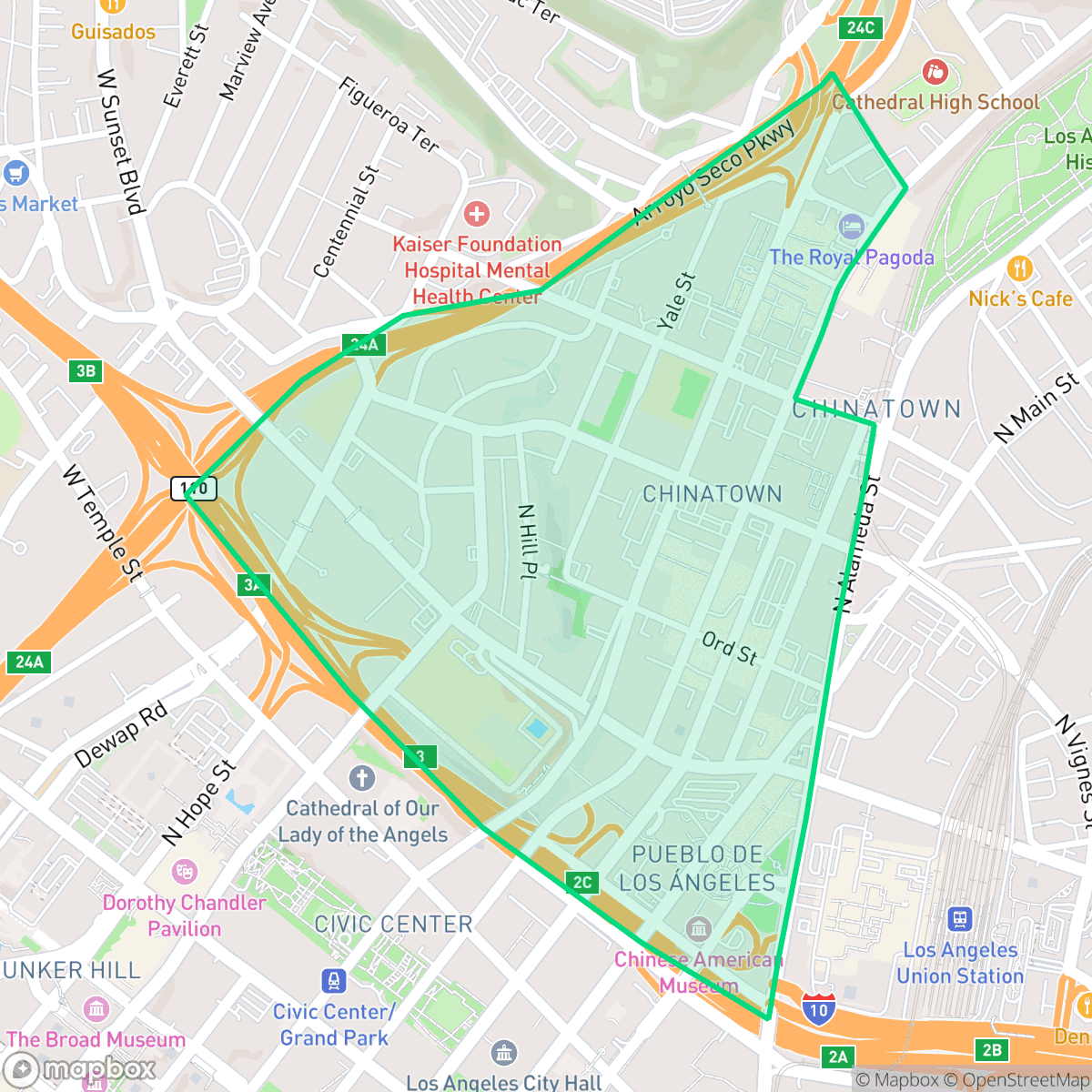
The neighborhood functions as a dense, transit-oriented core where residents benefit from a highly connected street grid. The area features a mix of institutional buildings and commercial blocks, hosting a variety of social hubs and dining establishments that contribute to a lively local atmosphere. According to iHuus data, the area maintains a high level of walkability, allowing for easy navigation between local businesses and nearby transit links.
Prospective residents should consider the trade-offs of living in such a compact environment. The area is characterized by heavy concrete infrastructure with minimal green space, making it less suitable for those seeking outdoor recreation or dog-friendly environments. With an average noise level of 67 decibels, the neighborhood is best suited for individuals who prioritize central city access and vibrant urban density over quiet, suburban-style living.
Neighborhood Scores Across 15 Qualities
Limited private outdoor space and narrow separation between buildings characterize this area. According to iHuus data, the density of shared walls and multi-unit structures is significantly higher than the Los Angeles average.
Pedestrian infrastructure is interrupted by large parking lots and massive freeway interchanges, making the area less walkable than much of Los Angeles. While many streets feature sidewalks and marked crossings, the dense street grid is frequently severed by high-traffic corridors.
Largely composed of institutional buildings and dense apartment blocks, the visual landscape is less varied than the Los Angeles average. According to iHuus data, the area features a uniform mix of commercial architecture and small-footprint housing without much private greenery.
Concrete sidewalks and heavy freeway borders dominate the landscape, making access to open grass or wide green verges less common than in the rest of the city. While residents can reach specific urban parks like Grand Park, pet owners will find fewer natural areas for exercise compared to the city average.
Dense low-rise structures and significant asphalt coverage from nearby highways and parking lots characterize the area. This level of built environment is notably less dense than the average for Los Angeles.
Social hubs and diverse dining options provide a level of activity that is slightly higher than the city average. While some blocks offer a calm atmosphere near green spaces, other areas feature a denser, high-energy landscape centered around transit corridors and local landmarks.
Frequent noise from heavy rail and nearby transit corridors makes this area significantly louder than most Los Angeles neighborhoods. Continuous acoustic disruptions are a consistent feature for residents here according to iHuus data.
Air quality remains high with rare instances of elevated readings. This level of cleanliness is largely consistent with the average found across Los Angeles.
Heavy industrial activity is largely absent from the neighborhood, though residents may experience elevated noise and air pollution from nearby freeway interchanges and rail infrastructure. According to iHuus data, the area contains more industrial proximity than the Los Angeles average.
Health insurance access among residents is lower than the Los Angeles average, according to iHuus data.
Voting patterns and census indicators reflect a predominantly liberal political climate that is even more pronounced than the Los Angeles city average.
Residents live alongside a balanced demographic of young professionals, families, and seniors. This age distribution is roughly in line with the broader Los Angeles area, according to iHuus data.
Flood risk is significantly higher than the Los Angeles average; residents should prepare for potentially elevated or prohibitive insurance costs. According to iHuus data, the area is subject to notable hazard zone designations.
Fire safety infrastructure and accessibility in this area are lower than the city average, according to iHuus data. Residents should be aware of heightened vulnerability to fire-related incidents compared to most other Los Angeles neighborhoods.
Address-Level Insights for Chinatown


iHuus Neighborhood Intelligence Insights
Get address-level neighborhood insights for Chinatown
- Street-level scores — see how individual blocks compare, not just neighborhood averages
- Micro-zone boundaries — identify quiet pockets, flood boundaries, and walkable clusters before you visit
- 15 dimensions in full — walkability, noise, air quality, school quality, insurance coverage, population age profile, urban/rural index, and more
- Boundary risk alerts — know if your address sits near a block boundary where scores drop, the kind of detail no listing will ever mention
- School insights — individual school ratings and insights, not just district-level data
- Compare before you commit — side-by-side data across neighborhoods, down to block precision
No credit card required
Compare with Any Neighborhood
| Dimension | Chinatown | Adams-Normandie |
|---|---|---|
| 🚶 Walkabilityavg 8.9 | ||
| 🔊 Acoustic Comfortavg 2.91 | ||
| 🤫 Privacy Indexavg 4.14 | ||
| 🎨 Visual Appealavg 6.58 | ||
| 🐕 Dog Friendlinessavg 5.04 | ||
| 🗺️ Urban-Rural Indexavg 5.96 | ||
| ✨ Neighborhood Vibeavg 5.07 | ||
| 🏥 Health Insurance Coverageavg 6.2 | ||
| 🌿 Air Qualityavg 8.12 | ||
| 🏭 Industrial Proximityavg 8.46 | ||
| 🌊 Flood Safetyavg 2.66 | ||
| 🗳️ Ideological Leanavg 9.56 | ||
| 👥 Population Age Profileavg 4.85 | ||
| 🔥 Fire Safetyavg 0.18 | ||
| 🏫 School Quality |
Chinatown Rankings
School Districts Serving Chinatown
School Insights for Chinatown
Below average outcomes; significant attendance and academic challenges.
School Insights
See what's really behind every school rating near Chinatown
- Individual school ratings — each school's own score with outcome context, not just a district average
- Enrollment & class size data — student-to-teacher ratio and how it compares to the state average
- Full demographics breakdown — ethnicity and gender composition for every school in the enrollment zone
- Every school in the district — all schools within the enrollment boundary ranked by rating, not just the closest one
- Grade levels & benchmarks — elementary through high school, with below/above state-average flags
No credit card required