Cheviot Hills, Los Angeles
Updated · 15,331 residents
Cheviot Hills is a quiet, affluent residential enclave in Los Angeles known for its diverse architectural styles and strong ties to the entertainment industry. It offers a highly walkable, tree-lined environment with consistent sidewalk access, though residents should expect noticeable noise from regional road traffic.
Key Highlights
About Cheviot Hills
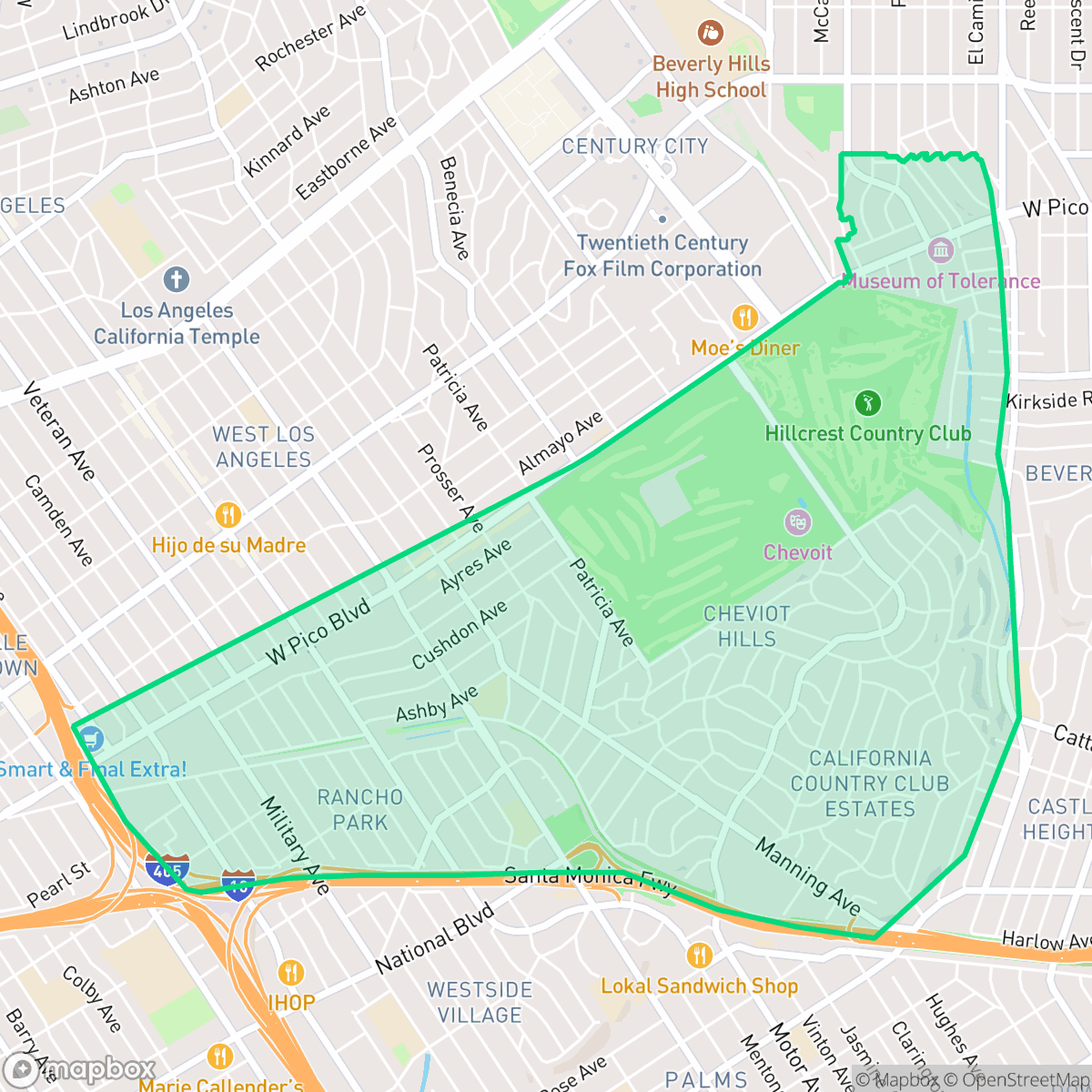
Founded in 1924 on the former Spanish land grant Rancho Rincon de los Bueyes, Cheviot Hills was named for the rolling hills bordering England and Scotland. Developed as a residential haven, its history is deeply intertwined with the entertainment industry due to its location between Fox Studios and Sony Pictures Studios (formerly MGM). Motor Avenue, which bisects the neighborhood, was named by studio executives who motored between the lots. The neighborhood became a premier filming location for countless films and television shows, as well as a home for prominent actors, directors, and executives. Architecturally diverse, Cheviot Hills features Spanish Colonial, Tudor, and Traditional homes, including notable designs like the Harry Culver Estate by Wallace Neff and the Strauss-Lewis House by Raphael Soriano. It also features the historic Hillcrest Country Club, founded as a haven for Jewish Hollywood figures.
The neighborhood features a dense, well-connected grid of single-family homes, characterized by manicured landscaping and frequent private pools. It provides a peaceful, suburban feel despite its central location in Los Angeles. Residents benefit from high levels of health insurance coverage and a complete absence of industrial activity, contributing to a clean and stable living environment.
While the area is exceptionally walkable, the proximity to major thoroughfares results in elevated noise levels from traffic. It is best suited for families or professionals seeking an established community with access to top-rated local schools like Overland Avenue Elementary. Prospective residents should consider acoustic factors when choosing a home, as the area remains primarily car-oriented despite its pedestrian-friendly infrastructure.
Neighborhood Scores Across 15 Qualities
Residential spacing provides a greater degree of privacy than the Los Angeles average, characterized by detached homes with moderate setbacks. While some multi-unit buildings feature shared walls, most properties maintain a buffer of distance between neighbors.
Continuous sidewalk networks and well-marked crosswalks provide safe pedestrian access throughout the residential grid. This connectivity is slightly above the city average, although the nearby freeway interchange remains a significant physical barrier for movement.
Large homes with well-maintained landscaping and frequent private pools create a highly aesthetic environment that is notably more visually polished than the Los Angeles average. According to iHuus data, the area is characterized by spacious lots and premium residential amenities.
Wide green verges and proximity to large golf course landscapes provide more ample walking space than the Los Angeles average. According to iHuus data, many residential blocks feature consistent parkway strips that offer safe, tree-lined paths for pets.
Residential streets and mature tree canopies are balanced by paved road networks and local commercial structures. This layout offers a classic suburban environment that is slightly more developed than the average for Los Angeles.
Primarily quiet and suburban, this area offers a mix of serene green spaces and occasional lively pockets of dining and social hubs. According to iHuus data, the local energy is slightly higher than the city average due to these accessible pockets of amenities.
Frequent traffic and transit noise from nearby freeways and rail lines characterize the area. This level of acoustic disturbance is higher than the Los Angeles average, according to iHuus data.
Air quality remains consistently clear with rare instances of elevated readings, performing closely to the Los Angeles average according to iHuus data.
Industrial activity and large-scale warehouses are absent from the area, making the neighborhood significantly cleaner of industrial hazards than the Los Angeles average. Residents can expect a landscape comprised almost entirely of residential and light commercial uses with no visible heavy manufacturing or factory sites.
Health insurance access is exceptionally high among residents, significantly outpacing the Los Angeles city average according to iHuus data.
Voting patterns and census indicators reflect a deeply liberal political landscape, closely mirroring the broader trends seen across Los Angeles.
Residents live alongside a balanced mix of young adults, families, and older populations. This demographic variety is slightly more widespread than the typical Los Angeles profile, according to iHuus data.
Flood risk in this area is notably higher than the Los Angeles average, though the specific level of danger remains undetermined due to a lack of detailed federal studies. Residents should remain aware that current data indicates more vulnerability to flooding than most parts of the city.
Address-Level Insights for Cheviot Hills


iHuus Neighborhood Intelligence Insights
Get address-level neighborhood insights for Cheviot Hills
- Street-level scores — see how individual blocks compare, not just neighborhood averages
- Micro-zone boundaries — identify quiet pockets, flood boundaries, and walkable clusters before you visit
- 15 dimensions in full — walkability, noise, air quality, school quality, insurance coverage, population age profile, urban/rural index, and more
- Boundary risk alerts — know if your address sits near a block boundary where scores drop, the kind of detail no listing will ever mention
- School insights — individual school ratings and insights, not just district-level data
- Compare before you commit — side-by-side data across neighborhoods, down to block precision
No credit card required
Compare with Any Neighborhood
| Dimension | Cheviot Hills | Adams-Normandie |
|---|---|---|
| 🚶 Walkabilityavg 8.9 | ||
| 🔊 Acoustic Comfortavg 2.91 | ||
| 🤫 Privacy Indexavg 4.14 | ||
| 🎨 Visual Appealavg 6.58 | ||
| 🐕 Dog Friendlinessavg 5.04 | ||
| 🗺️ Urban-Rural Indexavg 5.96 | ||
| ✨ Neighborhood Vibeavg 5.07 | ||
| 🏥 Health Insurance Coverageavg 6.2 | ||
| 🌿 Air Qualityavg 8.12 | ||
| 🏭 Industrial Proximityavg 8.46 | ||
| 🌊 Flood Safetyavg 2.66 | ||
| 🗳️ Ideological Leanavg 9.56 | ||
| 👥 Population Age Profileavg 4.85 | ||
| 🔥 Fire Safetyavg 0.18 | ||
| 🏫 School Quality |
Cheviot Hills Rankings
School Districts Serving Cheviot Hills
School Insights for Cheviot Hills
Below average outcomes; significant attendance and academic challenges.
School Insights
See what's really behind every school rating near Cheviot Hills
- Individual school ratings — each school's own score with outcome context, not just a district average
- Enrollment & class size data — student-to-teacher ratio and how it compares to the state average
- Full demographics breakdown — ethnicity and gender composition for every school in the enrollment zone
- Every school in the district — all schools within the enrollment boundary ranked by rating, not just the closest one
- Grade levels & benchmarks — elementary through high school, with below/above state-average flags
No credit card required