Century City, Los Angeles
Updated · 5,249 residents
Century City is a dense, high-rise business and residential hub defined by its distinct modernist architecture and central Westside location. Residents benefit from exceptional walkability and proximity to professional centers, though the area experiences notable noise levels from consistent road traffic.
Key Highlights
About Century City
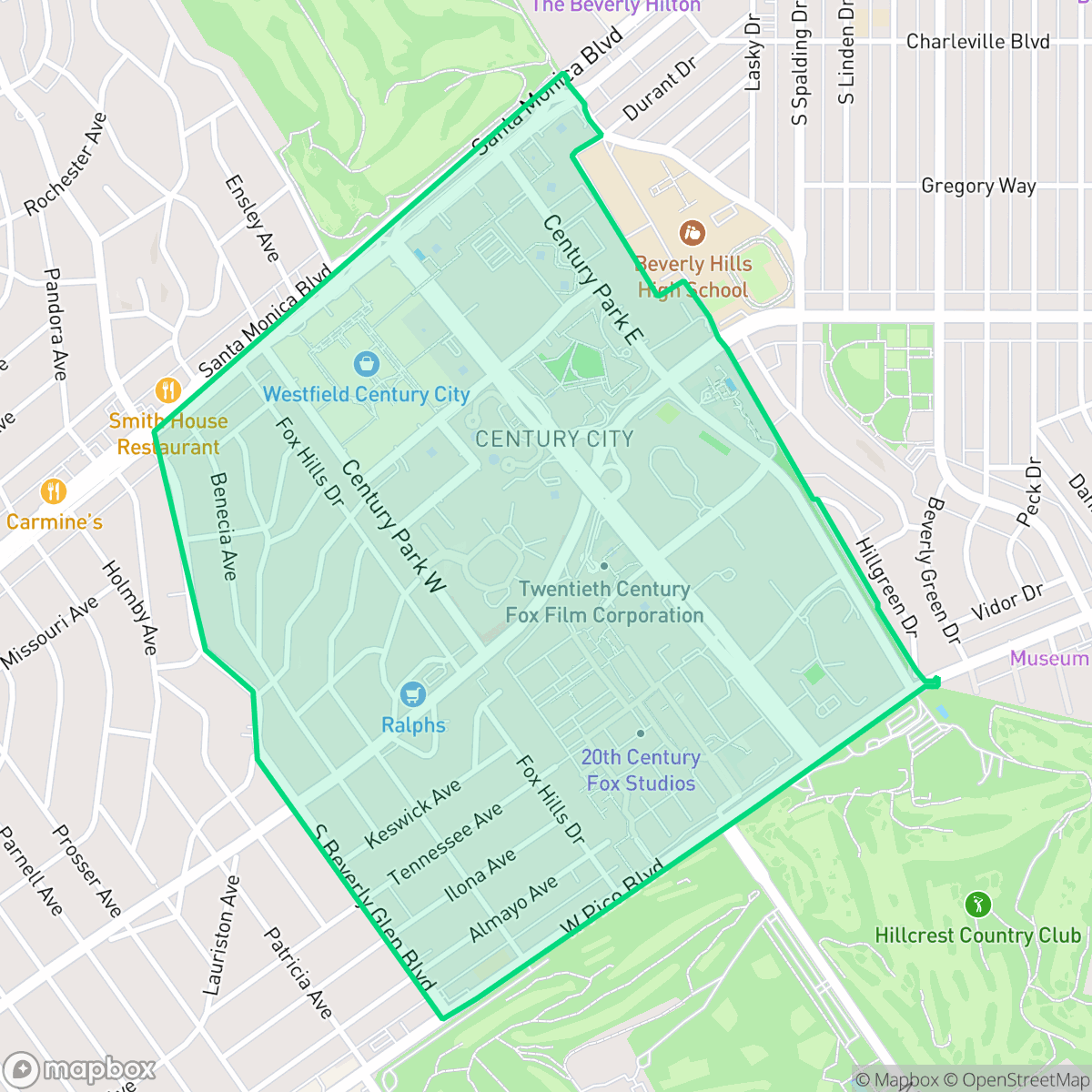
Originally a ranch owned by cowboy actor Tom Mix, the 176-acre site that is now Century City became the backlot of 20th Century Fox in the mid-20th century. Following massive financial strains from the production of the film Cleopatra, the studio sold the land in 1961 to developer William Zeckendorf and Alcoa (Aluminum Co. of America). Alcoa envisioned a "city within a city" to showcase aluminum's potential in high-rise construction. Developed from a master plan by Welton Becket Associates, the neighborhood emerged as a premier mid-century modern business district. Its distinctive skyline is defined by wide boulevards like Avenue of the Stars and architectural landmarks, including the crescent-shaped Century Plaza Hotel designed by Minoru Yamasaki, and the twin Century Plaza Towers. Today, it remains a major financial hub and employment center on Los Angeles's Westside.
The neighborhood functions as a prominent Westside employment and residential center. It is defined by a high-density layout, featuring luxury high-rise condominiums and commercial towers that offer a polished, urban aesthetic. According to iHuus data, the area maintains a high walkability score, allowing residents to easily access local dining, professional services, and retail destinations like the Westfield Century City mall. The district maintains a clean environment with minimal industrial presence, and residents enjoy high rates of health insurance coverage.
Living in the area involves a trade-off between urban convenience and acoustic comfort, as the district records elevated noise levels primarily driven by constant road traffic. The high-density environment means that private outdoor space is limited, and prospective residents should be aware of the low fire safety scores that are characteristic of the region. This neighborhood is well-suited for professionals and individuals seeking a central, walkable urban lifestyle with immediate access to major business hubs and upscale amenities.
Neighborhood Scores Across 15 Qualities
Residential spacing varies significantly, ranging from dense high-rise complexes to single-family homes with moderate buffers. This level of privacy is slightly higher than the city average, according to iHuus data.
Continuous sidewalk networks and well-marked crossings make navigating the area on foot very easy. According to iHuus data, the pedestrian infrastructure here is even more comprehensive than the Los Angeles average.
Polished landscapes, luxury high-rise towers, and private amenities like golf courses and pools characterize the area. This level of visual upkeep and architectural density is notably higher than the Los Angeles average, according to iHuus data.
Extensive green belts, a massive central golf course, and wide, tree-lined verges provide much better access to pet-friendly walking space than the Los Angeles average. According to iHuus data, these connected green spaces offer safe paths away from traffic for many residential blocks.
High-rise commercial towers and dense apartment blocks transition into traditional residential grids. This area offers a blend of urban density and suburban greenery that is slightly less dense than the Los Angeles average, according to iHuus data.
Active dining corridors and mid-rise blocks provide a slightly more vibrant atmosphere than the city average. Some pockets remain quiet and suburban, characterized by more greenery and fewer walkable amenities.
Frequent noise from nearby freeways and transit corridors characterizes the area. According to iHuus data, acoustic levels are slightly higher than the Los Angeles average.
Air quality remains consistently high with rare instances of elevated readings. This level of cleanliness is roughly in line with the broader Los Angeles area according to iHuus data.
Industrial presence is virtually non-existent here, as the area consists primarily of residential, office, and light commercial spaces. According to iHuus data, this neighborhood is significantly cleaner of warehouses and heavy machinery sites than the Los Angeles average.
Health insurance access is exceptionally high for residents in this area, significantly exceeding the Los Angeles city average according to iHuus data.
Voting patterns and census indicators reflect a highly liberal leaning, though this is slightly less pronounced than the broader Los Angeles average.
Residents live alongside a varied mix of young professionals, families, and seniors. This population distribution is more balanced than the average seen across Los Angeles, according to iHuus data.
Flood risk in this area is notably higher than the Los Angeles average, although official FEMA studies for this specific zone remain incomplete. Residents should remain aware of potential vulnerabilities during heavy rain events according to iHuus data.
Address-Level Insights for Century City


iHuus Neighborhood Intelligence Insights
Get address-level neighborhood insights for Century City
- Street-level scores — see how individual blocks compare, not just neighborhood averages
- Micro-zone boundaries — identify quiet pockets, flood boundaries, and walkable clusters before you visit
- 15 dimensions in full — walkability, noise, air quality, school quality, insurance coverage, population age profile, urban/rural index, and more
- Boundary risk alerts — know if your address sits near a block boundary where scores drop, the kind of detail no listing will ever mention
- School insights — individual school ratings and insights, not just district-level data
- Compare before you commit — side-by-side data across neighborhoods, down to block precision
No credit card required
Compare with Any Neighborhood
| Dimension | Century City | Adams-Normandie |
|---|---|---|
| 🚶 Walkabilityavg 8.9 | ||
| 🔊 Acoustic Comfortavg 2.91 | ||
| 🤫 Privacy Indexavg 4.14 | ||
| 🎨 Visual Appealavg 6.58 | ||
| 🐕 Dog Friendlinessavg 5.04 | ||
| 🗺️ Urban-Rural Indexavg 5.96 | ||
| ✨ Neighborhood Vibeavg 5.07 | ||
| 🏥 Health Insurance Coverageavg 6.2 | ||
| 🌿 Air Qualityavg 8.12 | ||
| 🏭 Industrial Proximityavg 8.46 | ||
| 🌊 Flood Safetyavg 2.66 | ||
| 🗳️ Ideological Leanavg 9.56 | ||
| 👥 Population Age Profileavg 4.85 | ||
| 🔥 Fire Safetyavg 0.18 | ||
| 🏫 School Quality |
Century City Rankings
School Districts Serving Century City
School Insights for Century City
Below average outcomes; significant attendance and academic challenges.
School Insights
See what's really behind every school rating near Century City
- Individual school ratings — each school's own score with outcome context, not just a district average
- Enrollment & class size data — student-to-teacher ratio and how it compares to the state average
- Full demographics breakdown — ethnicity and gender composition for every school in the enrollment zone
- Every school in the district — all schools within the enrollment boundary ranked by rating, not just the closest one
- Grade levels & benchmarks — elementary through high school, with below/above state-average flags
No credit card required