Canoga Park, Los Angeles
Updated · 48,082 residents
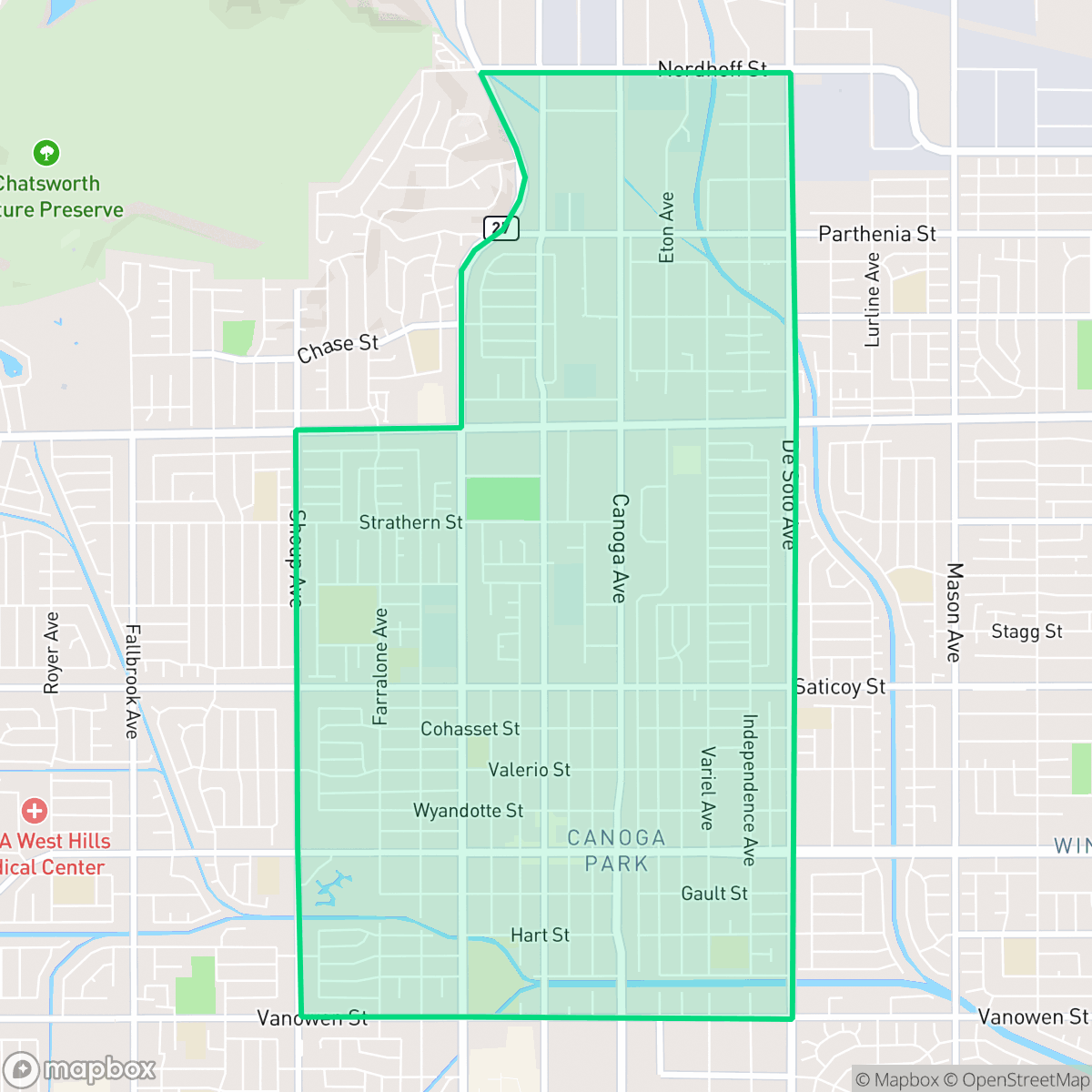
Canoga Park is a historically significant neighborhood defined by its vibrant Sherman Way corridor and a legacy as a former aerospace manufacturing hub. Residents experience a dense, walkable suburban environment, though the area is characterized by high traffic noise and closely spaced housing.
Key Highlights
About Canoga Park
Founded on March 30, 1912, as the agricultural town of Owensmouth, Canoga Park was established by the Los Angeles Suburban Homes Company in anticipation of the Los Angeles Aqueduct's completion. To secure water, the community was annexed by Los Angeles in 1917 and renamed Canoga Park in 1931. Sherman Way served as the neighborhood's main thoroughfare, once carrying Pacific Electric "Red Cars" down its center. The area transitioned from farming to a high-tech hub in 1955 when aerospace giant Rocketdyne established its headquarters here, famously manufacturing engines for the Space Shuttle. Today, historic downtown Canoga Park along Sherman Way is celebrated as "Antique Row," featuring vintage shops and the historic Madrid Theatre, which originally opened in 1926 as a silent movie house.
The area functions as a dense, mixed-use community that balances its industrial roots with a traditional suburban layout. While the landscape is dominated by tract housing and apartment complexes, the presence of the Madrid Theatre and various vintage shops along Sherman Way maintains a distinct local identity. The neighborhood is highly accessible for pedestrians, featuring a comprehensive sidewalk grid that connects residential blocks to commercial strips and essential services.
Prospective residents should note that the neighborhood presents specific trade-offs regarding privacy and acoustic comfort. Due to the high-density residential layout, homes are often situated in close proximity, and the area experiences significant noise levels primarily driven by road traffic. While it offers a practical, urban-suburban lifestyle for those seeking proximity to transit and local amenities, it may be less suitable for those prioritizing quiet, expansive green spaces or high levels of seclusion.
Neighborhood Scores Across 15 Qualities
Residential spacing varies from shared-wall apartment complexes to detached single-family homes with moderate yards. According to iHuus data, this level of density provides more separation between neighbors than is typically found across Los Angeles.
A comprehensive sidewalk network and clear pedestrian crossings exist on both residential and arterial streets, making the area slightly more pedestrian-friendly than the Los Angeles average. According to iHuus data, the consistent grid and well-defined crosswalks facilitate easy movement through both commercial and residential blocks.
Property aesthetics range from affluent estates with private pools to denser, standard tract housing. This visual diversity is roughly in line with the broader Los Angeles average according to iHuus data.
Dog walking options are somewhat restricted because greenery is primarily located in private backyards with narrow sidewalk verges. While some areas feature large public parks and wide grassy parkways, the overall availability of accessible public space is slightly below the city average according to iHuus data.
More open land and scattered residential pockets are found here than in most parts of Los Angeles. The landscape primarily consists of low-density suburban layouts featuring single-family homes and interspersed commercial or industrial zones.
Local activity is characterized by a steady but low-key pace, often centered around scattered dining options and light industrial pockets. This sense of liveliness sits slightly below the Los Angeles average, as many residential blocks remain tranquil and largely car-dependent.
Frequent noise from nearby freeways and railroad tracks characterizes the area. This level of acoustic disturbance is slightly higher than the Los Angeles average, according to iHuus data.
Air quality remains consistently high with rare instances of elevated readings, performing very similarly to the Los Angeles average according to iHuus data.
Light commercial activity and scattered warehouse structures are present, though the area lacks the heavy industrial density found elsewhere in Los Angeles. Most of the neighborhood remains composed of residential and light commercial zones, with some larger-scale logistics facilities concentrated near the western and northern edges.
Health insurance accessibility is lower than the Los Angeles average, according to iHuus data. Residents may face more challenges accessing covered medical services compared to other parts of the city.
Voting patterns and census indicators show a strong liberal leaning, though this is slightly less pronounced than the average seen across Los Angeles.
Residents live alongside a balanced distribution of young adults, families, and seniors. This demographic spread is nearly identical to the broader Los Angeles area, according to iHuus data.
Significant flood risk exists here because portions of the area sit within a designated floodplain. According to iHuus data, this level of risk is higher than the average for Los Angeles.
Fire safety levels in this area are significantly below the Los Angeles average. According to iHuus data, residents should be aware of heightened vulnerability to wildfire-related incidents.
Address-Level Insights for Canoga Park


iHuus Neighborhood Intelligence Insights
Get address-level neighborhood insights for Canoga Park
- Street-level scores — see how individual blocks compare, not just neighborhood averages
- Micro-zone boundaries — identify quiet pockets, flood boundaries, and walkable clusters before you visit
- 15 dimensions in full — walkability, noise, air quality, school quality, insurance coverage, population age profile, urban/rural index, and more
- Boundary risk alerts — know if your address sits near a block boundary where scores drop, the kind of detail no listing will ever mention
- School insights — individual school ratings and insights, not just district-level data
- Compare before you commit — side-by-side data across neighborhoods, down to block precision
No credit card required
Compare with Any Neighborhood
| Dimension | Canoga Park | Adams-Normandie |
|---|---|---|
| 🚶 Walkabilityavg 8.9 | ||
| 🔊 Acoustic Comfortavg 2.91 | ||
| 🤫 Privacy Indexavg 4.14 | ||
| 🎨 Visual Appealavg 6.58 | ||
| 🐕 Dog Friendlinessavg 5.04 | ||
| 🗺️ Urban-Rural Indexavg 5.96 | ||
| ✨ Neighborhood Vibeavg 5.07 | ||
| 🏥 Health Insurance Coverageavg 6.2 | ||
| 🌿 Air Qualityavg 8.12 | ||
| 🏭 Industrial Proximityavg 8.46 | ||
| 🌊 Flood Safetyavg 2.66 | ||
| 🗳️ Ideological Leanavg 9.56 | ||
| 👥 Population Age Profileavg 4.85 | ||
| 🔥 Fire Safetyavg 0.18 | ||
| 🏫 School Quality |
Canoga Park Rankings
School Districts Serving Canoga Park
School Insights for Canoga Park
Below average outcomes; significant attendance and academic challenges.
School Insights
See what's really behind every school rating near Canoga Park
- Individual school ratings — each school's own score with outcome context, not just a district average
- Enrollment & class size data — student-to-teacher ratio and how it compares to the state average
- Full demographics breakdown — ethnicity and gender composition for every school in the enrollment zone
- Every school in the district — all schools within the enrollment boundary ranked by rating, not just the closest one
- Grade levels & benchmarks — elementary through high school, with below/above state-average flags
No credit card required