Brentwood, Los Angeles
Updated · 34,603 residents
Brentwood is a prestigious Los Angeles neighborhood defined by its scenic hillside estates, architectural variety, and proximity to the Getty Center. While the area offers high visual appeal and exceptional health insurance coverage, residents should expect a car-dependent lifestyle with moderate noise levels from local traffic.
Key Highlights
About Brentwood
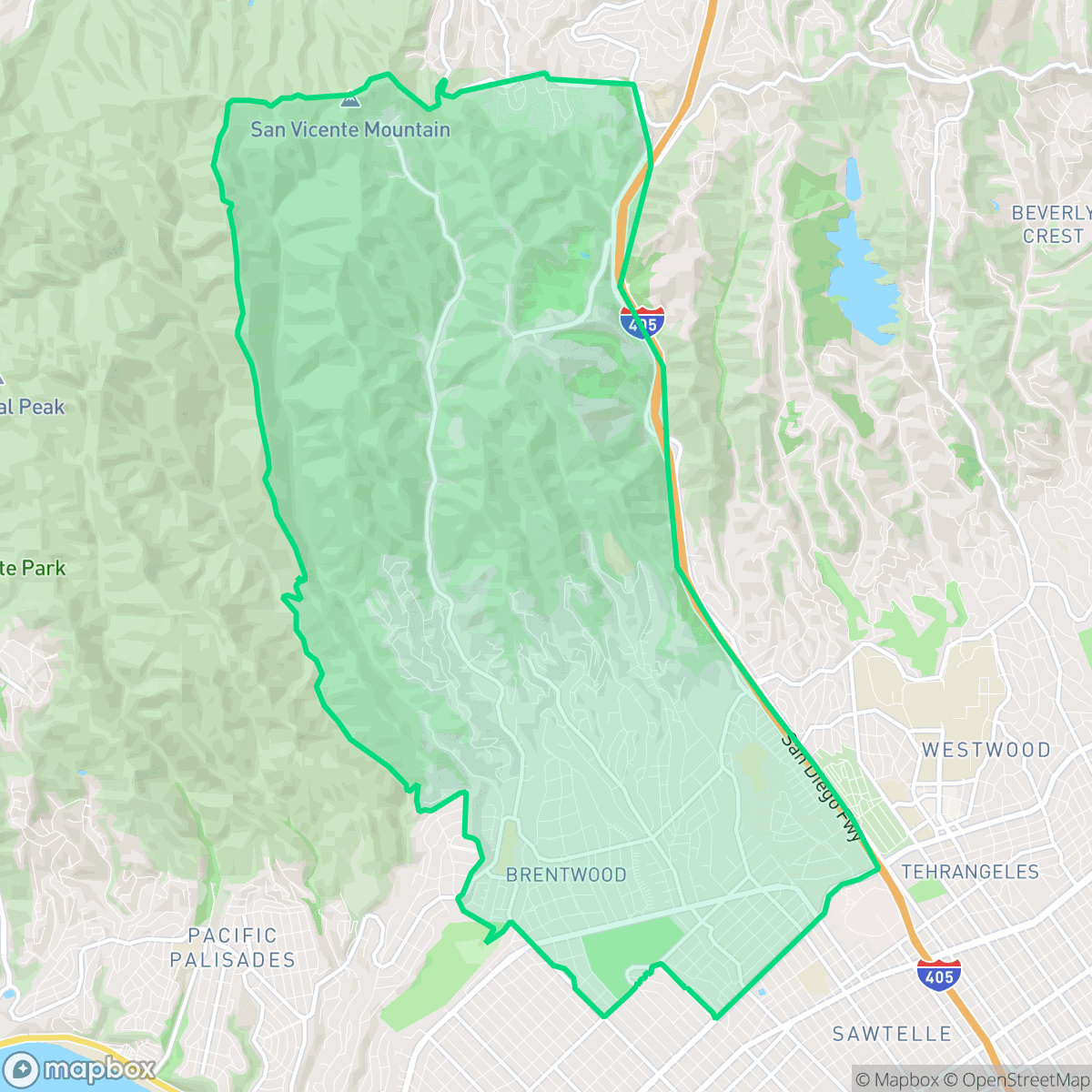
Originally part of the 1839 Rancho San Vicente y Santa Monica Mexican land grant, Brentwood’s modern development began in the late 1880s near the Pacific Branch Soldiers' Home. Initially known as Westgate, the community was annexed by Los Angeles in 1916. In 1906, the exclusive Brentwood Park subdivision was established, setting a precedent for low-density, upscale estates. A defining local landmark is San Vicente Boulevard, featuring a historic median of large coral trees that replaced the old Pacific Electric Red Car trolley tracks. Architecturally, Brentwood features diverse styles, from Spanish Colonial Revival to the mid-century modern cooperative enclave of Crestwood Hills, designed by architects like A. Quincy Jones. Culturally, the neighborhood is known for landmarks like the Brentwood Country Mart, the hillside Getty Center, and its history of high-profile residents, including Marilyn Monroe.
The area provides a tranquil, upscale environment characterized by a blend of low-density residential pockets and vibrant dining and retail hubs. Residents benefit from high-performing local schools, including Brentwood Science and Paul Revere Charter Middle, alongside abundant green spaces that contribute to a high visual appeal. While the community maintains a strong sense of prestige, the reliance on personal vehicles is a consistent factor for navigating daily errands and accessing local amenities.
Living here involves balancing a serene, suburban atmosphere with specific regional trade-offs. While the neighborhood boasts excellent health insurance coverage and complete isolation from industrial hazards, it faces significant fire safety challenges common to the surrounding terrain. The acoustic environment is primarily influenced by road traffic, and the overall pace is quieter than more central urban districts. This neighborhood is best suited for families and professionals seeking an established community with access to top-tier educational resources and a refined, quiet setting.
Neighborhood Scores Across 15 Qualities
Residential privacy varies across the neighborhood due to a mix of large estates and more closely packed multi-family units. According to iHuus data, this level of density offers more separation between structures than the typical Los Angeles neighborhood.
Continuous sidewalks and frequent crosswalks provide a safe environment for navigating the neighborhood on foot. This infrastructure offers a slightly lower level of walkability than the broader Los Angeles average.
Large custom homes, private pools, and well-maintained greenery define the landscape, offering a level of visual polish that is significantly higher than the Los Angeles average. According to iHuus data, the area is characterized by expansive estates and high-end residential amenities.
Abundant public parks and wide, tree-lined paths provide significantly more accessible green space for pets than the Los Angeles average. Large golf course borders and manicured verges offer plenty of walking space, according to iHuus data.
Residential streets and green spaces exist in roughly equal measure, offering a suburban feel that is slightly less urbanized than the Los Angeles average. According to iHuus data, the landscape transitions between low-density hillside estates and mid-rise institutional blocks.
A mix of serene residential streets and vibrant dining districts provides a more active atmosphere than the Los Angeles average. While some areas feature dense, high-energy hubs with diverse restaurants, other sections remain quiet and car-dependent.
Frequent noise from nearby major freeways and transit corridors defines the acoustic environment here. According to iHuus data, levels of disturbance are slightly higher than the average for Los Angeles.
Air quality in this area remains mostly clean with infrequent periods of elevated readings. According to iHuus data, the air quality is slightly below the Los Angeles average.
Industrial activity is virtually non-existent here, as the area is composed of residential, commercial, and green spaces without heavy manufacturing or warehouses. According to iHuus data, this lack of industrial proximity is significantly better than the Los Angeles average.
Health insurance access is widespread among residents, significantly higher than the Los Angeles average. According to iHuus data, nearly all inhabitants are covered.
Voting patterns and census indicators show a predominantly liberal political leaning that is consistent with the broader Los Angeles area, according to iHuus data.
Residents live alongside a diverse range of age groups, including young professionals, families, and seniors. This demographic spread is more varied than the typical age distribution seen across Los Angeles.
Flood risk levels are higher than the Los Angeles average, though current FEMA records lack a detailed study to confirm specific vulnerability. According to iHuus data, the area falls into a category of undetermined risk.
High wildfire vulnerability exists throughout this area, which is consistent with the broader Los Angeles city average according to iHuus data.
Address-Level Insights for Brentwood


iHuus Neighborhood Intelligence Insights
Get address-level neighborhood insights for Brentwood
- Street-level scores — see how individual blocks compare, not just neighborhood averages
- Micro-zone boundaries — identify quiet pockets, flood boundaries, and walkable clusters before you visit
- 15 dimensions in full — walkability, noise, air quality, school quality, insurance coverage, population age profile, urban/rural index, and more
- Boundary risk alerts — know if your address sits near a block boundary where scores drop, the kind of detail no listing will ever mention
- School insights — individual school ratings and insights, not just district-level data
- Compare before you commit — side-by-side data across neighborhoods, down to block precision
No credit card required
Compare with Any Neighborhood
| Dimension | Brentwood | Adams-Normandie |
|---|---|---|
| 🚶 Walkabilityavg 8.9 | ||
| 🔊 Acoustic Comfortavg 2.91 | ||
| 🤫 Privacy Indexavg 4.14 | ||
| 🎨 Visual Appealavg 6.58 | ||
| 🐕 Dog Friendlinessavg 5.04 | ||
| 🗺️ Urban-Rural Indexavg 5.96 | ||
| ✨ Neighborhood Vibeavg 5.07 | ||
| 🏥 Health Insurance Coverageavg 6.2 | ||
| 🌿 Air Qualityavg 8.12 | ||
| 🏭 Industrial Proximityavg 8.46 | ||
| 🌊 Flood Safetyavg 2.66 | ||
| 🗳️ Ideological Leanavg 9.56 | ||
| 👥 Population Age Profileavg 4.85 | ||
| 🔥 Fire Safetyavg 0.18 | ||
| 🏫 School Quality |
Brentwood Rankings
School Districts Serving Brentwood
School Insights for Brentwood
Below average outcomes; significant attendance and academic challenges.
School Insights
See what's really behind every school rating near Brentwood
- Individual school ratings — each school's own score with outcome context, not just a district average
- Enrollment & class size data — student-to-teacher ratio and how it compares to the state average
- Full demographics breakdown — ethnicity and gender composition for every school in the enrollment zone
- Every school in the district — all schools within the enrollment boundary ranked by rating, not just the closest one
- Grade levels & benchmarks — elementary through high school, with below/above state-average flags
No credit card required