Beverlywood, Los Angeles
Updated · 9,217 residents
Beverlywood is a serene, tree-lined residential community in West Los Angeles known for its distinct architectural character and active neighborhood association. Residents enjoy high walkability and proximity to essential services, though the area experiences notable road traffic noise and limited private outdoor space compared to other affluent enclaves.
Key Highlights
About Beverlywood
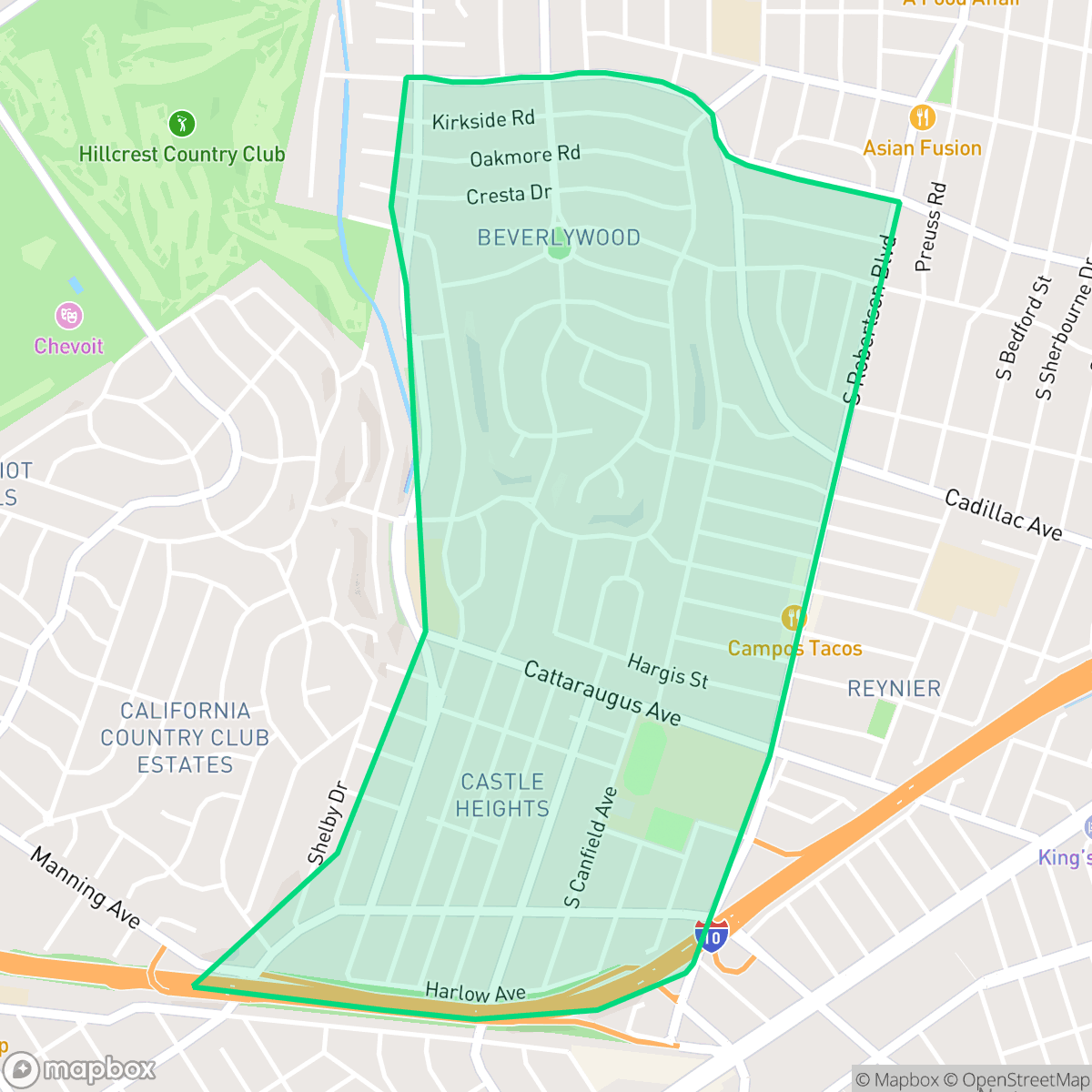
Developed in 1940 by Walter H. Leimert—the prominent developer behind Leimert Park—Beverlywood was designed as a serene, tree-lined residential enclave in West Los Angeles. It was one of the first master-planned communities in Southern California to implement binding Covenants, Conditions, and Restrictions (CC&Rs). Administered by the highly active Beverlywood Homes Association, these strict regulations historically governed home size, architectural style, and landscaping to maintain visual consistency. The neighborhood features a mix of mid-century modern, Spanish, and traditional homes built primarily between the 1920s and 1950s. At its heart lies Circle Park, a central teardrop-shaped green space that remains a focal point for the community. Over the decades, Beverlywood has evolved into a prominent Orthodox Jewish enclave, celebrated for its quiet, family-oriented character.
The area serves as a quiet, family-oriented residential hub characterized by its dense grid and well-maintained single-family homes. With its high walkability and consistent sidewalk network, the neighborhood encourages pedestrian activity despite the presence of major arterial roads. According to iHuus data, the community benefits from strong health insurance coverage and a lack of heavy industrial proximity, contributing to a stable living environment for its residents.
Prospective residents should weigh the neighborhood's aesthetic appeal and strong sense of community against certain livability trade-offs. The area faces challenges with road traffic noise and limited privacy due to the close proximity of houses. While it offers a desirable location with access to high-performing schools like Castle Heights Elementary, the high density and specific flood and fire safety profiles are factors to consider when evaluating long-term housing options.
Neighborhood Scores Across 15 Qualities
Residential spacing provides a moderate level of separation between homes, offering slightly more buffer between neighbors than the Los Angeles average. According to iHuus data, property layouts vary from detached houses with clear yards to more closely spaced multi-unit buildings.
Continuous sidewalk networks and clear pedestrian crossings exist throughout the residential grid, making it slightly more pedestrian friendly than the Los Angeles average. Most residential streets feature dedicated sidewalks on both sides, providing easy movement through the neighborhood despite the presence of the nearby freeway corridor.
Manicured landscapes, large homes, and frequent private swimming pools create a visual environment that is notably more polished than the Los Angeles average. While some areas feature denser housing, much of the neighborhood is characterized by spacious lots and well-maintained properties according to iHuus data.
Walking areas often feature continuous green parkway strips, though the neighborhood lacks large accessible public parks and falls slightly below the city average for dog friendliness. According to iHuus data, most greenery is contained within private yards rather than wide, public verges.
Frequent open spaces and mature tree coverage provide a more semi-rural feel than the typical Los Angeles urban landscape. According to iHuus data, this layout offers a dense suburban environment with plenty of greenery.
Mixes quiet, green residential streets with pockets of active commercial activity and diverse dining options. According to iHuus data, the level of local activity and amenity access is slightly higher than the Los Angeles average.
Frequent noise from nearby freeway corridors and transit paths is a notable characteristic of this area. According to iHuus data, acoustic levels are slightly higher than the typical experience found across Los Angeles.
Air quality remains mostly clean with infrequent periods of elevated readings. This level of air quality is consistent with the average found across Los Angeles.
Industrial activity and warehouses are absent from this area, making it significantly more residential than the Los Angeles average. According to iHuus data, the neighborhood contains no visible heavy industry or hazardous facilities.
Health insurance access is significantly higher than the Los Angeles average, according to iHuus data. Most residents in this area are covered by health insurance plans.
Voting patterns and census indicators show a highly liberal leaning that is only slightly lower than the Los Angeles city average.
A balanced mix of young adults, families, and older residents characterizes the local demographic. This age distribution is consistent with the broader Los Angeles area, according to iHuus data.
Flood risk levels in this area are higher than the city average, though precise assessments are currently unavailable due to incomplete federal studies. According to iHuus data, the lack of a detailed FEMA study means residents should remain cautious regarding potential drainage issues during heavy rain.
Address-Level Insights for Beverlywood


iHuus Neighborhood Intelligence Insights
Get address-level neighborhood insights for Beverlywood
- Street-level scores — see how individual blocks compare, not just neighborhood averages
- Micro-zone boundaries — identify quiet pockets, flood boundaries, and walkable clusters before you visit
- 15 dimensions in full — walkability, noise, air quality, school quality, insurance coverage, population age profile, urban/rural index, and more
- Boundary risk alerts — know if your address sits near a block boundary where scores drop, the kind of detail no listing will ever mention
- School insights — individual school ratings and insights, not just district-level data
- Compare before you commit — side-by-side data across neighborhoods, down to block precision
No credit card required
Compare with Any Neighborhood
| Dimension | Beverlywood | Adams-Normandie |
|---|---|---|
| 🚶 Walkabilityavg 8.9 | ||
| 🔊 Acoustic Comfortavg 2.91 | ||
| 🤫 Privacy Indexavg 4.14 | ||
| 🎨 Visual Appealavg 6.58 | ||
| 🐕 Dog Friendlinessavg 5.04 | ||
| 🗺️ Urban-Rural Indexavg 5.96 | ||
| ✨ Neighborhood Vibeavg 5.07 | ||
| 🏥 Health Insurance Coverageavg 6.2 | ||
| 🌿 Air Qualityavg 8.12 | ||
| 🏭 Industrial Proximityavg 8.46 | ||
| 🌊 Flood Safetyavg 2.66 | ||
| 🗳️ Ideological Leanavg 9.56 | ||
| 👥 Population Age Profileavg 4.85 | ||
| 🔥 Fire Safetyavg 0.18 | ||
| 🏫 School Quality |
Beverlywood Rankings
School Districts Serving Beverlywood
School Insights for Beverlywood
Below average outcomes; significant attendance and academic challenges.
School Insights
See what's really behind every school rating near Beverlywood
- Individual school ratings — each school's own score with outcome context, not just a district average
- Enrollment & class size data — student-to-teacher ratio and how it compares to the state average
- Full demographics breakdown — ethnicity and gender composition for every school in the enrollment zone
- Every school in the district — all schools within the enrollment boundary ranked by rating, not just the closest one
- Grade levels & benchmarks — elementary through high school, with below/above state-average flags
No credit card required