Arlington Heights, Los Angeles
Updated · 10,318 residents
Arlington Heights is a dense, highly walkable residential community characterized by its historic architectural charm and grid-based street layout. While the area offers excellent access to diverse local dining, residents should expect a high-density environment with limited private green space and noticeable road traffic noise.
Key Highlights
About Arlington Heights
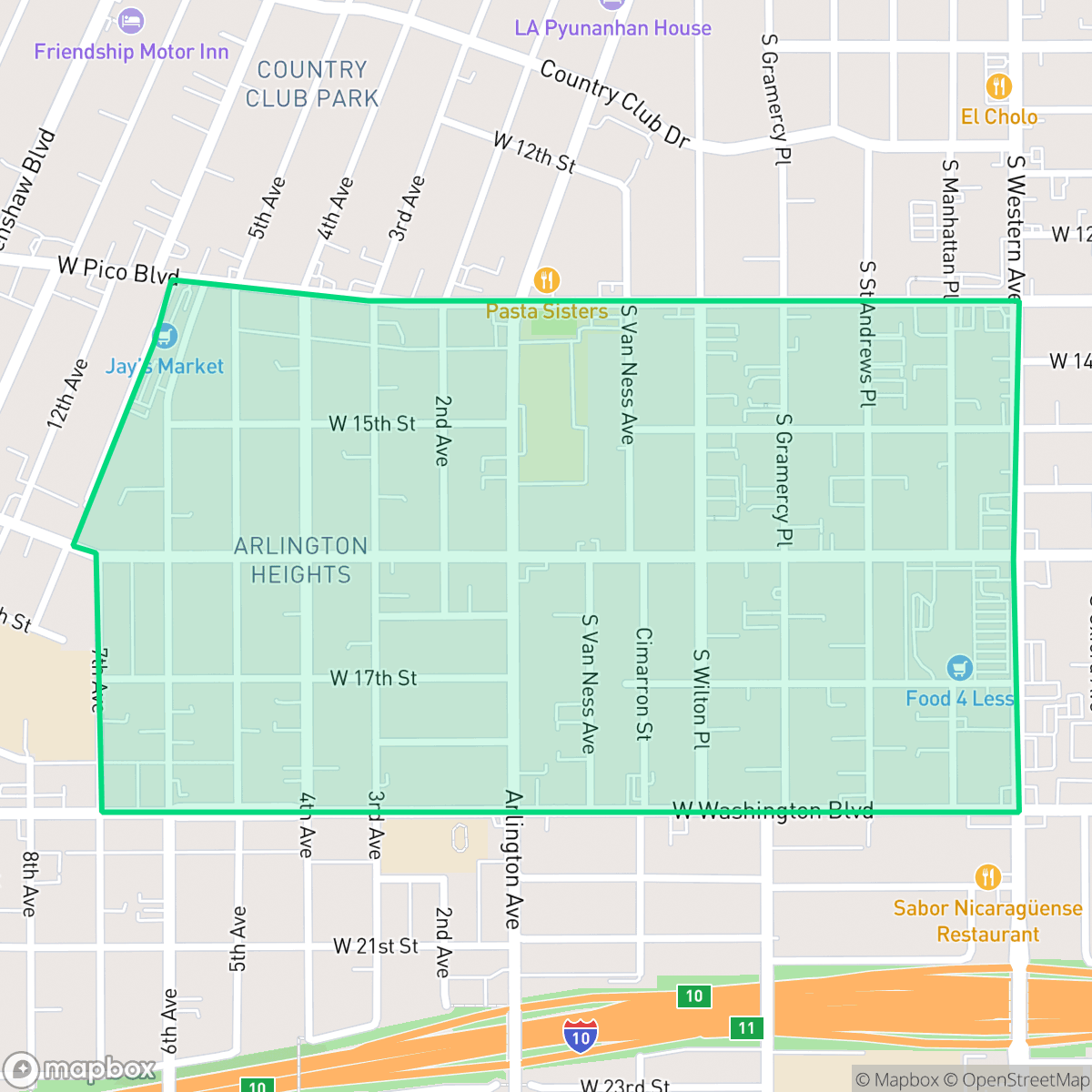
Initially marketed in the late 1800s as "Right in the Way of Los Angeles City's Magnificent March to the Sea," Arlington Heights was successfully subdivided as a "streetcar suburb" in 1904. Perched on a level mesa, the neighborhood developed rapidly along Washington Boulevard—originally designed as L.A.’s first 100-foot-wide "Grand Avenue to the Sea" to accommodate trolleys and carriages. Today, Arlington Heights is celebrated for its highly intact historic housing stock, featuring an impressive concentration of American Foursquare, Craftsman, and Spanish Colonial Revival homes. Notable local landmarks include the Central Arlington Heights Historic District, the 1926 Spanish-style Washington Irving branch library (Los Angeles Historic-Cultural Monument 307), and the Tate-McCoy Homestead.
The neighborhood serves as a dense, low-rise urban environment that prioritizes a traditional grid layout, making it one of the most accessible areas for pedestrians in Los Angeles. According to iHuus data, the area maintains a high walkability score, allowing residents to easily navigate the streets despite the lack of extensive public green spaces. The local atmosphere is defined by its mix of long-standing residential blocks and pockets of light commercial activity, which provide access to a variety of diverse dining options along major thoroughfares.
Living here requires balancing the benefits of a central, walkable location with the realities of high-density urban life. The housing stock is tightly packed, which often results in reduced privacy and limited yard space for residents. Additionally, the area experiences moderate noise levels due to road traffic, and prospective residents should be aware of the environmental risks, including higher flood and fire vulnerability compared to the city average. It is best suited for individuals who prioritize proximity to urban amenities and historic character over expansive private outdoor space or quiet, secluded living.
Neighborhood Scores Across 15 Qualities
Close proximity between buildings and minimal property buffering result in less residential privacy than the Los Angeles average. According to iHuus data, many structures are spaced closely together with shared side yards or very narrow separations.
Continuous sidewalks and clearly marked crosswalks exist throughout the grid, making the area more pedestrian friendly than much of Los Angeles. Most local trips can be completed on foot thanks to the dense street layout and well-maintained crossings.
Tract housing and multi-unit complexes feature modest yards and functional architecture. This visual landscape is slightly less varied than the broader Los Angeles average, according to iHuus data.
Minimal public green space and narrow sidewalk verges make much of the neighborhood unsuitable for outdoor exercise. According to iHuus data, most greenery is confined to private, fenced backyards, leaving the area below the city average for dog friendliness.
Residential blocks feature a mix of single-family homes and low-rise multi-unit complexes. This balance of street density and green space is nearly identical to the city average, according to iHuus data.
Varied pockets of activity ranging from quiet suburban streets to lively dining blocks create a social atmosphere slightly more active than the Los Angeles average. Residents can access a diverse selection of international restaurants and parks, though many amenities require a short drive rather than being accessible on foot.
Frequent noise from nearby freeways and transit corridors makes this area louder than most of Los Angeles. According to iHuus data, residents should expect significant acoustic disturbances from heavy vehicle traffic and proximity to major transit routes.
Air quality in this area remains consistently good with rare instances of elevated readings. This level of air purity is roughly in line with the average seen across Los Angeles.
The area is almost entirely residential and light commercial, with no detectable warehouses or heavy industrial hazards. This lack of industrial activity is more pronounced here than in most other parts of Los Angeles, according to iHuus data.
Health insurance access is significantly lower than the Los Angeles average. According to iHuus data, a small minority of local residents possess health coverage.
Voting patterns and census indicators show a predominantly liberal political leaning that is even more pronounced than the Los Angeles average, according to iHuus data.
Residents live alongside a balanced mix of young professionals, families, and older adults. This demographic distribution is roughly in line with the broader Los Angeles area, according to iHuus data.
Address-Level Insights for Arlington Heights


iHuus Neighborhood Intelligence Insights
Get address-level neighborhood insights for Arlington Heights
- Street-level scores — see how individual blocks compare, not just neighborhood averages
- Micro-zone boundaries — identify quiet pockets, flood boundaries, and walkable clusters before you visit
- 15 dimensions in full — walkability, noise, air quality, school quality, insurance coverage, population age profile, urban/rural index, and more
- Boundary risk alerts — know if your address sits near a block boundary where scores drop, the kind of detail no listing will ever mention
- School insights — individual school ratings and insights, not just district-level data
- Compare before you commit — side-by-side data across neighborhoods, down to block precision
No credit card required
Compare with Any Neighborhood
| Dimension | Arlington Heights | Adams-Normandie |
|---|---|---|
| 🚶 Walkabilityavg 8.9 | ||
| 🔊 Acoustic Comfortavg 2.91 | ||
| 🤫 Privacy Indexavg 4.14 | ||
| 🎨 Visual Appealavg 6.58 | ||
| 🐕 Dog Friendlinessavg 5.04 | ||
| 🗺️ Urban-Rural Indexavg 5.96 | ||
| ✨ Neighborhood Vibeavg 5.07 | ||
| 🏥 Health Insurance Coverageavg 6.2 | ||
| 🌿 Air Qualityavg 8.12 | ||
| 🏭 Industrial Proximityavg 8.46 | ||
| 🌊 Flood Safetyavg 2.66 | ||
| 🗳️ Ideological Leanavg 9.56 | ||
| 👥 Population Age Profileavg 4.85 | ||
| 🔥 Fire Safetyavg 0.18 | ||
| 🏫 School Quality |
Arlington Heights Rankings
School Districts Serving Arlington Heights
School Insights for Arlington Heights
Below average outcomes; significant attendance and academic challenges.
School Insights
See what's really behind every school rating near Arlington Heights
- Individual school ratings — each school's own score with outcome context, not just a district average
- Enrollment & class size data — student-to-teacher ratio and how it compares to the state average
- Full demographics breakdown — ethnicity and gender composition for every school in the enrollment zone
- Every school in the district — all schools within the enrollment boundary ranked by rating, not just the closest one
- Grade levels & benchmarks — elementary through high school, with below/above state-average flags
No credit card required