Arleta, Los Angeles
Updated · 38,396 residents
Arleta is a dense, suburban neighborhood in the San Fernando Valley characterized by its mid-century housing and high walkability. Residents benefit from a consistent grid-based street layout with sidewalks on both sides, though the area experiences notable noise from nearby freeway traffic.
Key Highlights
About Arleta
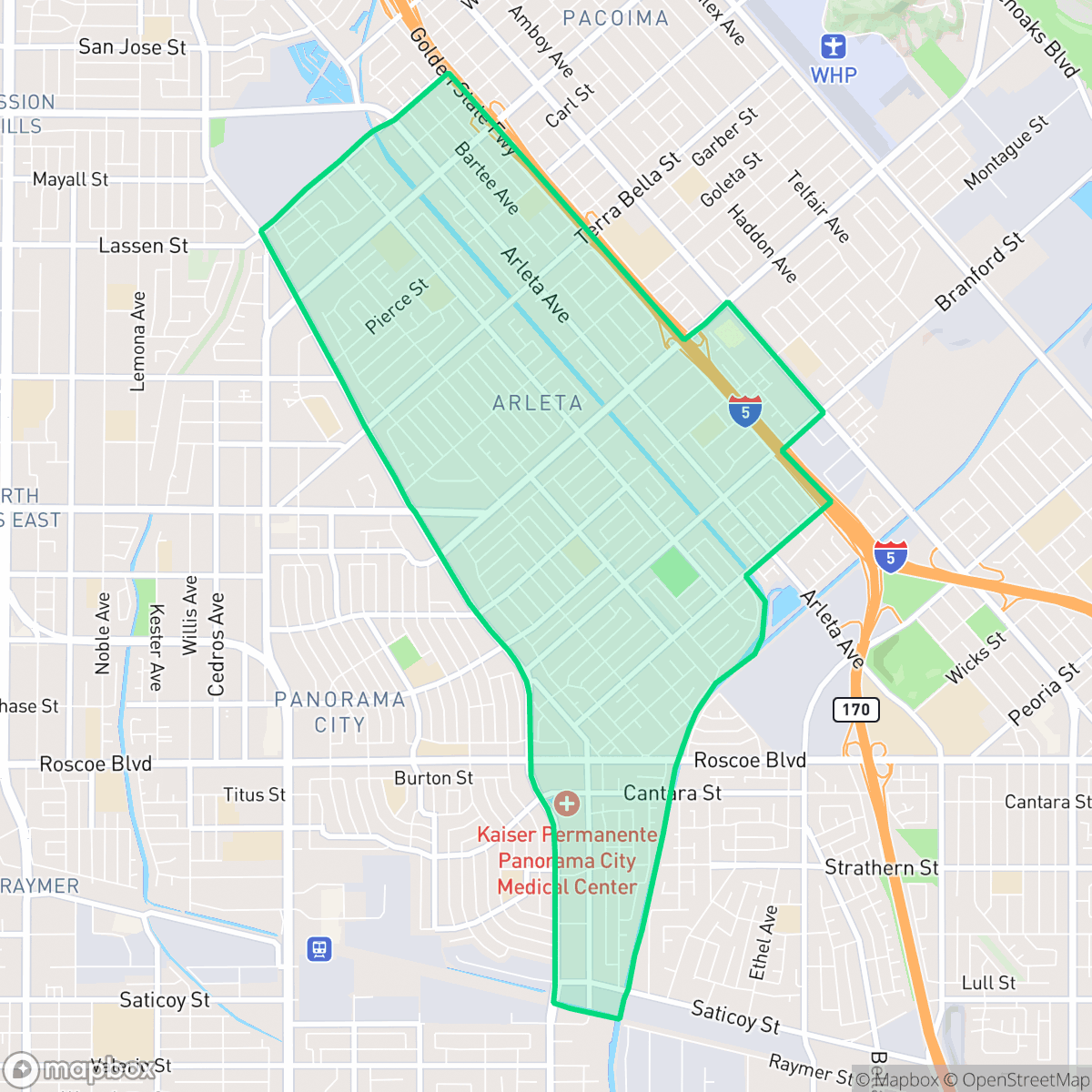
Located in the San Fernando Valley, Arleta was originally a semirural, agricultural portion of Pacoima, carpeted with citrus groves and poultry farms following the 1913 opening of the Los Angeles Aqueduct. During and after World War II, developers built modest mid-century ranch homes to house assembly-line workers from nearby aerospace plants. The construction of the Interstate 5 Freeway in the early 1960s physically divided Pacoima. Seeking separation, western residents successfully petitioned to form their own community, and Arleta was officially recognized in 1968. A notable local landmark is Branford Park, which was created from a portion of western film star Tom Mix’s retired 17-acre ranch. Today, the neighborhood has evolved from its mid-century suburban roots into a vibrant, predominantly Latino community.
The neighborhood functions as a quiet residential enclave defined by its grid-based street layout and reliable pedestrian infrastructure. Many properties feature private backyard swimming pools and well-maintained driveways, contributing to a suburban aesthetic that balances residential density with light commercial activity. While the area lacks extensive public green spaces, the presence of Branford Park provides a central hub for community recreation and outdoor activity. The local environment is largely residential, with minimal heavy industrial presence, creating a stable atmosphere for families and long-term residents. Prospective residents should note that the area experiences significant road traffic noise due to its proximity to major freeway corridors. While the neighborhood offers high walkability and access to schools such as Vena Avenue Elementary, it is best suited for those who prioritize an established suburban environment over high-energy nightlife or extensive public park access. The community remains a practical choice for those seeking a balance of accessibility and residential privacy in the San Fernando Valley.
Neighborhood Scores Across 15 Qualities
Housing layouts feature a mix of closely spaced detached homes and multi-family units with shared walls. This level of density provides more separation between neighbors than the typical Los Angeles average.
Continuous sidewalks on both sides of residential streets and clearly marked crosswalks at major intersections ensure safe pedestrian access. This neighborhood offers superior connectivity for walkers compared to the city average.
Private backyard pools and well-maintained properties are frequently observed throughout certain residential pockets. According to iHuus data, the visual landscape of Arleta is slightly more upscale than the Los Angeles average.
Walking routes for pets are primarily limited to private yards and narrow sidewalk verges, as public park access is sparse. This level of dog friendliness is slightly below the city average.
Residential streets and green spaces exist in roughly equal measure, offering a suburban feel that is slightly more developed than the Los Angeles average. According to iHuus data, the area features a mix of single-family homes, apartment complexes, and localized commercial clusters.
Suburban streets and green spaces provide a steady rhythm of residential life, occasionally meeting more lively pockets of diverse dining and local amenities. This balance of quiet residential blocks and scattered social hubs reflects a neighborhood energy that is consistent with the city average.
Frequent sounds from nearby freeways and rail lines characterize the area. According to iHuus data, acoustic levels are slightly higher than the Los Angeles average.
Air quality remains consistently good with infrequent periods of elevated readings. According to iHuus data, the air quality in Arleta is slightly below the Los Angeles city average.
Residential and light commercial uses dominate the landscape, though some areas near the southern edge and highway corridors contain large warehouses and rail infrastructure. While the area is slightly more industrial than the Los Angeles average, it lacks significant heavy industrial hazards or large-scale manufacturing sites.
Health insurance access for residents is slightly above the Los Angeles average, according to iHuus data. Most members of the community have access to medical coverage through employer or private plans.
Voting patterns and census indicators show a highly liberal political leaning, matching the average found across Los Angeles.
Residents live among a balanced distribution of young adults, families, and seniors. This demographic spread is largely consistent with the broader Los Angeles area according to iHuus data.
Flood risk in this area is significantly higher than the Los Angeles average, which may lead to elevated or prohibitive insurance costs for residents. According to iHuus data, the area is subject to much greater vulnerability to water-related hazards than most parts of the city.
Address-Level Insights for Arleta


iHuus Neighborhood Intelligence Insights
Get address-level neighborhood insights for Arleta
- Street-level scores — see how individual blocks compare, not just neighborhood averages
- Micro-zone boundaries — identify quiet pockets, flood boundaries, and walkable clusters before you visit
- 15 dimensions in full — walkability, noise, air quality, school quality, insurance coverage, population age profile, urban/rural index, and more
- Boundary risk alerts — know if your address sits near a block boundary where scores drop, the kind of detail no listing will ever mention
- School insights — individual school ratings and insights, not just district-level data
- Compare before you commit — side-by-side data across neighborhoods, down to block precision
No credit card required
Compare with Any Neighborhood
| Dimension | Arleta | Adams-Normandie |
|---|---|---|
| 🚶 Walkabilityavg 8.9 | ||
| 🔊 Acoustic Comfortavg 2.91 | ||
| 🤫 Privacy Indexavg 4.14 | ||
| 🎨 Visual Appealavg 6.58 | ||
| 🐕 Dog Friendlinessavg 5.04 | ||
| 🗺️ Urban-Rural Indexavg 5.96 | ||
| ✨ Neighborhood Vibeavg 5.07 | ||
| 🏥 Health Insurance Coverageavg 6.2 | ||
| 🌿 Air Qualityavg 8.12 | ||
| 🏭 Industrial Proximityavg 8.46 | ||
| 🌊 Flood Safetyavg 2.66 | ||
| 🗳️ Ideological Leanavg 9.56 | ||
| 👥 Population Age Profileavg 4.85 | ||
| 🔥 Fire Safetyavg 0.18 | ||
| 🏫 School Quality |
Arleta Rankings
School Districts Serving Arleta
School Insights for Arleta
Below average outcomes; significant attendance and academic challenges.
School Insights
See what's really behind every school rating near Arleta
- Individual school ratings — each school's own score with outcome context, not just a district average
- Enrollment & class size data — student-to-teacher ratio and how it compares to the state average
- Full demographics breakdown — ethnicity and gender composition for every school in the enrollment zone
- Every school in the district — all schools within the enrollment boundary ranked by rating, not just the closest one
- Grade levels & benchmarks — elementary through high school, with below/above state-average flags
No credit card required