Alvarado Terrace Historic District, Los Angeles
Updated · 386 residents
Alvarado Terrace Historic District is a dense, highly walkable urban enclave in Los Angeles known for its diverse architectural heritage and central location. While the area offers excellent access to local dining and pedestrian infrastructure, residents experience limited privacy due to the close proximity of neighboring homes and moderate street noise.
Key Highlights
About Alvarado Terrace Historic District
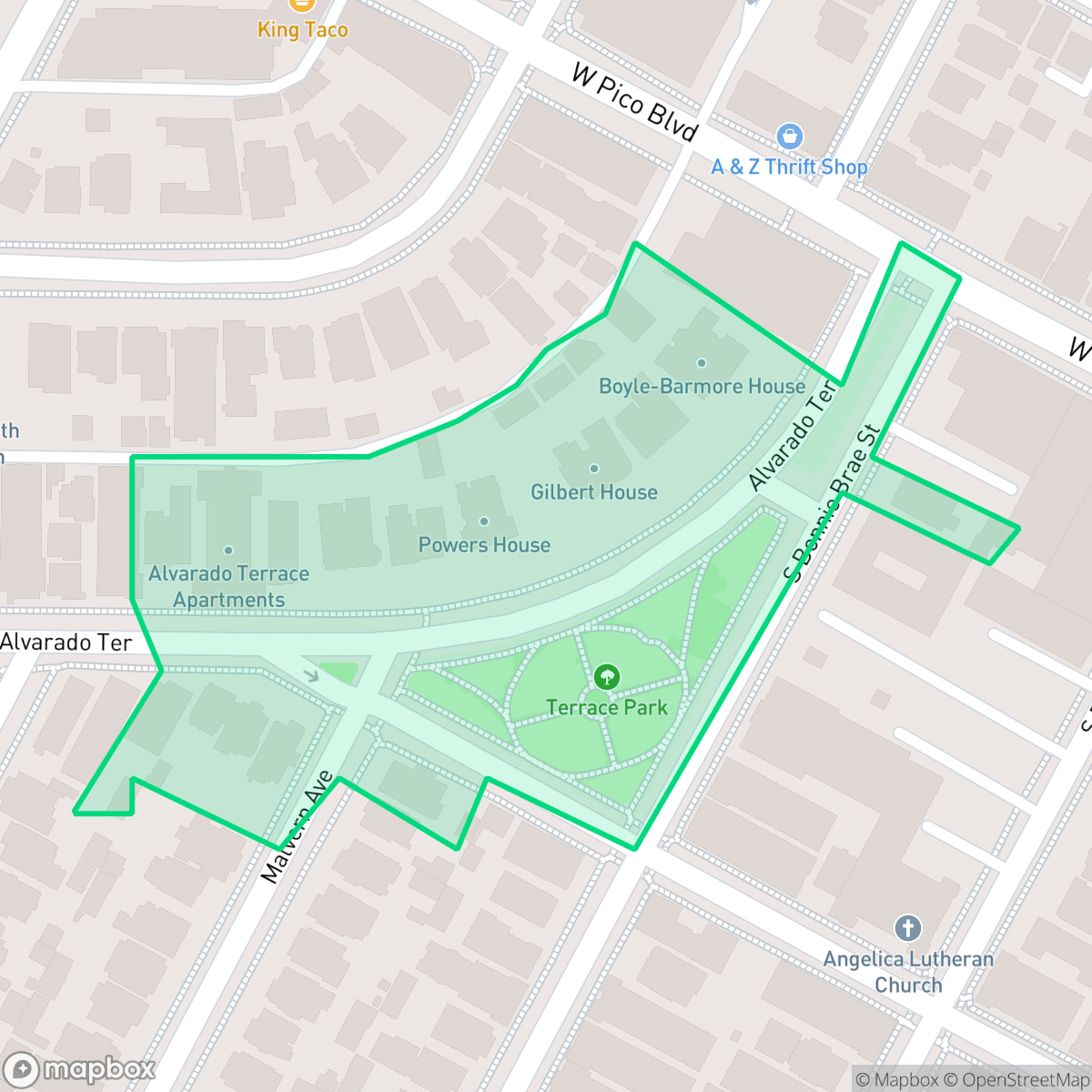
Bounded by Pico Boulevard and Alvarado Street, the Alvarado Terrace Historic District was originally part of the 1781 Pueblo of Los Angeles. In the late 19th century, the land hosted the Los Angeles Golf Club's "Windmill Links" before landowner Doria Deighton Jones subdivided it in 1902. To foster an exclusive enclave, Jones sold lots for $10 on the condition that buyers build homes costing at least $4,000. The resulting neighborhood features an eclectic mix of Craftsman, Victorian, Mission Revival, Tudor, and Shingle style architecture. Six grand residences on a single block, along with Elmer Grey's 1912 Romanesque-style First Church of Christ, Scientist, are designated Los Angeles Historic-Cultural Monuments. The district also features Terrace Park and the 36-foot-long brick-paved Powers Place, recognized as the shortest street in Los Angeles.
The neighborhood functions as a dense, transit-oriented community that prioritizes pedestrian mobility. Its grid-based layout supports a high level of walkability, allowing residents to easily access local eateries like Happy Taco and Nieves Xochi Oax. The atmosphere is distinctly urban, characterized by a mix of multi-story apartments and tightly packed single-family residences that create a vibrant, active streetscape.
Living here requires balancing the benefits of a central location with the realities of high-density urban life. According to iHuus data, the area faces challenges regarding limited private green space and reduced acoustic comfort from road traffic. It is best suited for individuals who prioritize walkability and proximity to city life over suburban seclusion, though prospective residents should note the area's vulnerability to environmental risks like fire and flooding.
Neighborhood Scores Across 15 Qualities
Structures in this district are positioned in close proximity with many buildings sharing property lines. This level of density is significantly higher than the Los Angeles average, according to iHuus data.
Pedestrian infrastructure is exceptional throughout the district, featuring a consistent grid of wide sidewalks and frequent crosswalks. This level of connectivity for walkers is notably higher than the average for Los Angeles.
Modest yards and uniform rooflines characterize this area, which offers slightly less visual variety than the broader Los Angeles average. According to iHuus data, the landscape consists primarily of tidy, middle-class urban housing with minimal private greenery or pools.
Narrow sidewalks and a lack of accessible public parks make outdoor exercise more difficult here than in many other parts of Los Angeles. According to iHuus data, most available greenery is confined to private, fenced backyards.
Street layouts and green spaces offer a suburban balance of density and open area, making the landscape less urbanized than much of the city. According to iHuus data, the district features a mix of multi-story apartments and tightly packed single-family homes.
Active street life and diverse dining options provide a level of engagement that is higher than the Los Angeles average. While certain blocks offer lively urban experiences with notable restaurants, some areas maintain a more quiet, suburban character.
Steady noise from nearby busy streets is present, though it remains notably quieter than the average for Los Angeles. According to iHuus data, the area experiences a consistent level of ambient sound from local traffic.
Air quality in this district is consistently excellent and notably cleaner than the average found throughout Los Angeles. Residents can expect minimal exposure to pollutants according to iHuus data.
Largely residential in character, this area lacks heavy industrial hazards and maintains a composition very similar to the broader Los Angeles average. While some larger warehouses are present, they do not constitute a significant industrial presence according to iHuus data.
Health insurance access is significantly lower than the Los Angeles average, according to iHuus data. Most residents in this area lack medical coverage.
Voting patterns and census indicators reflect a very liberal political leaning, which is slightly more pronounced than the Los Angeles average.
Residents live alongside a balanced mix of young adults, families, and older individuals. This demographic distribution is very similar to the broader Los Angeles area, according to iHuus data.
Address-Level Insights for Alvarado Terrace Historic District


iHuus Neighborhood Intelligence Insights
Get address-level neighborhood insights for Alvarado Terrace Historic District
- Street-level scores — see how individual blocks compare, not just neighborhood averages
- Micro-zone boundaries — identify quiet pockets, flood boundaries, and walkable clusters before you visit
- 15 dimensions in full — walkability, noise, air quality, school quality, insurance coverage, population age profile, urban/rural index, and more
- Boundary risk alerts — know if your address sits near a block boundary where scores drop, the kind of detail no listing will ever mention
- School insights — individual school ratings and insights, not just district-level data
- Compare before you commit — side-by-side data across neighborhoods, down to block precision
No credit card required
Compare with Any Neighborhood
| Dimension | Alvarado Terrace Historic District | Adams-Normandie |
|---|---|---|
| 🚶 Walkabilityavg 8.9 | ||
| 🔊 Acoustic Comfortavg 2.91 | ||
| 🤫 Privacy Indexavg 4.14 | ||
| 🎨 Visual Appealavg 6.58 | ||
| 🐕 Dog Friendlinessavg 5.04 | ||
| 🗺️ Urban-Rural Indexavg 5.96 | ||
| ✨ Neighborhood Vibeavg 5.07 | ||
| 🏥 Health Insurance Coverageavg 6.2 | ||
| 🌿 Air Qualityavg 8.12 | ||
| 🏭 Industrial Proximityavg 8.46 | ||
| 🌊 Flood Safetyavg 2.66 | ||
| 🗳️ Ideological Leanavg 9.56 | ||
| 👥 Population Age Profileavg 4.85 | ||
| 🔥 Fire Safetyavg 0.18 | ||
| 🏫 School Quality |
Alvarado Terrace Historic District Rankings
School Districts Serving Alvarado Terrace Historic District
School Insights for Alvarado Terrace Historic District
Below average outcomes; significant attendance and academic challenges.
School Insights
See what's really behind every school rating near Alvarado Terrace Historic District
- Individual school ratings — each school's own score with outcome context, not just a district average
- Enrollment & class size data — student-to-teacher ratio and how it compares to the state average
- Full demographics breakdown — ethnicity and gender composition for every school in the enrollment zone
- Every school in the district — all schools within the enrollment boundary ranked by rating, not just the closest one
- Grade levels & benchmarks — elementary through high school, with below/above state-average flags
No credit card required