Zaferia, Long Beach
Updated · 12,740 residents
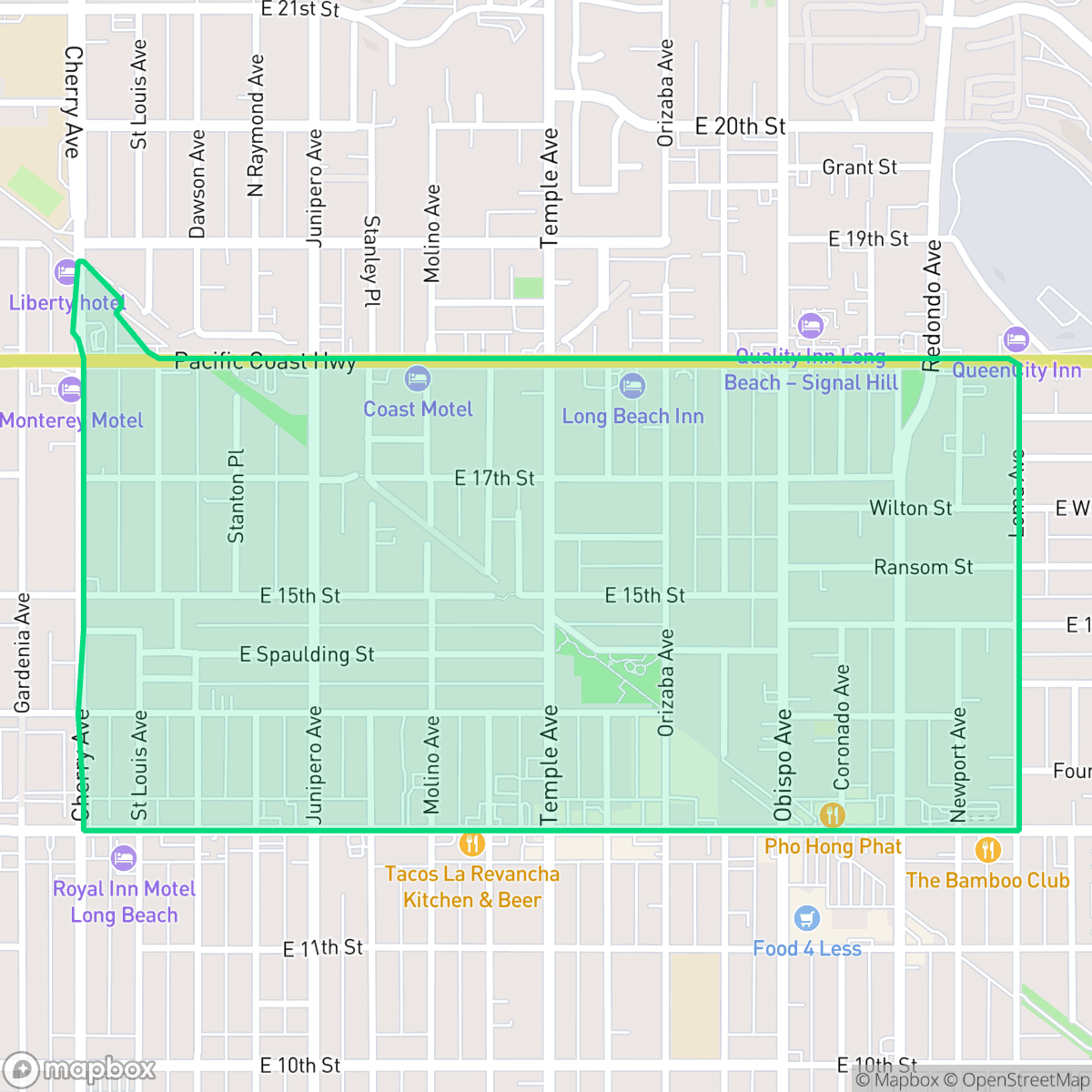
Zaferia is a dense, highly walkable urban enclave in Long Beach known for its creative design sector and diverse culinary landscape. While residents enjoy excellent air quality and convenient access to local dining, the area is characterized by tightly packed housing and significant road traffic noise.
Key Highlights
About Zaferia
Zaferia originated in the late 19th century as a rural village of Mexican farmhands working the mustard and sugar beet fields of Rancho Los Alamitos. Its growth accelerated in 1904 when Henry Huntington’s Pacific Electric Railway established "Zaferia Station" near Anaheim Road and Redondo Avenue. Because Long Beach was a "dry" city, Zaferia thrived as a "wet" enclave, drawing visitors to its local bars and pool halls. Officially annexed into Long Beach on Labor Day in 1920, the neighborhood was renamed East Long Beach, though its original identity endured. In the late 20th century, the East Anaheim Street corridor welcomed a significant influx of Cambodian refugees, transforming the area's cultural and culinary landscape. Today, Zaferia is celebrated for its historic bungalows, the Wilton Historic District, and a thriving creative design sector.
The neighborhood functions as a vibrant, high-density district that blends residential living with active commercial corridors. The East Anaheim Street area serves as a primary social hub, featuring a variety of local dining options that reflect the area's cultural diversity. With a consistent grid layout and well-maintained sidewalks, the district is highly accessible for pedestrians, allowing residents to navigate the local amenities with ease.
Living in the area involves balancing urban convenience with certain environmental trade-offs. The high density of housing means that properties are closely spaced with minimal private green space, which may impact privacy. Additionally, road traffic contributes to elevated noise levels, making it a better fit for those who prioritize proximity to city life and dining over quiet, secluded environments. The neighborhood remains an attractive option for individuals seeking a central, walkable location within the Long Beach urban fabric.
Neighborhood Scores Across 15 Qualities
Residential structures are tightly packed with minimal separation between buildings, resulting in less privacy than the Long Beach average. Most homes and apartment blocks share property lines or are situated very close to one another according to iHuus data.
Extremely accessible sidewalks and a dense grid of marked crosswalks make navigating the area on foot easy. This level of connectivity is slightly above the Long Beach average, providing seamless access between residential zones, parks, and schools.
Standard tract housing and multi-unit apartments define the landscape, offering a modest level of visual variety that sits below the Long Beach average. Most properties feature uniform rooflines and small yards with very few private luxury amenities, according to iHuus data.
Limited public green space and narrow sidewalks make outdoor exercise difficult for pets. According to iHuus data, the neighborhood offers fewer walking options for dogs than the Long Beach average.
Residential streets and green spaces exist in roughly equal measure, creating a landscape similar to the Long Beach average. The area features a dense mix of low-rise housing and commercial corridors with limited permeable surface.
Frequent dining options and local social spots create a more active atmosphere than the Long Beach average. According to iHuus data, the area features a noticeable concentration of diverse eateries and community spaces interspersed with industrial and suburban blocks.
Local traffic from nearby thoroughfares creates a consistent level of ambient noise, though this remains quieter than the average for Long Beach according to iHuus data.
Air quality in Zaferia is exceptionally high, representing a notable improvement over the Long Beach average. Residents can expect minimal pollution and very few air-related health concerns according to iHuus data.
Residential blocks are interspersed with light commercial facilities and some warehouse structures, though heavy industrial presence is absent. While this mix is slightly higher in industrial activity than the Long Beach average, there are no visible heavy industrial hazards or large-scale manufacturing sites in the area.
Health insurance accessibility is lower in this area compared to the Long Beach average, according to iHuus data.
Voting patterns and census indicators show a distinctly liberal leaning that is even more pronounced than the Long Beach average, according to iHuus data.
Residents live alongside a diverse range of age groups, from young professionals to older adults. This demographic spread is slightly lower than the Long Beach average, according to iHuus data.
Frequent flood risk exists due to the area being located within a designated floodplain. According to iHuus data, this risk level is notably higher than the Long Beach average and may necessitate flood insurance.
Address-Level Insights for Zaferia


iHuus Neighborhood Intelligence Insights
Get address-level neighborhood insights for Zaferia
- Street-level scores — see how individual blocks compare, not just neighborhood averages
- Micro-zone boundaries — identify quiet pockets, flood boundaries, and walkable clusters before you visit
- 15 dimensions in full — walkability, noise, air quality, school quality, insurance coverage, population age profile, urban/rural index, and more
- Boundary risk alerts — know if your address sits near a block boundary where scores drop, the kind of detail no listing will ever mention
- School insights — individual school ratings and insights, not just district-level data
- Compare before you commit — side-by-side data across neighborhoods, down to block precision
No credit card required
Compare with Any Neighborhood
| Dimension | Zaferia | Airport Area |
|---|---|---|
| 🚶 Walkabilityavg 9.37 | ||
| 🔊 Acoustic Comfortavg 3.04 | ||
| 🤫 Privacy Indexavg 3.63 | ||
| 🎨 Visual Appealavg 6.3 | ||
| 🐕 Dog Friendlinessavg 5.35 | ||
| 🗺️ Urban-Rural Indexavg 6 | ||
| ✨ Neighborhood Vibeavg 5.01 | ||
| 🏥 Health Insurance Coverageavg 6.4 | ||
| 🌿 Air Qualityavg 8.69 | ||
| 🏭 Industrial Proximityavg 8.14 | ||
| 🌊 Flood Safetyavg 3.75 | ||
| 🗳️ Ideological Leanavg 9.2 | ||
| 👥 Population Age Profileavg 4.81 | ||
| 🔥 Fire Safety | ||
| 🏫 School Quality |
Zaferia Rankings
School Districts Serving Zaferia
School Insights for Zaferia
Below average outcomes; significant attendance and academic challenges.
School Insights
See what's really behind every school rating near Zaferia
- Individual school ratings — each school's own score with outcome context, not just a district average
- Enrollment & class size data — student-to-teacher ratio and how it compares to the state average
- Full demographics breakdown — ethnicity and gender composition for every school in the enrollment zone
- Every school in the district — all schools within the enrollment boundary ranked by rating, not just the closest one
- Grade levels & benchmarks — elementary through high school, with below/above state-average flags
No credit card required