Willmore City, Long Beach
Updated · 10,769 residents
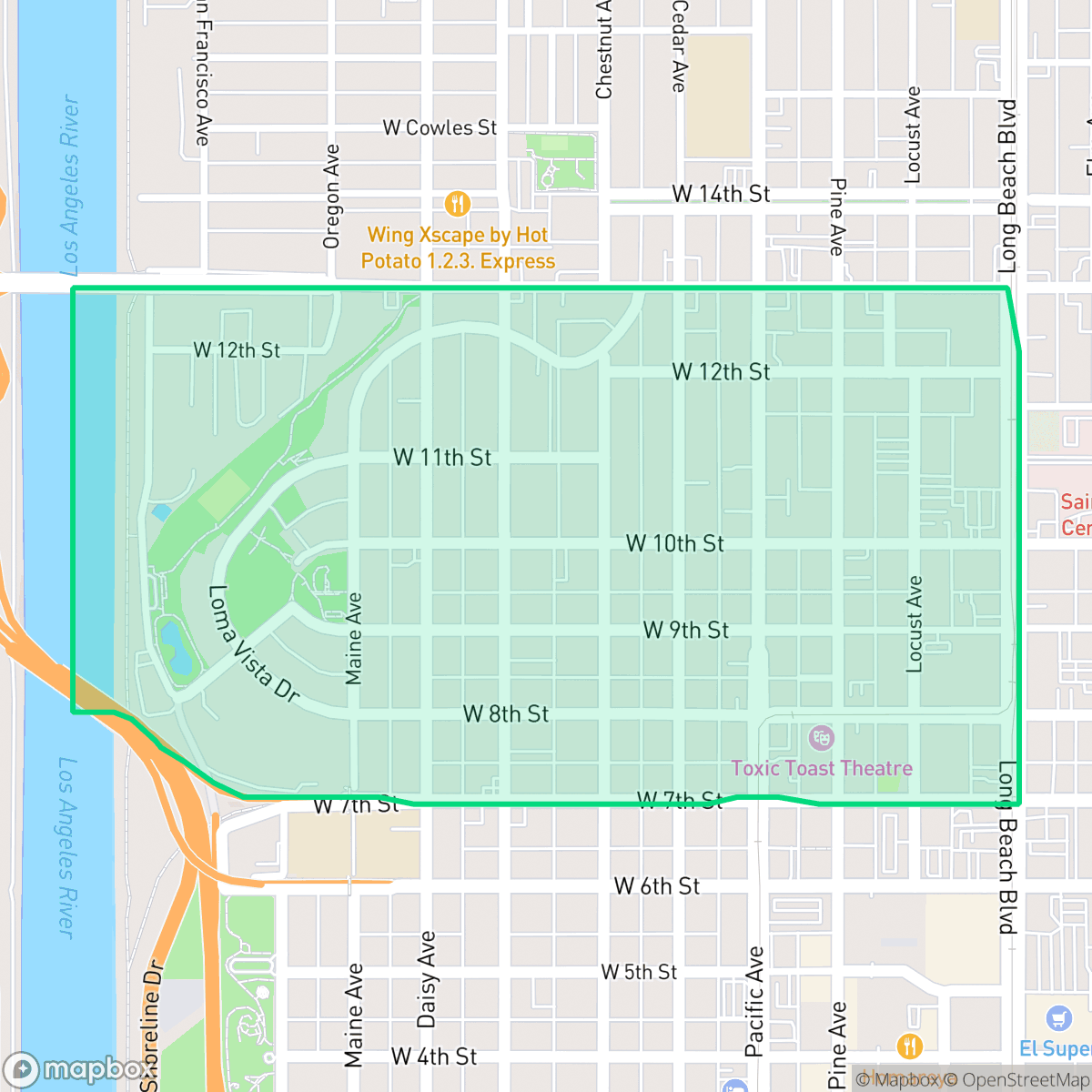
Willmore City is a dense, historic urban neighborhood in Long Beach known for its well-preserved Victorian and Craftsman architecture. While the area offers a walkable grid and high air quality, residents experience limited privacy due to high-density housing and noticeable road noise from nearby transit routes.
Key Highlights
About Willmore City
Established in 1881 by developer William E. Willmore as the "American Colony," Willmore City is the historic birthplace of Long Beach. Originally a 350-acre township built on leased Rancho Los Cerritos land, the development defaulted in 1884 and was subsequently renamed Long Beach. Today, the Drake Park/Willmore City Historic District stands as the city's first designated historic district. It preserves the city's highest concentration of late 19th- and early 20th-century residential architecture, showcasing Victorian, Craftsman, Mission, and Spanish Colonial Revival homes. Key neighborhood landmarks include Drake Park—donated in 1904 by amusement pioneer Colonel Charles Rivers Drake—the historic Bembridge House, and the Windham House, home of early mayor Charles H. Windham.
The neighborhood functions as a dense, low-rise urban environment that blends residential life with light industrial and commercial activity. The area maintains a consistent street grid that supports moderate walkability, though the proximity to major transport routes contributes to a steady ambient noise level. Local social hubs, including neighborhood bakeries and diverse dining establishments, provide points of connection for the community, which is characterized by a strong ideological lean. Residents benefit from high air quality compared to the city average, though the landscape is dominated by building coverage rather than large-scale green space.
Prospective residents should note the high-density nature of the housing, which results in minimal private outdoor space and limited privacy between properties. According to iHuus data, the area faces significant challenges regarding flood and fire safety, and the local school district is currently navigating a period of fiscal transition. This neighborhood is best suited for individuals who prioritize historic character and urban accessibility over expansive private amenities or quiet suburban seclusion.
Neighborhood Scores Across 15 Qualities
Structures throughout the area are positioned very close together with minimal separation between buildings. According to iHuus data, this high-density urban layout offers significantly less privacy than the Long Beach average.
Pedestrian navigation is easy due to a complete grid of sidewalks on both sides of the streets and clearly marked crosswalks. This level of walkability is slightly below the Long Beach average.
Standard tract housing and multi-unit buildings define the landscape, offering a functional but modest visual environment. This area sits slightly below the Long Beach average for visual variety due to the prevalence of compact footprints and minimal private greenery.
Large public parks with extensive walking paths provide excellent opportunities for exercise, though other parts of the neighborhood feature high concrete density and limited green verges. According to iHuus data, overall accessibility to open space is roughly comparable to the Long Beach average.
High building coverage and heavy transport infrastructure create a dense urban feel that is more developed than the Long Beach average. According to iHuus data, the area features significant industrial and residential density with limited large-scale green space.
Diverse dining options and active social hubs create a lively atmosphere that is significantly more energetic than the Long Beach average. According to iHuus data, the area features a mix of dense urban pockets and active suburban streets with steady access to local services.
Steady traffic sounds from nearby busy streets are present, though levels are generally quieter than the Long Beach average according to iHuus data.
Air quality remains consistently high with minimal health concerns for residents. According to iHuus data, the air in this area is cleaner than the Long Beach average.
Residential and light commercial structures dominate the landscape, making the area notably clearer of heavy industry than the Long Beach average. While a small cluster of warehouses is present on the western edge, most of the neighborhood lacks large-scale industrial plants or heavy manufacturing.
Health insurance coverage among residents is moderate and falls below the Long Beach city average, according to iHuus data.
Voting patterns and census indicators show a predominantly liberal political landscape that is even more pronounced than the Long Beach average, according to iHuus data.
Residents experience a balanced demographic spread consisting of young adults, families, and older individuals. This age distribution is consistent with the broader Long Beach area, according to iHuus data.
Significant flood vulnerability exists in this area, representing a much higher risk level than the Long Beach average. Residents should prepare for potential drainage issues during heavy rain events, according to iHuus data.
Address-Level Insights for Willmore City


iHuus Neighborhood Intelligence Insights
Get address-level neighborhood insights for Willmore City
- Street-level scores — see how individual blocks compare, not just neighborhood averages
- Micro-zone boundaries — identify quiet pockets, flood boundaries, and walkable clusters before you visit
- 15 dimensions in full — walkability, noise, air quality, school quality, insurance coverage, population age profile, urban/rural index, and more
- Boundary risk alerts — know if your address sits near a block boundary where scores drop, the kind of detail no listing will ever mention
- School insights — individual school ratings and insights, not just district-level data
- Compare before you commit — side-by-side data across neighborhoods, down to block precision
No credit card required
Compare with Any Neighborhood
| Dimension | Willmore City | Airport Area |
|---|---|---|
| 🚶 Walkabilityavg 9.37 | ||
| 🔊 Acoustic Comfortavg 3.04 | ||
| 🤫 Privacy Indexavg 3.63 | ||
| 🎨 Visual Appealavg 6.3 | ||
| 🐕 Dog Friendlinessavg 5.35 | ||
| 🗺️ Urban-Rural Indexavg 6 | ||
| ✨ Neighborhood Vibeavg 5.01 | ||
| 🏥 Health Insurance Coverageavg 6.4 | ||
| 🌿 Air Qualityavg 8.69 | ||
| 🏭 Industrial Proximityavg 8.14 | ||
| 🌊 Flood Safetyavg 3.75 | ||
| 🗳️ Ideological Leanavg 9.2 | ||
| 👥 Population Age Profileavg 4.81 | ||
| 🔥 Fire Safety | ||
| 🏫 School Quality |
Willmore City Rankings
School Districts Serving Willmore City
School Insights for Willmore City
Below average outcomes; significant attendance and academic challenges.
School Insights
See what's really behind every school rating near Willmore City
- Individual school ratings — each school's own score with outcome context, not just a district average
- Enrollment & class size data — student-to-teacher ratio and how it compares to the state average
- Full demographics breakdown — ethnicity and gender composition for every school in the enrollment zone
- Every school in the district — all schools within the enrollment boundary ranked by rating, not just the closest one
- Grade levels & benchmarks — elementary through high school, with below/above state-average flags
No credit card required