Washington School, Long Beach
Updated · 9,735 residents
Washington School is a densely populated urban neighborhood in Long Beach defined by its efficient grid layout and proximity to industrial zones. Residents benefit from exceptional walkability, though the area is characterized by high noise levels from road traffic and limited privacy due to closely spaced housing.
Key Highlights
About Washington School
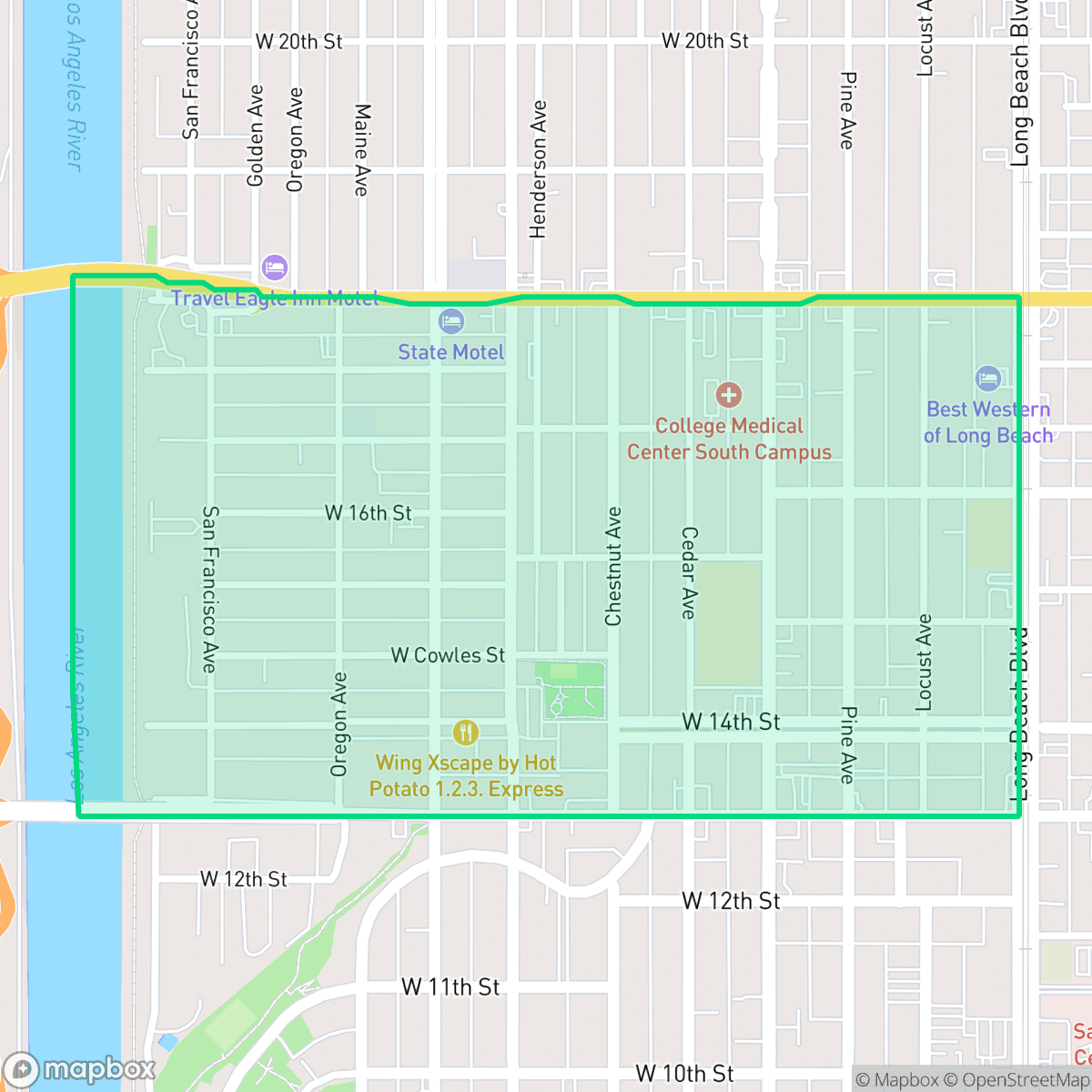
Established in 1909, the Washington School neighborhood in Long Beach, California, is a densely populated urban enclave bounded by Magnolia Avenue, Long Beach Boulevard, Anaheim Street, and Pacific Coast Highway. The neighborhood's identity is deeply tied to the historic Washington Middle School (originally American Avenue School). Rebuilt in 1921 and expanded in 1926, the school building was designed by prominent architects W. Horace Austin and John C. Austin. It stands as a local landmark featuring a blend of Art Deco, Streamline Moderne, and PWA Moderne architectural styles, complete with low-relief Beaux-Arts sculptures. Today, the neighborhood is recognized for its vibrant Latino heritage, particularly its strong Mexican-American cultural presence, and ongoing community-led revitalization efforts.
The area functions as a compact, mixed-use environment where residential blocks integrate with active industrial sectors. Its layout prioritizes pedestrian access, offering a highly walkable grid that connects local residents to nearby amenities and services. While the environment remains active during the day, the proximity to major thoroughfares contributes to a consistent ambient noise level, primarily driven by road traffic. According to data from iHuus, the neighborhood maintains a high walkability score, reflecting its accessible street design.
Prospective residents should note that the neighborhood offers minimal private green space, with limited opportunities for pet owners and those seeking quiet retreats. Housing is tightly packed, which impacts individual privacy, and the area faces specific challenges regarding flood safety and health insurance coverage. This location is best suited for individuals who prioritize walkability and proximity to commercial hubs over suburban seclusion or expansive private amenities.
Neighborhood Scores Across 15 Qualities
Residential structures are positioned in extremely close quarters with minimal separation between buildings. This level of density is notably higher than the Long Beach average, with many homes situated on narrow lots with very little gap between neighbors.
A complete sidewalk grid with clearly marked crossings and pedestrian-priority areas makes navigating the neighborhood on foot easy. This level of accessibility is nearly on par with the Long Beach average.
Standard tract housing and high-density apartment complexes characterize the area, which features small lots and modest private amenities. This level of visual variety is slightly below the Long Beach average.
Limited sidewalk verges and a lack of widespread public greenery make this area less ideal for dog owners than the Long Beach average. Most accessible green space is restricted to small parks or private, fenced yards.
Residential blocks and industrial sectors exist in a relatively even balance of streets and green space. This environment is less densely developed than the Long Beach average, offering a mix of multi-family housing and light industrial infrastructure.
Active dining pockets and local social hubs provide a noticeable energy that is notably higher than the Long Beach average. Residents can find a diverse range of steady services and eateries, ranging from mid-rise urban districts to suburban streets featuring local bakeries and cafes.
Frequent sounds from nearby railroad tracks and heavy freeway traffic characterize this area. According to iHuus data, acoustic comfort is slightly below the Long Beach average.
Air quality remains consistently high with minimal health concerns. According to iHuus data, the atmosphere in this area is notably cleaner than the Long Beach average.
Residential life remains largely undisturbed by heavy industry, as the area consists primarily of housing and institutional uses. While some warehouse clusters exist on the western edge, the neighborhood lacks significant industrial activity and remains consistent with the Long Beach average.
Health insurance access is significantly lower than the Long Beach average. According to iHuus data, the vast majority of residents in this area lack health coverage.
Voting patterns and census indicators reflect a predominantly liberal political leaning. This tendency is even more pronounced here than in the rest of Long Beach, according to iHuus data.
A balanced mix of young adults, families, and older residents defines this area, though the demographic spread is slightly less varied than the Long Beach average according to iHuus data.
Flood vulnerability in this area is significantly higher than the Long Beach average. Residents should be aware of increased susceptibility to water damage during heavy rain events according to iHuus data.
Address-Level Insights for Washington School


iHuus Neighborhood Intelligence Insights
Get address-level neighborhood insights for Washington School
- Street-level scores — see how individual blocks compare, not just neighborhood averages
- Micro-zone boundaries — identify quiet pockets, flood boundaries, and walkable clusters before you visit
- 15 dimensions in full — walkability, noise, air quality, school quality, insurance coverage, population age profile, urban/rural index, and more
- Boundary risk alerts — know if your address sits near a block boundary where scores drop, the kind of detail no listing will ever mention
- School insights — individual school ratings and insights, not just district-level data
- Compare before you commit — side-by-side data across neighborhoods, down to block precision
No credit card required
Compare with Any Neighborhood
| Dimension | Washington School | Airport Area |
|---|---|---|
| 🚶 Walkabilityavg 9.37 | ||
| 🔊 Acoustic Comfortavg 3.04 | ||
| 🤫 Privacy Indexavg 3.63 | ||
| 🎨 Visual Appealavg 6.3 | ||
| 🐕 Dog Friendlinessavg 5.35 | ||
| 🗺️ Urban-Rural Indexavg 6 | ||
| ✨ Neighborhood Vibeavg 5.01 | ||
| 🏥 Health Insurance Coverageavg 6.4 | ||
| 🌿 Air Qualityavg 8.69 | ||
| 🏭 Industrial Proximityavg 8.14 | ||
| 🌊 Flood Safetyavg 3.75 | ||
| 🗳️ Ideological Leanavg 9.2 | ||
| 👥 Population Age Profileavg 4.81 | ||
| 🔥 Fire Safety | ||
| 🏫 School Quality |
Washington School Rankings
School Districts Serving Washington School
School Insights for Washington School
Below average outcomes; significant attendance and academic challenges.
School Insights
See what's really behind every school rating near Washington School
- Individual school ratings — each school's own score with outcome context, not just a district average
- Enrollment & class size data — student-to-teacher ratio and how it compares to the state average
- Full demographics breakdown — ethnicity and gender composition for every school in the enrollment zone
- Every school in the district — all schools within the enrollment boundary ranked by rating, not just the closest one
- Grade levels & benchmarks — elementary through high school, with below/above state-average flags
No credit card required