University Park Estates, Long Beach
Updated · 2,214 residents
University Park Estates is a distinctive residential enclave characterized by its varied mid-century architectural designs and the scenic Channel View Park. While the neighborhood offers high visual appeal and excellent air quality, residents experience significant noise levels from nearby road traffic and a reliance on personal vehicles for daily errands.
Key Highlights
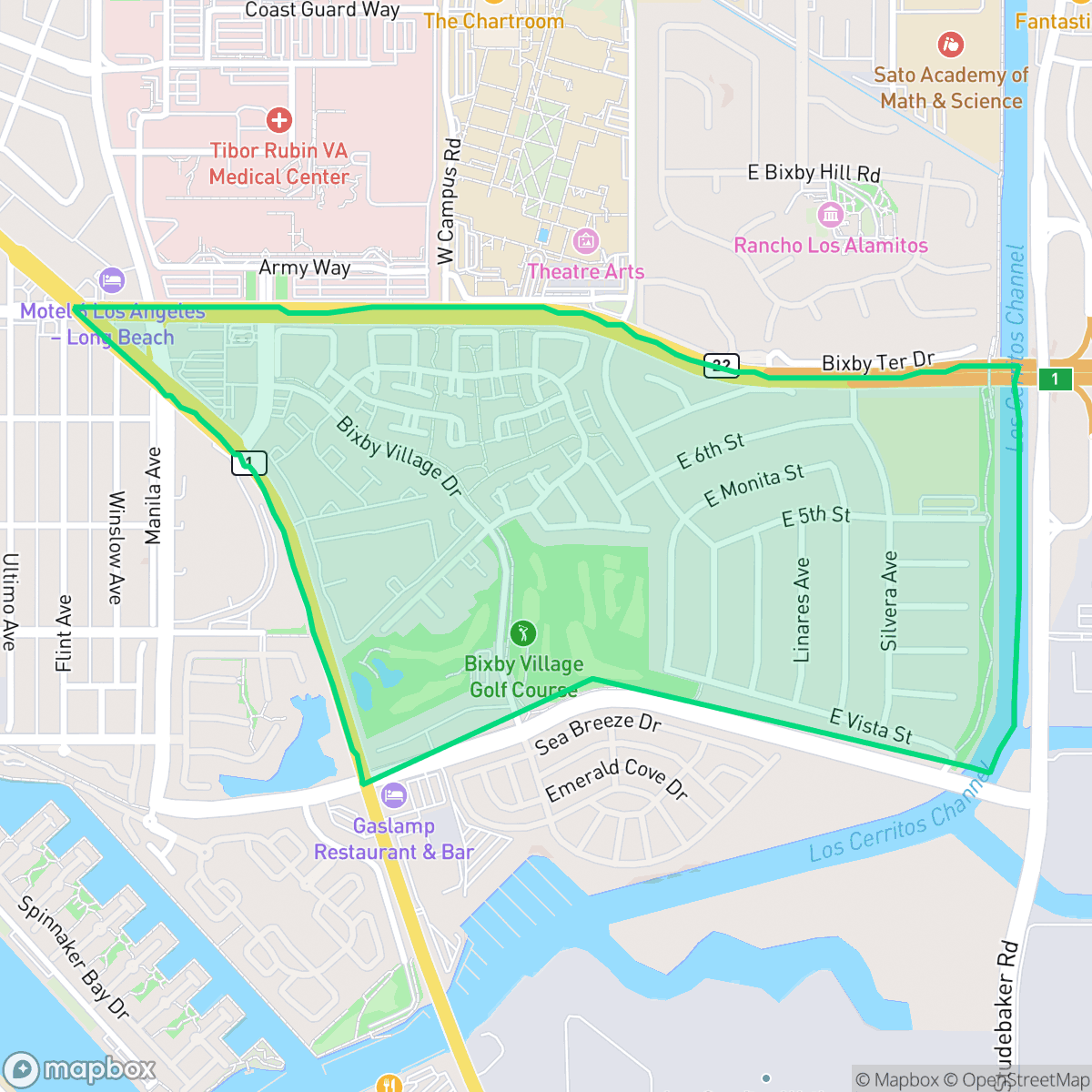
About University Park Estates
Tucked south of California State University, Long Beach, the University Park Estates neighborhood was built in 1960–1961 by S&S Construction on a portion of the historic Bixby Ranch. Originally named College Park Estates, the tract was renamed in 1972 when its neighboring college achieved university status. Locals affectionately refer to the secluded enclave of roughly 450 homes as "The Hole," a nickname inspired by the steep descent of Margo Avenue, the neighborhood's primary entrance off Seventh Street. Although developed as tract housing, the neighborhood avoids uniformity because the builder offered buyers 28 distinct exterior designs. A defining community feature is Channel View Park, a five-acre greenbelt and walking path established in 1970 that runs along the Los Cerritos Channel.
The area maintains a unique aesthetic due to its diverse exterior home designs, which distinguish it from typical tract developments of the era. Residents benefit from proximity to local green spaces like Channel View Park, providing a quiet respite despite the neighborhood's position near major industrial infrastructure, including a local power plant. According to iHuus data, the community enjoys superior air quality compared to the broader Long Beach area, contributing to its reputation as a desirable, albeit suburban, pocket of the city.
Prospective residents should note that the neighborhood is highly car-dependent, with limited walkability for daily needs. The acoustic environment is notably impacted by heavy road traffic, which remains the primary source of noise in the area. While the local Kettering Elementary School maintains a strong rating, the broader school district is currently navigating significant fiscal transitions. This neighborhood is best suited for those who prioritize visual character and air quality over absolute quiet or immediate pedestrian access to commercial hubs.
Neighborhood Scores Across 15 Qualities
Housing density is moderate with varying distances between neighbors. Residents experience more separation between properties than is typical for the Long Beach average, although some multi-family structures feature shared walls and communal grounds.
A clear grid of sidewalks and safe crossings facilitates pedestrian movement throughout most residential streets and major arterials, though connectivity is slightly lower than the Long Beach average.
Well-maintained homes and frequent private backyard pools contribute to a visual landscape that is more aesthetically pleasing than the Long Beach average. According to iHuus data, the presence of large residences and spacious driveways defines the area's polished suburban character.
Wide grassy verges and interconnected park pockets offer ample relief areas for pets. According to iHuus data, these continuous green spaces make the area more accommodating for dog owners than the Long Beach average.
Open spaces and scattered greenery provide a more semi-rural character than most of Long Beach. This layout features a mix of residential tracts and significant utility infrastructure, according to iHuus data.
Suburban streets offer a moderate mix of dining and convenience, providing a slightly more active atmosphere than the Long Beach average. While the area features various local eateries, much of the neighborhood remains car-dependent due to the sparse distribution of businesses.
Frequent aircraft noise from the nearby airport runway is a primary characteristic of this area. According to iHuus data, acoustic comfort is significantly lower than the Long Beach average.
Air quality remains consistently high with minimal health concerns. According to iHuus data, the levels of atmospheric pollutants here are significantly better than the Long Beach average.
Industrial presence is virtually non-existent here, offering a cleaner environment than the Long Beach average. According to iHuus data, the area is comprised of residential and institutional zones without the presence of warehouses or heavy industrial hazards.
Health insurance access is notably higher here than the Long Beach average, according to iHuus data. Most residents in the area are covered by health insurance plans.
Political leanings in this area are largely liberal, though the community is slightly less progressive than the broader Long Beach average according to iHuus data.
Residents experience a varied demographic mix of young adults, families, and older individuals, representing a more balanced age distribution than the Long Beach average. According to iHuus data, this variety contributes to a stable, multi-generational community feel.
Flood risk is significantly lower here than the Long Beach average, though some residual risk remains due to the area's location within the 500-year floodplain. According to iHuus data, the neighborhood is situated in a zone that is generally considered stable but requires awareness of potential seasonal drainage issues.
Address-Level Insights for University Park Estates


iHuus Neighborhood Intelligence Insights
Get address-level neighborhood insights for University Park Estates
- Street-level scores — see how individual blocks compare, not just neighborhood averages
- Micro-zone boundaries — identify quiet pockets, flood boundaries, and walkable clusters before you visit
- 15 dimensions in full — walkability, noise, air quality, school quality, insurance coverage, population age profile, urban/rural index, and more
- Boundary risk alerts — know if your address sits near a block boundary where scores drop, the kind of detail no listing will ever mention
- School insights — individual school ratings and insights, not just district-level data
- Compare before you commit — side-by-side data across neighborhoods, down to block precision
No credit card required
Compare with Any Neighborhood
| Dimension | University Park Estates | Airport Area |
|---|---|---|
| 🚶 Walkabilityavg 9.37 | ||
| 🔊 Acoustic Comfortavg 3.04 | ||
| 🤫 Privacy Indexavg 3.63 | ||
| 🎨 Visual Appealavg 6.3 | ||
| 🐕 Dog Friendlinessavg 5.35 | ||
| 🗺️ Urban-Rural Indexavg 6 | ||
| ✨ Neighborhood Vibeavg 5.01 | ||
| 🏥 Health Insurance Coverageavg 6.4 | ||
| 🌿 Air Qualityavg 8.69 | ||
| 🏭 Industrial Proximityavg 8.14 | ||
| 🌊 Flood Safetyavg 3.75 | ||
| 🗳️ Ideological Leanavg 9.2 | ||
| 👥 Population Age Profileavg 4.81 | ||
| 🔥 Fire Safety | ||
| 🏫 School Quality |
University Park Estates Rankings
School Districts Serving University Park Estates
School Insights for University Park Estates
Below average outcomes; significant attendance and academic challenges.
School Insights
See what's really behind every school rating near University Park Estates
- Individual school ratings — each school's own score with outcome context, not just a district average
- Enrollment & class size data — student-to-teacher ratio and how it compares to the state average
- Full demographics breakdown — ethnicity and gender composition for every school in the enrollment zone
- Every school in the district — all schools within the enrollment boundary ranked by rating, not just the closest one
- Grade levels & benchmarks — elementary through high school, with below/above state-average flags
No credit card required