The Plaza, Long Beach
Updated · 18,984 residents
The Plaza is an established, highly walkable residential community in East Long Beach known for its mid-century ranch-style architecture and well-maintained properties. Residents enjoy high air quality and consistent access to local services, though the area experiences notable road noise and limited public green space for pets.
Key Highlights
About The Plaza
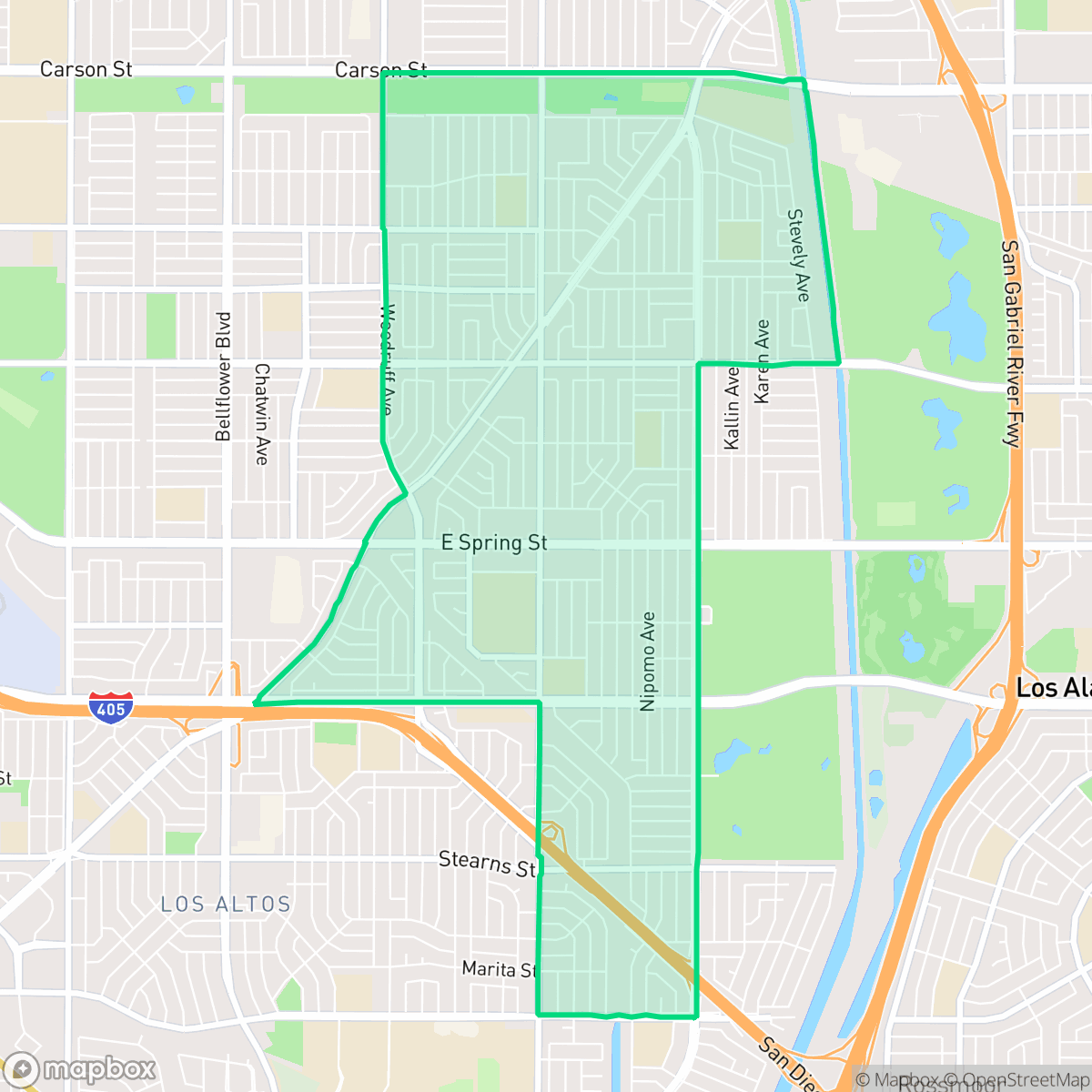
The Plaza neighborhood in East Long Beach, California, was originally developed in 1951 by the Aldon Construction Company as a suburban tract named Lakewood Plaza. Built on unincorporated Los Angeles County land to house young post-World War II families, the neighborhood was annexed by Long Beach in March 1953 after a local vote. The area is defined by its classic mid-century ranch-style homes, which were considered deluxe for their era. These properties featured raised foundations, oak hardwood floors, solid wood paneling, and walls of crystal glass panels designed to integrate indoor and outdoor living. Located adjacent to the expansive El Dorado Park West, the neighborhood is bounded by Spring Street, Studebaker Road, Stearns Street, and Palo Verde Avenue.
The neighborhood serves as a prime example of mid-century suburban planning, featuring a dense grid of single-family homes and a highly accessible, pedestrian-friendly street network. The area maintains a strong visual appeal through manicured landscapes and a high density of private swimming pools, contributing to a stable and affluent atmosphere. Residents benefit from excellent health insurance coverage and proximity to high-performing schools such as Ernest S. Mcbride Sr. High and Helen Keller Middle, making the location a reliable choice for families seeking educational stability.
While the area excels in walkability and air quality, prospective residents should note the acoustic environment, which is impacted by consistent road traffic. The neighborhood is primarily residential with minimal industrial presence, though its quiet, suburban rhythm results in limited nightlife and social activity. Those prioritizing a calm, orderly environment with easy access to neighborhood services will find the area well-suited to their needs, provided they can accommodate the ambient noise levels and the lack of large public parks within the immediate residential blocks.
Neighborhood Scores Across 15 Qualities
Homes are situated with moderate spacing and typical suburban setbacks, offering more separation between neighbors than the Long Beach average. According to iHuus data, most properties feature detached structures with small side yards or shared fencing.
Continuous sidewalk networks and well-defined pedestrian crossings make navigating the area on foot easy. This level of connectivity and sidewalk coverage is even higher than the Long Beach average according to iHuus data.
Well-maintained landscapes and a high density of private swimming pools characterize this area. According to iHuus data, the visual quality of the neighborhood is notably higher than the Long Beach average.
Abundant green space and large public parks with accessible trails make this area significantly more dog friendly than the Long Beach average. Wide, continuous parkways between sidewalks and streets provide safe, paved routes for exercise throughout the neighborhood.
Established single-family housing and organized commercial strips define this area. The neighborhood features a slightly more open landscape compared to the Long Beach average.
Suburban streets and green spaces offer a serene environment, though social activity and local business density are below the Long Beach average. Most dining and service options are spread out, making the area feel more practical and car-oriented than lively.
Frequent noise from nearby freeways and railroad tracks is common in this area. According to iHuus data, acoustic levels are slightly higher than the Long Beach average.
Air quality in this area is excellent and remains notably higher than the Long Beach average. Residents can expect very low levels of pollution and minimal health concerns according to iHuus data.
Residential and recreational land use dominates the area with no detectable warehouses or heavy industrial hazards. This lack of industrial proximity is notably higher than the Long Beach average, according to iHuus data.
Health insurance access among residents is significantly higher than the Long Beach average. According to iHuus data, the vast majority of the population is covered.
Political leanings in this area are primarily liberal, though the neighborhood leans slightly less progressive than the Long Beach average.
A diverse mix of young adults, families, and older residents characterizes the area. This demographic spread is slightly more varied than the typical Long Beach profile, according to iHuus data.
Residual flood risk exists due to the area being within a 500-year floodplain, though safety levels remain significantly higher than the Long Beach average according to iHuus data.
Address-Level Insights for The Plaza


iHuus Neighborhood Intelligence Insights
Get address-level neighborhood insights for The Plaza
- Street-level scores — see how individual blocks compare, not just neighborhood averages
- Micro-zone boundaries — identify quiet pockets, flood boundaries, and walkable clusters before you visit
- 15 dimensions in full — walkability, noise, air quality, school quality, insurance coverage, population age profile, urban/rural index, and more
- Boundary risk alerts — know if your address sits near a block boundary where scores drop, the kind of detail no listing will ever mention
- School insights — individual school ratings and insights, not just district-level data
- Compare before you commit — side-by-side data across neighborhoods, down to block precision
No credit card required
Compare with Any Neighborhood
| Dimension | The Plaza | Airport Area |
|---|---|---|
| 🚶 Walkabilityavg 9.37 | ||
| 🔊 Acoustic Comfortavg 3.04 | ||
| 🤫 Privacy Indexavg 3.63 | ||
| 🎨 Visual Appealavg 6.3 | ||
| 🐕 Dog Friendlinessavg 5.35 | ||
| 🗺️ Urban-Rural Indexavg 6 | ||
| ✨ Neighborhood Vibeavg 5.01 | ||
| 🏥 Health Insurance Coverageavg 6.4 | ||
| 🌿 Air Qualityavg 8.69 | ||
| 🏭 Industrial Proximityavg 8.14 | ||
| 🌊 Flood Safetyavg 3.75 | ||
| 🗳️ Ideological Leanavg 9.2 | ||
| 👥 Population Age Profileavg 4.81 | ||
| 🔥 Fire Safety | ||
| 🏫 School Quality |
The Plaza Rankings
School Districts Serving The Plaza
School Insights for The Plaza
Below average outcomes; significant attendance and academic challenges.
School Insights
See what's really behind every school rating near The Plaza
- Individual school ratings — each school's own score with outcome context, not just a district average
- Enrollment & class size data — student-to-teacher ratio and how it compares to the state average
- Full demographics breakdown — ethnicity and gender composition for every school in the enrollment zone
- Every school in the district — all schools within the enrollment boundary ranked by rating, not just the closest one
- Grade levels & benchmarks — elementary through high school, with below/above state-average flags
No credit card required