Sunrise, Long Beach
Updated · 283 residents
Sunrise is a historic enclave defined by its collection of early 20th-century Craftsman bungalows and Spanish Colonial Revival homes. The area offers exceptional walkability for residents, though it remains a quiet, functional community with noticeable noise from nearby transit corridors.
Key Highlights
About Sunrise
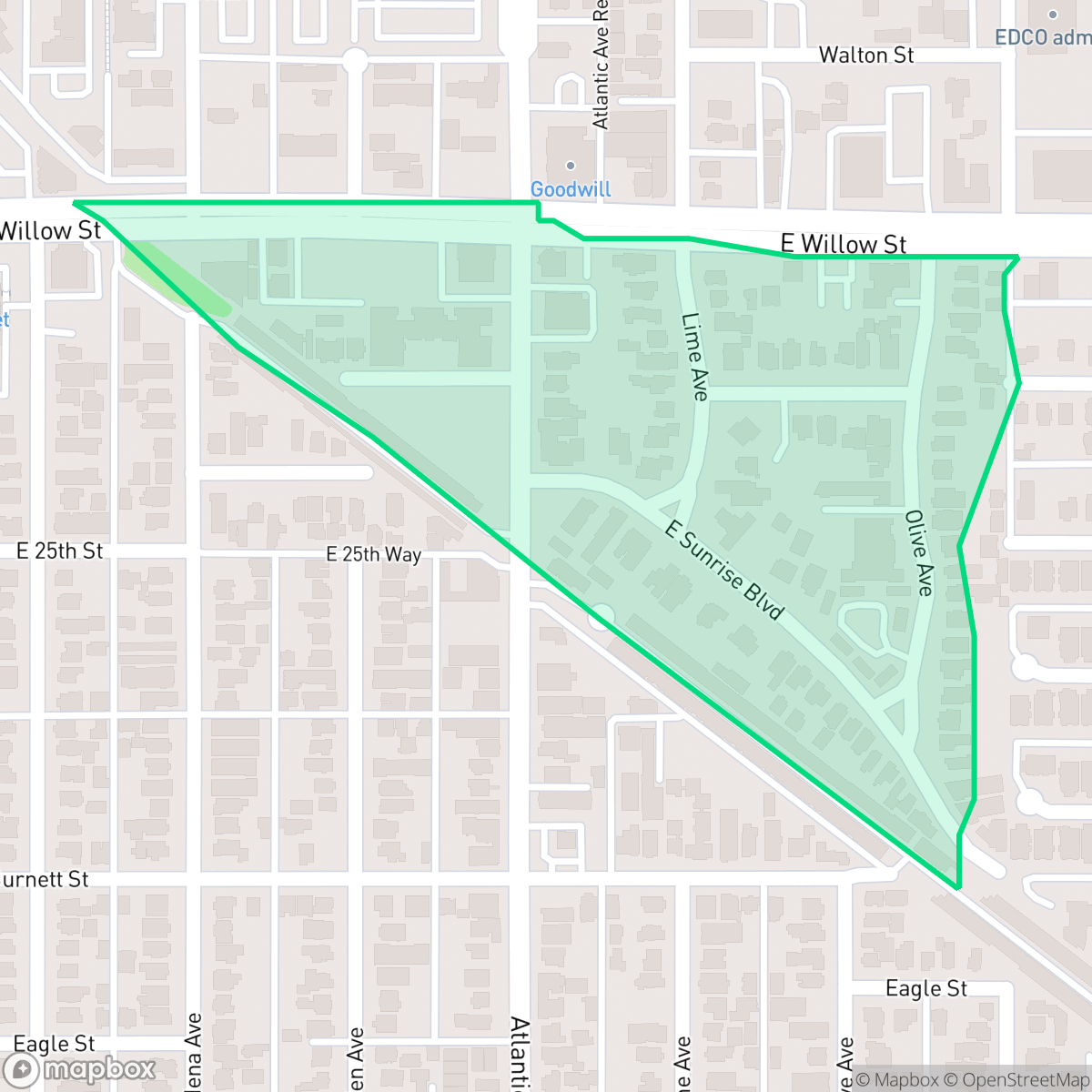
The Sunrise neighborhood, officially designated as the Sunrise Boulevard Historic Landmark District in 1990, evolved from early ranch lands into a residential enclave adjacent to the Pacific Electric Railway’s Balboa Line. Its historical character is defined by the 1907 Porter Milk Diet Sanitarium, which operated until 1924 before the site was later repurposed for the 1937 El Cortez Motor Court. Architecturally, the district is notable for its egalitarian mix of housing, featuring Craftsman Bungalows built between 1908 and 1924 that range from grand mansions to modest worker cottages, alongside examples of Spanish Colonial Revival style. Local landmarks like the historic Harnett House further anchor the neighborhood's identity as a preserved slice of early 20th-century Long Beach development.
The neighborhood maintains a semi-rural character, featuring open land and scattered greenery that distinguish it from more dense parts of the city. Residents benefit from exceptionally clean air and a highly walkable street grid that encourages pedestrian activity. The community is marked by a strongly progressive political culture and a diverse age demographic that includes families, young professionals, and older residents.
Potential residents should consider that the area is primarily functional, with limited commercial density. While the streets are easy to navigate on foot, the proximity to major transit corridors results in noticeable noise from freeway traffic and railroad tracks. Public green space is somewhat restricted, leading many homeowners to prioritize private yard space. Additionally, those moving to the area should be aware of the ongoing fiscal transitions within the local school district and the moderate flood risk present in the floodplain.
Neighborhood Scores Across 15 Qualities
Residential spacing varies throughout the area, with some high-density housing featuring closely situated structures and shared walls. According to iHuus data, the level of privacy is slightly higher than the Long Beach average.
Pedestrians benefit from a grid pattern of streets featuring continuous sidewalks and clear crossings. This level of accessibility is even higher than the Long Beach average according to iHuus data.
Uniform tract housing and industrial blocks define the local landscape. According to iHuus data, the visual variety in Sunrise is slightly lower than the Long Beach average.
Dog walking options are somewhat restricted due to narrow parkways and a lack of public green space, which is below the Long Beach average. While a large central park and occasional sidewalk verges provide some relief, most residents rely on private backyards for pet activity.
Open land and scattered greenery are more common here than in most of Long Beach. Residents will find a landscape characterized by frequent open spaces and a mix of residential pockets nestled among fields or woodlands.
Primarily characterized by industrial zones and suburban streets, this area offers a subdued atmosphere that is less active than the Long Beach average. While residential pockets feature green space and local dining, the neighborhood is largely car-oriented with limited commercial density.
Frequent noise from nearby freeway corridors and railroad tracks characterizes the area. According to iHuus data, acoustic levels in Sunrise are slightly higher than the Long Beach average.
Air quality remains exceptionally high and presents minimal health concerns for residents. According to iHuus data, the atmosphere in Sunrise is significantly cleaner than the Long Beach average.
Primarily residential and light commercial, this area lacks heavy industrial hazards or large warehouses. According to iHuus data, the neighborhood has slightly more industrial activity than the Long Beach average, though it remains largely free of heavy manufacturing.
Health insurance access is notably lower than the Long Beach average. According to iHuus data, a minority of residents in this area are covered by health insurance plans.
Voting patterns and census indicators show a highly progressive political leaning, which is even more pronounced than the average for Long Beach. This area reflects the broader liberal trends seen throughout the city according to iHuus data.
Residents live alongside a relatively even mix of young adults, families, and older populations. This demographic spread is slightly lower than the Long Beach average, according to iHuus data.
Flood risk in this area is notably higher than the Long Beach average due to its location within a 500-year floodplain. Residents may encounter some residual flood risk during extreme weather events according to iHuus data.
Address-Level Insights for Sunrise


iHuus Neighborhood Intelligence Insights
Get address-level neighborhood insights for Sunrise
- Street-level scores — see how individual blocks compare, not just neighborhood averages
- Micro-zone boundaries — identify quiet pockets, flood boundaries, and walkable clusters before you visit
- 15 dimensions in full — walkability, noise, air quality, school quality, insurance coverage, population age profile, urban/rural index, and more
- Boundary risk alerts — know if your address sits near a block boundary where scores drop, the kind of detail no listing will ever mention
- School insights — individual school ratings and insights, not just district-level data
- Compare before you commit — side-by-side data across neighborhoods, down to block precision
No credit card required
Compare with Any Neighborhood
| Dimension | Sunrise | Airport Area |
|---|---|---|
| 🚶 Walkabilityavg 9.37 | ||
| 🔊 Acoustic Comfortavg 3.04 | ||
| 🤫 Privacy Indexavg 3.63 | ||
| 🎨 Visual Appealavg 6.3 | ||
| 🐕 Dog Friendlinessavg 5.35 | ||
| 🗺️ Urban-Rural Indexavg 6 | ||
| ✨ Neighborhood Vibeavg 5.01 | ||
| 🏥 Health Insurance Coverageavg 6.4 | ||
| 🌿 Air Qualityavg 8.69 | ||
| 🏭 Industrial Proximityavg 8.14 | ||
| 🌊 Flood Safetyavg 3.75 | ||
| 🗳️ Ideological Leanavg 9.2 | ||
| 👥 Population Age Profileavg 4.81 | ||
| 🔥 Fire Safety | ||
| 🏫 School Quality |
Sunrise Rankings
School Districts Serving Sunrise
School Insights for Sunrise
Below average outcomes; significant attendance and academic challenges.
School Insights
See what's really behind every school rating near Sunrise
- Individual school ratings — each school's own score with outcome context, not just a district average
- Enrollment & class size data — student-to-teacher ratio and how it compares to the state average
- Full demographics breakdown — ethnicity and gender composition for every school in the enrollment zone
- Every school in the district — all schools within the enrollment boundary ranked by rating, not just the closest one
- Grade levels & benchmarks — elementary through high school, with below/above state-average flags
No credit card required