Rancho Estates, Long Beach
Updated · 1,594 residents
Rancho Estates is a quiet, highly walkable residential community in east Long Beach defined by its pristine midcentury modern architecture. While the area offers excellent air quality and a peaceful suburban atmosphere, residents experience moderate noise levels from nearby road traffic and limited local commercial activity.
Key Highlights
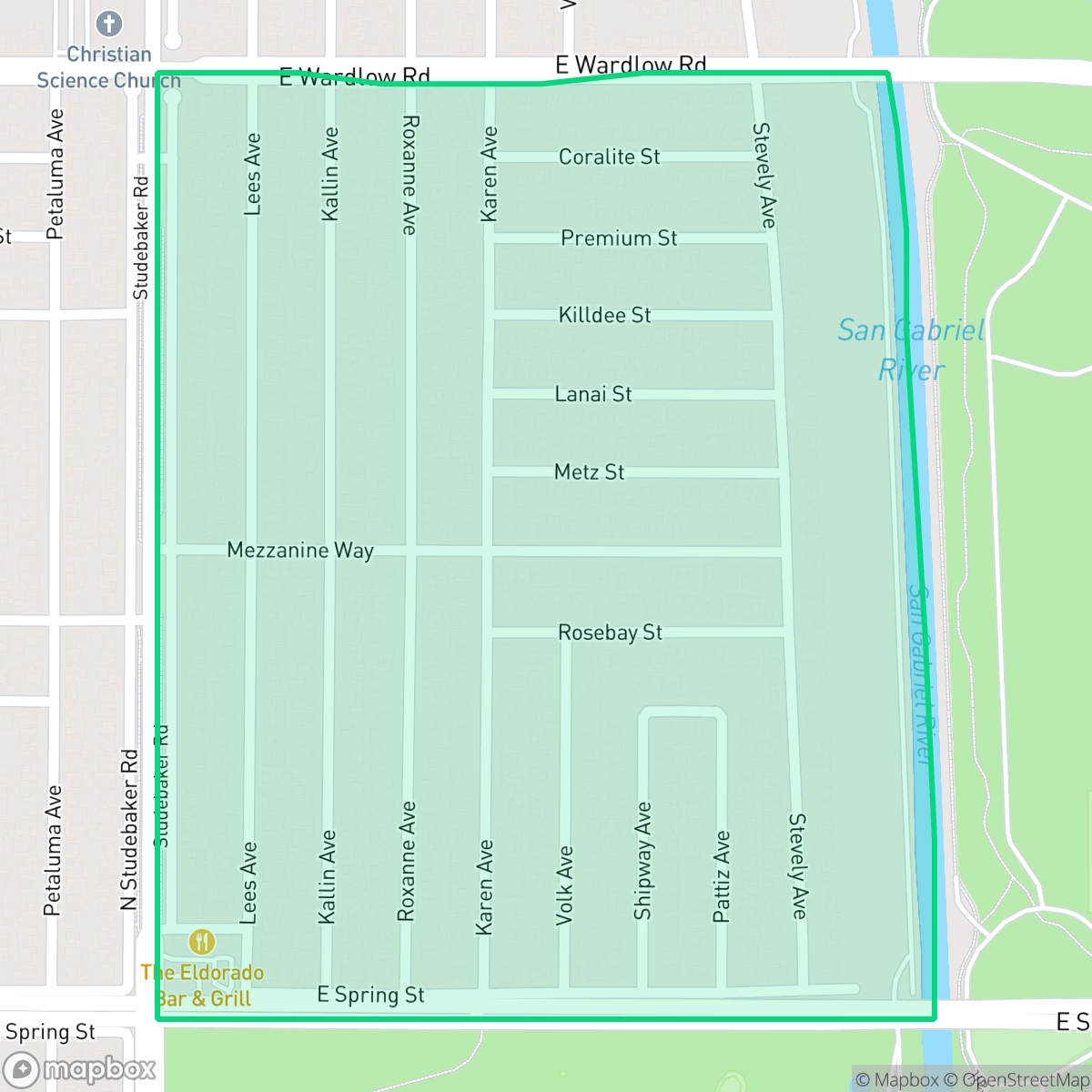
About Rancho Estates
Rancho Estates, also known as Lakewood Rancho Estates, is a highly regarded midcentury modern neighborhood in east Long Beach. Built between 1953 and 1954 by developer Ross Cortese, the 700-home tract is the largest residential development designed by legendary building designer Cliff May, often credited as the father of the modern California ranch house, alongside architect Chris Choate. The neighborhood is defined by its distinct L-shaped, post-and-beam homes featuring low-pitched gabled roofs, clerestory windows, and floor-to-ceiling glass walls that open directly onto private courtyards, epitomizing postwar indoor-outdoor living. Bounded by the San Gabriel River and Studebaker Road, the once-underappreciated tract has experienced a major cultural renaissance, with design-savvy preservationists actively restoring and safeguarding its signature midcentury architectural character.
This neighborhood functions as a strictly residential enclave, characterized by a complete absence of industrial activity and a high rate of health insurance coverage among residents. The layout features continuous sidewalks and wide parkways, making the area exceptionally accessible for pedestrians and dog owners alike. According to iHuus data, the community maintains a high visual standard, with well-manicured lawns and private swimming pools defining the aesthetic of the streetscape. The environment is notably quiet, fostering a suburban atmosphere that prioritizes residential privacy and recreational space over commercial density. Prospective residents should be aware that the area contains few immediate retail or dining options, requiring travel for most daily errands. While the neighborhood boasts clean air, the acoustic environment is influenced by consistent road traffic, resulting in moderate noise levels. Families should also consider that the local school district is currently navigating significant fiscal challenges and administrative transitions, which may impact long-term educational stability in the region.
Neighborhood Scores Across 15 Qualities
Residential spacing offers more separation between homes than is typical for Long Beach; neighbors are separated by small side yards that provide a modest buffer.
Continuous sidewalks on both sides of every street and clear pedestrian crossings at major intersections make navigating the area on foot exceptionally easy. According to iHuus data, this level of accessibility is even higher than the Long Beach average.
Manicured lawns and private swimming pools characterize this area, which offers significantly higher visual appeal than the Long Beach average according to iHuus data.
Extensive parklands and wide, grassy parkways provide significantly more space for pets than the Long Beach average. Residents have easy access to large nearby parks and open trails for walking.
More open land and greenery are present here than in the typical Long Beach neighborhood. This area features a residential grid of single-family homes interspersed with large park spaces and scattered vegetation.
Low-density housing and green spaces provide a serene setting, though the area is less active than the Long Beach average. Most local services and dining options are sparse, making the neighborhood feel more secluded than typical urban hubs.
Proximity to busy freeways and railroad tracks results in higher levels of ambient noise than the Long Beach average, according to iHuus data.
Air quality remains consistently high with minimal health concerns. This level of cleanliness is notably better than the Long Beach average, according to iHuus data.
Industrial activity is virtually nonexistent here, as the area consists entirely of residential and recreational zones without nearby warehouses or heavy industry. According to iHuus data, this lack of industrial proximity is significantly better than the Long Beach average.
Health insurance enrollment is exceptionally high in this area, significantly surpassing the Long Beach average according to iHuus data.
Political leanings in this area are predominantly liberal, though this is slightly less pronounced than the average seen across Long Beach.
Residents live alongside a balanced mix of young adults, families, and older generations. According to iHuus data, this demographic distribution is slightly more varied than the average found across Long Beach.
Flood risk in this area is slightly higher than the Long Beach average due to an undetermined risk level from recent FEMA studies. According to iHuus data, the lack of a completed detailed study means certain areas may be subject to unverified flood vulnerabilities.
Address-Level Insights for Rancho Estates


iHuus Neighborhood Intelligence Insights
Get address-level neighborhood insights for Rancho Estates
- Street-level scores — see how individual blocks compare, not just neighborhood averages
- Micro-zone boundaries — identify quiet pockets, flood boundaries, and walkable clusters before you visit
- 15 dimensions in full — walkability, noise, air quality, school quality, insurance coverage, population age profile, urban/rural index, and more
- Boundary risk alerts — know if your address sits near a block boundary where scores drop, the kind of detail no listing will ever mention
- School insights — individual school ratings and insights, not just district-level data
- Compare before you commit — side-by-side data across neighborhoods, down to block precision
No credit card required
Compare with Any Neighborhood
| Dimension | Rancho Estates | Airport Area |
|---|---|---|
| 🚶 Walkabilityavg 9.37 | ||
| 🔊 Acoustic Comfortavg 3.04 | ||
| 🤫 Privacy Indexavg 3.63 | ||
| 🎨 Visual Appealavg 6.3 | ||
| 🐕 Dog Friendlinessavg 5.35 | ||
| 🗺️ Urban-Rural Indexavg 6 | ||
| ✨ Neighborhood Vibeavg 5.01 | ||
| 🏥 Health Insurance Coverageavg 6.4 | ||
| 🌿 Air Qualityavg 8.69 | ||
| 🏭 Industrial Proximityavg 8.14 | ||
| 🌊 Flood Safetyavg 3.75 | ||
| 🗳️ Ideological Leanavg 9.2 | ||
| 👥 Population Age Profileavg 4.81 | ||
| 🔥 Fire Safety | ||
| 🏫 School Quality |
Rancho Estates Rankings
School Districts Serving Rancho Estates
School Insights for Rancho Estates
Below average outcomes; significant attendance and academic challenges.
School Insights
See what's really behind every school rating near Rancho Estates
- Individual school ratings — each school's own score with outcome context, not just a district average
- Enrollment & class size data — student-to-teacher ratio and how it compares to the state average
- Full demographics breakdown — ethnicity and gender composition for every school in the enrollment zone
- Every school in the district — all schools within the enrollment boundary ranked by rating, not just the closest one
- Grade levels & benchmarks — elementary through high school, with below/above state-average flags
No credit card required