Poly High District, Long Beach
Updated · 32,441 residents
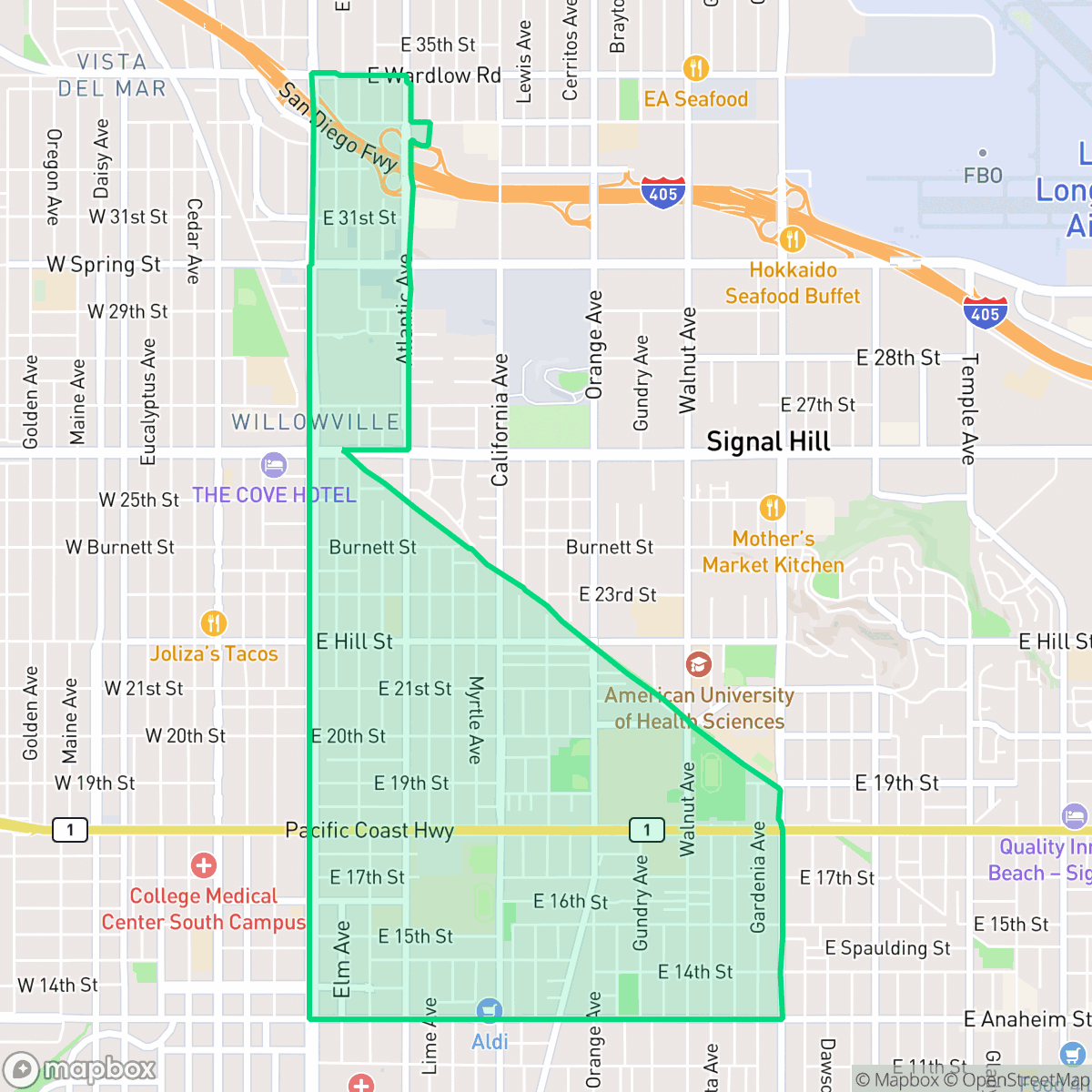
The Poly High District is a highly walkable, dense urban neighborhood in Long Beach known for its grid-style streets and vibrant cultural community. While residents enjoy exceptional access to local amenities on foot, the area is characterized by tightly packed housing and limited private green space.
Key Highlights
About Poly High District
The Poly High District in Long Beach, California, is a historic and culturally diverse neighborhood centered around the landmark Long Beach Polytechnic High School, which relocated to its 15-acre campus at 16th Street and Atlantic Avenue in 1911. Residential development in the area dates back to the early 20th century, featuring a rich architectural stock of Craftsman, California Bungalow, and Spanish Colonial Revival homes built primarily between 1900 and the 1930s. The neighborhood also encompasses the Sunrise Historic District. Today, the Poly High District is recognized for its dense, vibrant community and deep cultural identity, notably hosting a significant Cambodian-American population—with many residents speaking Mon-Khmer at home—alongside a prominent Latino community. Local landmarks and public spaces like Chittick Field and Martin Luther King Jr. Park serve as central gathering points for the neighborhood.
This area functions as a dense, low-rise urban grid that blends multi-family apartment buildings with smaller single-family homes. The neighborhood maintains a constant, active energy, supported by a diverse population and proximity to key educational and recreational institutions. According to iHuus data, the area achieves a perfect walkability score, making it a practical choice for those who rely on pedestrian access to daily services rather than personal vehicles. The trade-offs for this accessibility include a lower privacy index due to the close proximity of structures, which are often spaced less than five meters apart. Acoustic comfort is influenced by a background noise level of 61 decibels, largely driven by road traffic. While the neighborhood lacks expansive public parks, its central location and strong community identity make it well-suited for individuals who prioritize urban connectivity and cultural immersion over suburban seclusion.
Neighborhood Scores Across 15 Qualities
Residential structures are notably dense with very narrow gaps between buildings. According to iHuus data, many homes feature shared walls or minimal separation, resulting in less privacy than the Long Beach average.
Continuous sidewalks and clearly marked crosswalks are available on nearly every street, making it slightly more walkable than most of Long Beach. While a major high-traffic freeway acts as a barrier, the residential grid provides reliable pedestrian paths to local parks and schools.
Residential views consist primarily of high-density apartment complexes and standard tract housing with uniform rooflines. This landscape features modest yards and limited private greenery, appearing slightly less lush than the Long Beach average.
Public green space and accessible parklands are sparse across much of the district, making pet walking more difficult than in other parts of Long Beach. While some areas near larger parks offer relief, many blocks consist of dense urban grids with minimal sidewalk verges or visible public greenery.
Streetscapes feature a balance of residential housing and commercial corridors, though the area is slightly more urbanized than the Long Beach average. According to iHuus data, the neighborhood consists of a dense grid of low-rise apartments and single-family homes with limited large-scale green space.
Dynamic pockets of dining and social hubs coexist with quiet, suburban, and industrial sections. According to iHuus data, the neighborhood offers more varied social activity and amenities than the Long Beach average.
Frequent sounds from nearby rail lines and major freeways characterize the area. According to iHuus data, acoustic levels are slightly higher than the Long Beach average.
Air quality remains consistently high with minimal health concerns, performing significantly better than the Long Beach average according to iHuus data.
Primarily residential and light commercial in nature, this area lacks heavy industrial plants or significant warehouse clusters. According to iHuus data, the level of industrial proximity is largely consistent with the rest of the city.
Access to health insurance is notably lower in this area than the Long Beach average, according to iHuus data. Residents may face greater challenges accessing employer-sponsored or private medical plans within the district.
Voting patterns and census indicators show a predominantly liberal political leaning that is even more pronounced than the Long Beach average, according to iHuus data.
Residents live alongside a relatively even distribution of young adults, families, and older individuals; this demographic spread is slightly more varied than the broader Long Beach area.
Significant flood risk exists here due to the area being located within a designated floodplain. According to iHuus data, this level of risk is substantially higher than the Long Beach city average and may necessitate flood insurance.
Address-Level Insights for Poly High District


iHuus Neighborhood Intelligence Insights
Get address-level neighborhood insights for Poly High District
- Street-level scores — see how individual blocks compare, not just neighborhood averages
- Micro-zone boundaries — identify quiet pockets, flood boundaries, and walkable clusters before you visit
- 15 dimensions in full — walkability, noise, air quality, school quality, insurance coverage, population age profile, urban/rural index, and more
- Boundary risk alerts — know if your address sits near a block boundary where scores drop, the kind of detail no listing will ever mention
- School insights — individual school ratings and insights, not just district-level data
- Compare before you commit — side-by-side data across neighborhoods, down to block precision
No credit card required
Compare with Any Neighborhood
| Dimension | Poly High District | Airport Area |
|---|---|---|
| 🚶 Walkabilityavg 9.37 | ||
| 🔊 Acoustic Comfortavg 3.04 | ||
| 🤫 Privacy Indexavg 3.63 | ||
| 🎨 Visual Appealavg 6.3 | ||
| 🐕 Dog Friendlinessavg 5.35 | ||
| 🗺️ Urban-Rural Indexavg 6 | ||
| ✨ Neighborhood Vibeavg 5.01 | ||
| 🏥 Health Insurance Coverageavg 6.4 | ||
| 🌿 Air Qualityavg 8.69 | ||
| 🏭 Industrial Proximityavg 8.14 | ||
| 🌊 Flood Safetyavg 3.75 | ||
| 🗳️ Ideological Leanavg 9.2 | ||
| 👥 Population Age Profileavg 4.81 | ||
| 🔥 Fire Safety | ||
| 🏫 School Quality |
Poly High District Rankings
School Districts Serving Poly High District
School Insights for Poly High District
Below average outcomes; significant attendance and academic challenges.
School Insights
See what's really behind every school rating near Poly High District
- Individual school ratings — each school's own score with outcome context, not just a district average
- Enrollment & class size data — student-to-teacher ratio and how it compares to the state average
- Full demographics breakdown — ethnicity and gender composition for every school in the enrollment zone
- Every school in the district — all schools within the enrollment boundary ranked by rating, not just the closest one
- Grade levels & benchmarks — elementary through high school, with below/above state-average flags
No credit card required