Park Estates, Long Beach
Updated · 3,223 residents
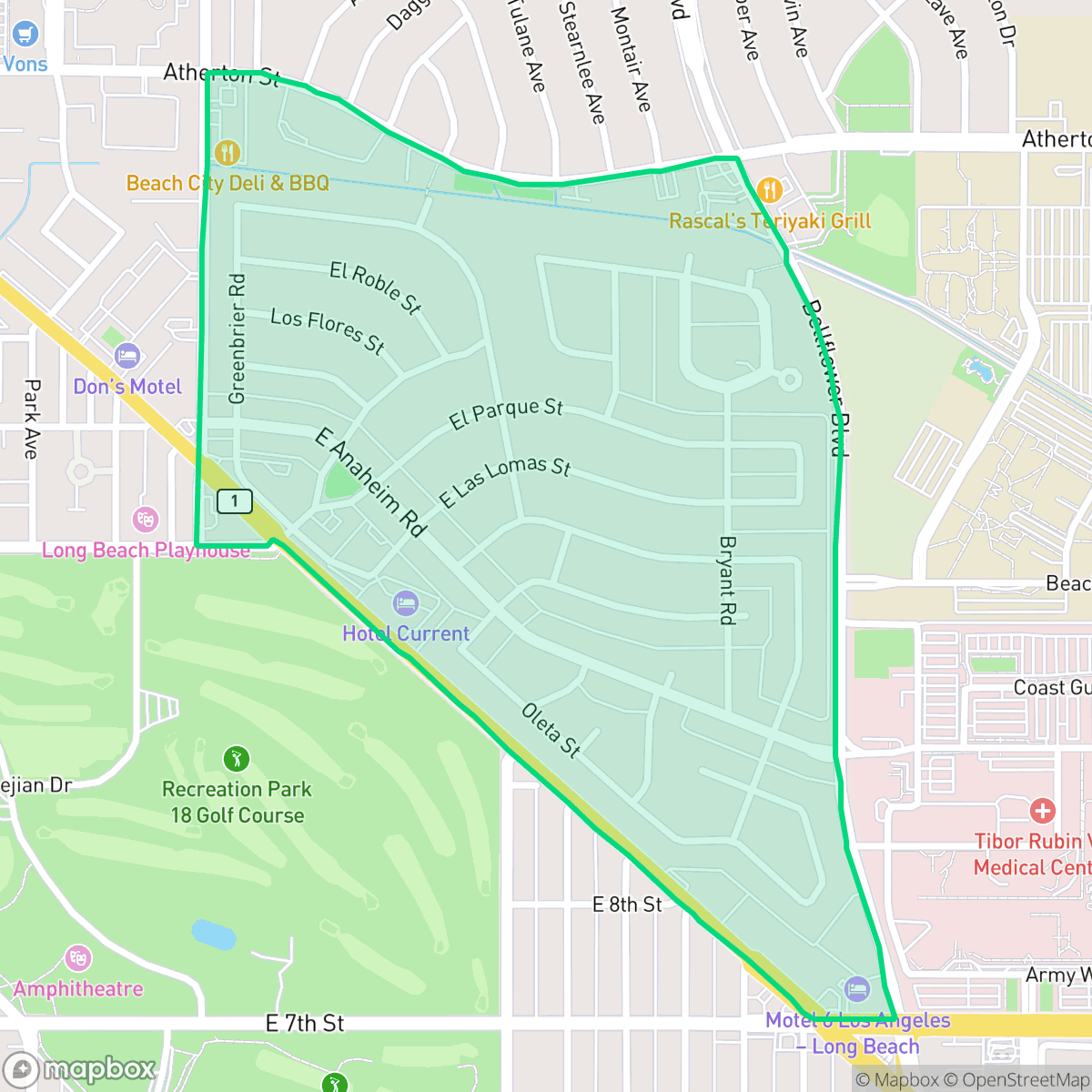
Park Estates is an affluent, pedestrian-friendly neighborhood in East Long Beach characterized by expansive lots and lush, tree-lined streets. Residents benefit from exceptional air quality and convenient access to public green space, though the area experiences moderate noise levels from local road traffic and aviation.
Key Highlights
About Park Estates
Developed in 1948 by Lloyd S. Whaley, Park Estates is an affluent, master-planned neighborhood in East Long Beach, California. Whaley commissioned landscape architect L. Deming Tilton to design the community, which is characterized by its wide, curving streets, mature tree canopies, and exceptionally large custom lots. Built on land formerly owned by Susanna Bixby Bryant—honored by the neighborhood's Bryant Road—Park Estates is celebrated for its remarkable mid-century modern architectural pedigree. It features homes designed by legendary architects, including Richard Neutra’s Hafley House, John Lautner’s Alexander House, and works by Paul Revere Williams, Edward Killingsworth, and Kenneth S. Wing. In its early years, the neighborhood also played a crucial role in local education, temporarily hosting classrooms and housing for the newly founded Long Beach State College.
The neighborhood offers a quiet, suburban environment defined by generous residential spacing and well-maintained landscaping. It maintains a high level of visual appeal, with many properties featuring private pools and mature vegetation. While the area is primarily residential, the presence of Whaley Park and wide, safe streets makes it a desirable location for those who prioritize outdoor activity and a sense of community space. The neighborhood is well-suited for residents seeking a stable, quiet environment with high standards for air quality and health coverage.
Prospective residents should note that while the area is highly walkable with consistent sidewalk coverage, it lacks immediate proximity to a wide variety of commercial amenities. The acoustic environment is influenced by a combination of road traffic and local aviation, resulting in moderate noise levels. Additionally, while the area is served by the Long Beach Unified School District, families should be aware of the district’s current fiscal challenges and ongoing administrative transitions as it manages budget deficits and enrollment shifts.
Neighborhood Scores Across 15 Qualities
Residential spacing varies between closely situated apartment blocks and single-family homes separated by yards. This level of separation provides more privacy than is typically found in the Long Beach average.
Continuous sidewalk networks and pedestrian-priority crossings make most errands easy to complete on foot. While the area remains very accessible, the level of walkability is slightly below the Long Beach average.
Large homes, private pools, and proximity to a golf course create a more aesthetically pleasing environment than the Long Beach average. According to iHuus data, the presence of well-maintained landscapes and spacious properties contributes to a high level of visual quality throughout the area.
Abundant green verges and proximity to large public parklands and golf courses offer significantly more space for pets than the Long Beach average. Wide paths and connected grassy areas provide ample walking opportunities and relief zones for dogs.
A dense mix of single-family homes and multi-story apartment complexes defines the area, offering slightly more open space than the typical Long Beach urban landscape according to iHuus data.
Concentrated pockets of local dining and art venues provide a noticeably more active atmosphere than the Long Beach average. While many streets offer a calm suburban feel near Whaley Park, certain areas remain car-dependent due to the proximity of major highways.
Frequent noise from nearby transit corridors and flight paths characterizes this area. According to iHuus data, acoustic comfort in Park Estates is notably lower than the Long Beach average.
Air quality remains consistently high with minimal health concerns. According to iHuus data, the air quality in Park Estates is notably cleaner than the Long Beach average.
Industrial activity is nonexistent in this area, as the neighborhood consists entirely of residential, commercial, and recreational zones. This lack of heavy industry or large-scale warehousing makes the area notably cleaner of industrial hazards than the Long Beach average.
Health insurance accessibility is significantly higher in Park Estates than in the rest of Long Beach, according to iHuus data.
Voting patterns and census indicators show a predominantly liberal leaning, though this is slightly less pronounced than the city average according to iHuus data.
Residents live alongside a balanced variety of young adults, families, and older individuals. This demographic spread is largely consistent with the broader Long Beach area according to iHuus data.
Flood safety levels are notably higher than the Long Beach average, though some residual risk remains as parts of the area sit within a 500 year floodplain according to iHuus data.
Address-Level Insights for Park Estates


iHuus Neighborhood Intelligence Insights
Get address-level neighborhood insights for Park Estates
- Street-level scores — see how individual blocks compare, not just neighborhood averages
- Micro-zone boundaries — identify quiet pockets, flood boundaries, and walkable clusters before you visit
- 15 dimensions in full — walkability, noise, air quality, school quality, insurance coverage, population age profile, urban/rural index, and more
- Boundary risk alerts — know if your address sits near a block boundary where scores drop, the kind of detail no listing will ever mention
- School insights — individual school ratings and insights, not just district-level data
- Compare before you commit — side-by-side data across neighborhoods, down to block precision
No credit card required
Compare with Any Neighborhood
| Dimension | Park Estates | Airport Area |
|---|---|---|
| 🚶 Walkabilityavg 9.37 | ||
| 🔊 Acoustic Comfortavg 3.04 | ||
| 🤫 Privacy Indexavg 3.63 | ||
| 🎨 Visual Appealavg 6.3 | ||
| 🐕 Dog Friendlinessavg 5.35 | ||
| 🗺️ Urban-Rural Indexavg 6 | ||
| ✨ Neighborhood Vibeavg 5.01 | ||
| 🏥 Health Insurance Coverageavg 6.4 | ||
| 🌿 Air Qualityavg 8.69 | ||
| 🏭 Industrial Proximityavg 8.14 | ||
| 🌊 Flood Safetyavg 3.75 | ||
| 🗳️ Ideological Leanavg 9.2 | ||
| 👥 Population Age Profileavg 4.81 | ||
| 🔥 Fire Safety | ||
| 🏫 School Quality |
Park Estates Rankings
School Districts Serving Park Estates
School Insights for Park Estates
Below average outcomes; significant attendance and academic challenges.
School Insights
See what's really behind every school rating near Park Estates
- Individual school ratings — each school's own score with outcome context, not just a district average
- Enrollment & class size data — student-to-teacher ratio and how it compares to the state average
- Full demographics breakdown — ethnicity and gender composition for every school in the enrollment zone
- Every school in the district — all schools within the enrollment boundary ranked by rating, not just the closest one
- Grade levels & benchmarks — elementary through high school, with below/above state-average flags
No credit card required