Naples, Long Beach
Updated · 3,339 residents
Naples is an affluent, highly walkable coastal enclave in Long Beach defined by its intricate canal system and Mediterranean-style architecture. Residents enjoy a serene, pedestrian-friendly environment with excellent air quality and convenient access to local dining, though the dense housing layout results in limited privacy between neighbors.
Key Highlights
About Naples
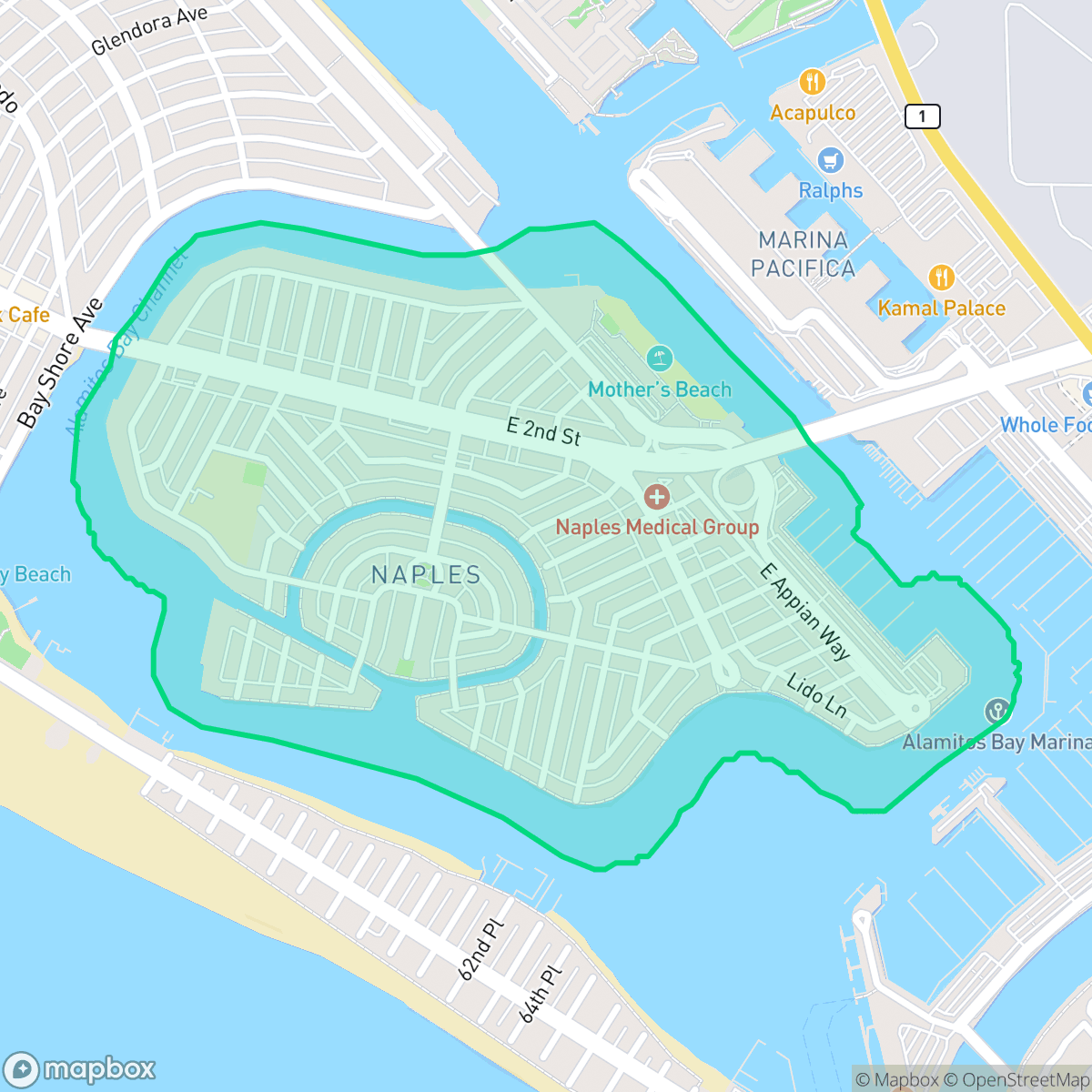
In 1903, developer Arthur M. Parsons envisioned an Italianate village in the marshy wetlands of Alamitos Bay, establishing the Naples neighborhood of Long Beach. Beginning in 1905, construction crews dredged the estuary and built concrete seawalls to shape three artificial islands divided by scenic canals. Designed by Mayberry & Parker, the neighborhood featured streets with Italian names, arched bridges, and early homes built in Mediterranean Revival and Spanish Colonial styles. At its center lies the landmark fountain, La Bella Fontana di Napoli. While initially planned to be named "Venice," the community was named Naples after a public contest. Today, Naples preserves its unique coastal character through active gondola tours along the Rivo Alto Canal and the annual Naples Island Christmas Boat Parade, a local tradition celebrated since 1946.
The neighborhood functions as a quiet, suburban waterfront community where the grid is designed for foot traffic and leisure. With a high walkability rating, the area encourages residents to traverse its bridges and canal-side paths, which provide a distinct visual appeal characterized by private docks and high-density luxury homes. Unlike the surrounding urban sprawl of Long Beach, the area maintains a peaceful, residential atmosphere that is entirely free from industrial activity. Prospective residents should note that the high density of the neighborhood creates a trade-off regarding privacy, as homes are often situated with minimal space between structures. While the area offers a high quality of life with excellent air quality and proximity to schools like Naples Elementary, the local flood risk is a factor to consider for property owners. According to iHuus data, the community is well-suited for those who prioritize a walkable, scenic lifestyle over expansive private yards, provided they are comfortable with a more compact living arrangement.
Neighborhood Scores Across 15 Qualities
Residential structures are closely packed with minimal separation between buildings, creating a more crowded environment than the Long Beach average. Many properties consist of shared-wall townhomes or detached houses positioned very near one another according to iHuus data.
Extensive sidewalk networks and dedicated waterfront paths make navigating the area on foot easy. This level of pedestrian connectivity is even higher than the Long Beach average, according to iHuus data.
High-value waterfront architecture and luxury amenities like private docks and yacht moorings create a landscape significantly more visually polished than the Long Beach average. According to iHuus data, the area features notable density of premium residential structures and manicured coastal properties.
Extensive waterfront paths, public beach access, and connected green spaces provide much better opportunities for pet exercise than the Long Beach average. According to iHuus data, the neighborhood offers safe, traffic-free routes through large parks and along the boardwalk.
Residential layouts feature a blend of dense waterfront development and suburban grids that feel slightly more open than much of Long Beach. This mix of paved infrastructure and maritime facilities provides a more varied landscape than the city average.
Residential streets offer a calm, low-energy atmosphere that is more subdued than the Long Beach average. While local dining and services are present, the area functions primarily as a serene coastal suburb with a steady but gentle pace of activity.
Steady sounds from nearby busy streets are present, though the level of acoustic disturbance is notably lower than the Long Beach average.
Air quality remains consistently high with minimal health concerns. According to iHuus data, these levels are notably better than the Long Beach average.
Industrial activity and hazardous facilities are entirely absent from this area. Residents can enjoy a landscape comprised solely of residential, retail, and recreational marina spaces, which is notably cleaner than the Long Beach average according to iHuus data.
Health insurance coverage among residents is notably higher than the Long Beach average, according to iHuus data.
Political leanings in this area are leaning liberal, though they are notably less progressive than the average for the city of Long Beach. According to iHuus data, the neighborhood maintains a more balanced political landscape with a modest opposing presence.
A diverse range of age groups resides here, including young professionals, families, and seniors. This demographic distribution is more varied than the average across Long Beach, according to iHuus data.
Frequent flood vulnerabilities exist here because parts of the neighborhood fall within a designated floodplain; according to iHuus data, this risk level is notably higher than the Long Beach average.
Address-Level Insights for Naples


iHuus Neighborhood Intelligence Insights
Get address-level neighborhood insights for Naples
- Street-level scores — see how individual blocks compare, not just neighborhood averages
- Micro-zone boundaries — identify quiet pockets, flood boundaries, and walkable clusters before you visit
- 15 dimensions in full — walkability, noise, air quality, school quality, insurance coverage, population age profile, urban/rural index, and more
- Boundary risk alerts — know if your address sits near a block boundary where scores drop, the kind of detail no listing will ever mention
- School insights — individual school ratings and insights, not just district-level data
- Compare before you commit — side-by-side data across neighborhoods, down to block precision
No credit card required
Compare with Any Neighborhood
| Dimension | Naples | Airport Area |
|---|---|---|
| 🚶 Walkabilityavg 9.37 | ||
| 🔊 Acoustic Comfortavg 3.04 | ||
| 🤫 Privacy Indexavg 3.63 | ||
| 🎨 Visual Appealavg 6.3 | ||
| 🐕 Dog Friendlinessavg 5.35 | ||
| 🗺️ Urban-Rural Indexavg 6 | ||
| ✨ Neighborhood Vibeavg 5.01 | ||
| 🏥 Health Insurance Coverageavg 6.4 | ||
| 🌿 Air Qualityavg 8.69 | ||
| 🏭 Industrial Proximityavg 8.14 | ||
| 🌊 Flood Safetyavg 3.75 | ||
| 🗳️ Ideological Leanavg 9.2 | ||
| 👥 Population Age Profileavg 4.81 | ||
| 🔥 Fire Safety | ||
| 🏫 School Quality |
Naples Rankings
School Districts Serving Naples
School Insights for Naples
Below average outcomes; significant attendance and academic challenges.
School Insights
See what's really behind every school rating near Naples
- Individual school ratings — each school's own score with outcome context, not just a district average
- Enrollment & class size data — student-to-teacher ratio and how it compares to the state average
- Full demographics breakdown — ethnicity and gender composition for every school in the enrollment zone
- Every school in the district — all schools within the enrollment boundary ranked by rating, not just the closest one
- Grade levels & benchmarks — elementary through high school, with below/above state-average flags
No credit card required