Los Cerritos Area, Long Beach
Updated · 6,505 residents
Los Cerritos is a visually distinct neighborhood in Long Beach known for its architectural diversity and high walkability. Residents enjoy wide, tree-lined streets and access to local parks, though the area experiences moderate noise levels due to its proximity to industrial and logistics corridors.
Key Highlights
About Los Cerritos Area
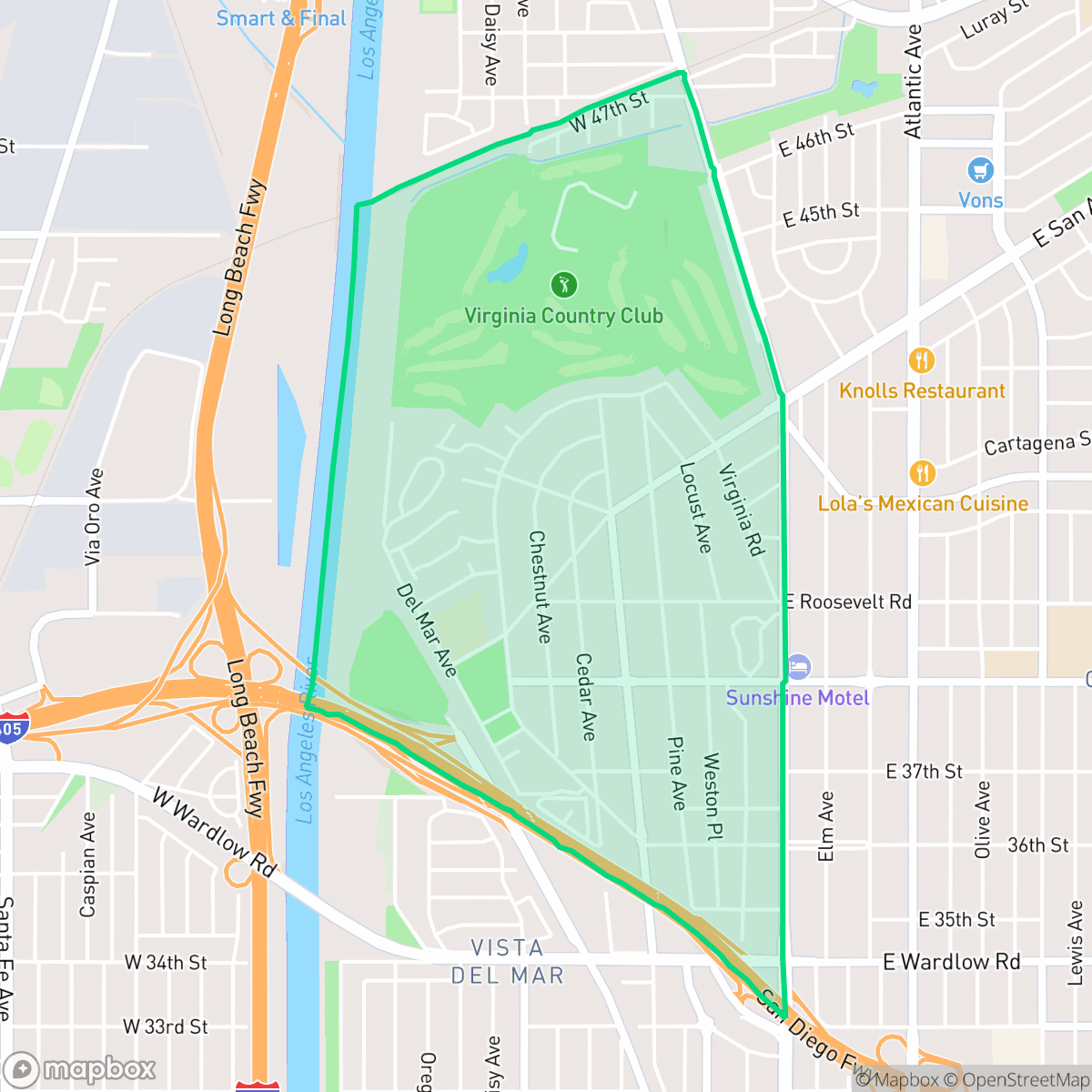
Established in 1906, the Los Cerritos neighborhood of Long Beach evolved from the historic 27,000-acre Rancho Los Cerritos. Centered around the landmark 1844 Monterey-style adobe ranch house, the community grew as a residential tract adjacent to the Virginia Country Club. The neighborhood faced a temporary decline in the 1920s when oil drilling rigs from nearby Signal Hill encroached on the area, but it rebounded in the 1930s following a ban on local drilling. Los Cerritos is highly regarded for its estate-sized homes designed by prominent architects, including Kirtland Cutter, Greene and Greene, and Edward Killingsworth. It also features La Linda Drive, one of Long Beach's oldest gated communities. The neighborhood's picturesque, tree-lined streets have frequently served as filming locations for major Hollywood films, including *Ferris Bueller's Day Off* and *Donnie Darko*.
The neighborhood maintains a dense suburban character, balancing large, estate-sized residential lots with accessible public green spaces. According to current data, the area features a highly connected sidewalk network, making it one of the more walkable residential zones in the city. Families are well-served by the local Los Cerritos Elementary school, which holds a high rating. The visual appeal of the area is bolstered by well-manicured backyards and private amenities, while the wide parkway verges between sidewalks and streets provide a welcoming environment for dog owners and pedestrians alike.
Prospective residents should consider the acoustic environment, as the neighborhood records an average noise level of 59 decibels, largely attributed to road traffic and nearby logistics activity. While the interior of the residential blocks remains quiet, the proximity to industrial zones and rail lines is a notable factor. The area is best suited for those who prioritize architectural character and walkability within a suburban setting, provided they are comfortable with the typical noise profile of a city that blends residential life with active logistics infrastructure.
Neighborhood Scores Across 15 Qualities
Residential spacing varies from dense townhouse clusters with shared walls to standard suburban lots. According to iHuus data, this level of separation provides more privacy than the typical Long Beach neighborhood.
A consistent grid of sidewalks and marked crosswalks facilitates easy pedestrian movement through residential streets. While major arterials and the nearby freeway create some navigation barriers, the network remains slightly below the Long Beach average for overall connectivity.
Property aesthetics are slightly above the Long Beach average due to a prevalence of large homes, private swimming pools, and well-maintained landscapes. While some areas feature standard tract housing, many residential pockets offer spacious yards and premium amenities according to iHuus data.
Access to dog walking areas varies by block, as some sections feature wide green parkways while others rely on private yards. According to iHuus data, the presence of nearby golf courses and athletic fields provides more green space than is typically found in other parts of Long Beach.
Open land and scattered greenery are more prevalent here than in much of Long Beach. This creates a landscape that feels less densely urban than the city average, featuring a mix of residential pockets and large-scale utility or commercial sites.
Local activity is slightly below the Long Beach average, characterized by a mix of quiet residential streets and specific social pockets anchored by local eateries and parks. While some areas near major transit corridors feature industrial landscapes with few services, other blocks offer a balanced blend of green space and accessible dining.
Frequent traffic and transit noise from nearby freeways and railroad tracks characterizes this area. Acoustic comfort levels are notably lower than the Long Beach average, according to iHuus data.
Air quality remains consistently good with only rare instances of elevated readings. According to iHuus data, the atmosphere here is slightly below the Long Beach city average.
Minimal heavy industry is present throughout most of the area, though some residents near the southern edges may encounter noise from nearby logistics hubs and warehouses. This level of industrial separation is slightly better than the Long Beach average according to iHuus data.
Health insurance accessibility is notably higher than the Long Beach average, according to iHuus data. Most residents in this area have access to comprehensive medical coverage.
Voting patterns and census indicators show a highly liberal leaning that is even more pronounced than the Long Beach average, according to iHuus data.
Residents will find a balanced mix of young adults, families, and older individuals, representing a slightly more varied demographic spread than the Long Beach average.
Residual flood risk exists within certain parts of this area, though overall safety levels remain significantly higher than the Long Beach average according to iHuus data.
Address-Level Insights for Los Cerritos Area


iHuus Neighborhood Intelligence Insights
Get address-level neighborhood insights for Los Cerritos Area
- Street-level scores — see how individual blocks compare, not just neighborhood averages
- Micro-zone boundaries — identify quiet pockets, flood boundaries, and walkable clusters before you visit
- 15 dimensions in full — walkability, noise, air quality, school quality, insurance coverage, population age profile, urban/rural index, and more
- Boundary risk alerts — know if your address sits near a block boundary where scores drop, the kind of detail no listing will ever mention
- School insights — individual school ratings and insights, not just district-level data
- Compare before you commit — side-by-side data across neighborhoods, down to block precision
No credit card required
Compare with Any Neighborhood
| Dimension | Los Cerritos Area | Airport Area |
|---|---|---|
| 🚶 Walkabilityavg 9.37 | ||
| 🔊 Acoustic Comfortavg 3.04 | ||
| 🤫 Privacy Indexavg 3.63 | ||
| 🎨 Visual Appealavg 6.3 | ||
| 🐕 Dog Friendlinessavg 5.35 | ||
| 🗺️ Urban-Rural Indexavg 6 | ||
| ✨ Neighborhood Vibeavg 5.01 | ||
| 🏥 Health Insurance Coverageavg 6.4 | ||
| 🌿 Air Qualityavg 8.69 | ||
| 🏭 Industrial Proximityavg 8.14 | ||
| 🌊 Flood Safetyavg 3.75 | ||
| 🗳️ Ideological Leanavg 9.2 | ||
| 👥 Population Age Profileavg 4.81 | ||
| 🔥 Fire Safety | ||
| 🏫 School Quality |
Los Cerritos Area Rankings
School Districts Serving Los Cerritos Area
School Insights for Los Cerritos Area
Below average outcomes; significant attendance and academic challenges.
School Insights
See what's really behind every school rating near Los Cerritos Area
- Individual school ratings — each school's own score with outcome context, not just a district average
- Enrollment & class size data — student-to-teacher ratio and how it compares to the state average
- Full demographics breakdown — ethnicity and gender composition for every school in the enrollment zone
- Every school in the district — all schools within the enrollment boundary ranked by rating, not just the closest one
- Grade levels & benchmarks — elementary through high school, with below/above state-average flags
No credit card required