Los Altos, Long Beach
Updated · 10,397 residents
Los Altos is a highly walkable, post-war suburban neighborhood in eastern Long Beach characterized by its mid-century architecture and quiet residential streets. While the area provides excellent air quality and access to top-rated elementary schools, residents should expect notable road traffic noise and limited public green space.
Key Highlights
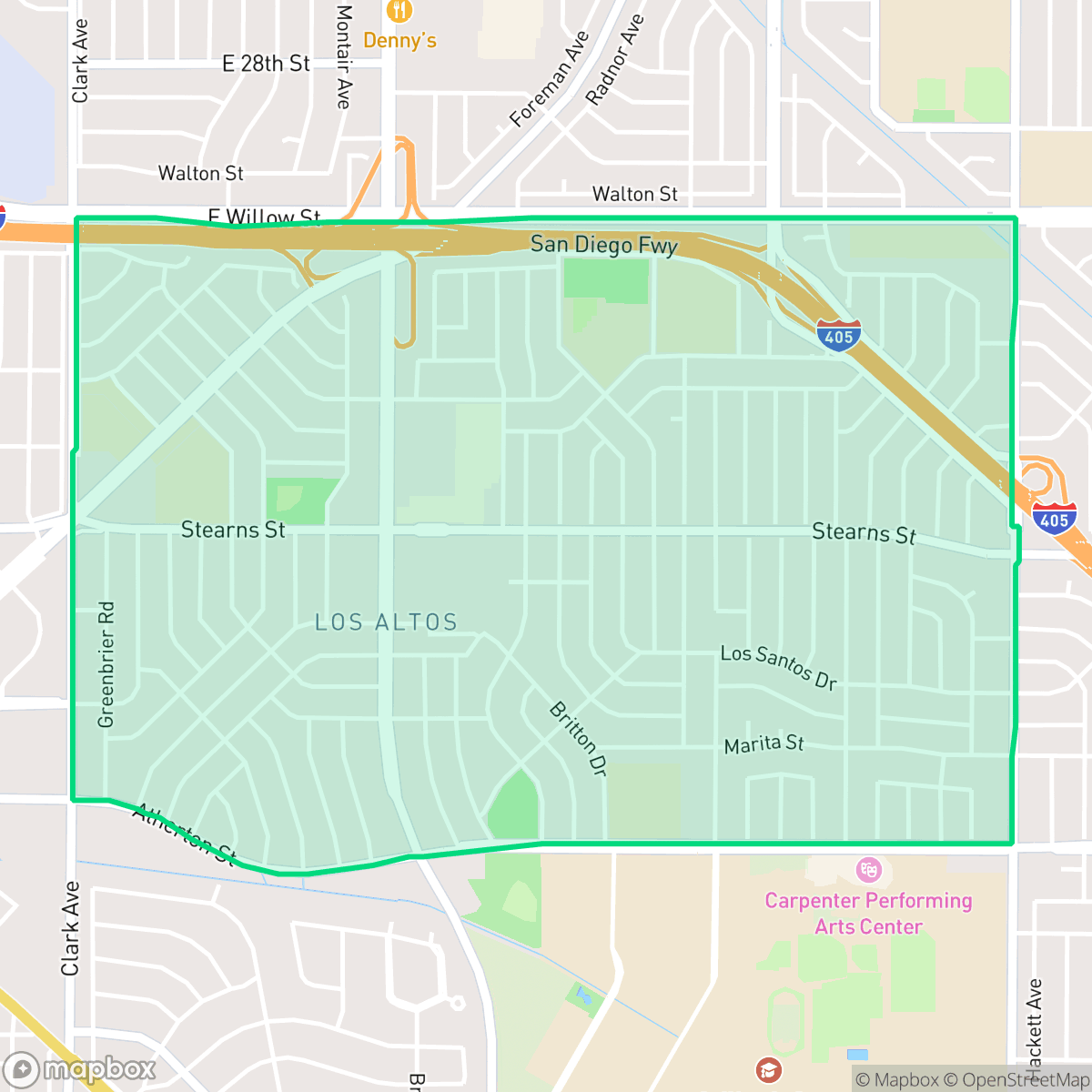
About Los Altos
Developed beginning in 1945 by Lloyd S. Whaley, Los Altos in eastern Long Beach was one of the nation's first planned, post-World War II communities. Whaley purchased the marshy land, then known as "Alkali Flats" due to its highly alkaline soil, from Susanna Bixby Bryant. Utilizing the GI Bill, the tract development accommodated returning military families with homes designed by local architects Richard L. Poper and William Lockett. These traditional and mid-century modern residences were divided by Bellflower Boulevard into Los Altos Terrace and Los Altos Manor. Whaley intentionally integrated family-centric infrastructure, donating land for Whaley Park and naming Britton Drive after Long Beach-born actress Barbara Britton. The neighborhood also features the mid-century Los Altos Neighborhood Library, which opened in 1957.
The neighborhood functions as a dense suburban grid that prioritizes residential comfort and pedestrian access. With consistent sidewalks spanning both residential and commercial corridors, it is easy for residents to navigate the area on foot. The landscape is defined by manicured lawns, private backyard pools, and a mix of traditional and mid-century modern homes. According to iHuus data, the area maintains high levels of health insurance coverage and enjoys clean air, free from industrial hazards or large-scale warehousing.
Living here involves balancing suburban convenience with specific environmental trade-offs. The proximity to major thoroughfares results in elevated road noise, which may impact acoustic comfort for some households. While the neighborhood is well-suited for families seeking access to high-performing schools such as Gant and Prisk Elementary, pet owners may find the lack of large public parks and the reliance on private yards to be a limitation. The overall environment remains steady and quiet, providing a predictable rhythm for those who value a structured, established community.
Neighborhood Scores Across 15 Qualities
Residential spacing provides more separation between neighbors than the Long Beach average. Homes are typically detached with small yards, though some higher density areas feature closer proximity between structures.
Extensive sidewalk networks and marked crosswalks are present on nearly all residential and commercial streets. This level of pedestrian infrastructure is even more comprehensive than the average found throughout Long Beach.
Well-maintained landscapes, private backyard pools, and large homes characterize this area, offering a more polished aesthetic than the Long Beach average. According to iHuus data, the neighborhood features spacious driveways and frequent upscale amenities throughout the residential blocks.
Walking options for pets vary across the area, as some streets feature narrow grass verges while other sections offer direct access to large public parks. According to iHuus data, the availability of shared green space in this neighborhood is consistent with the Long Beach average.
Residential layouts feature a dense suburban pattern with significant tree canopy and single-family homes, presenting a slightly more open landscape than the Long Beach average.
Quiet residential streets and green spaces are interspersed with occasional lively blocks and various dining options. This level of activity is slightly higher than the Long Beach average, offering a mix of serene suburban life and accessible local amenities.
Frequent noise from nearby freeway proximity and railroad corridors makes this area louder than the Long Beach average. Residents may experience consistent auditory disturbances from heavy transit patterns, according to iHuus data.
Air quality is consistently high with very few health concerns. According to iHuus data, the atmosphere in Los Altos remains notably cleaner than the Long Beach city average.
Industrial activity and heavy warehousing are notably absent from this area, which offers a landscape of residential streets and light commercial use. According to iHuus data, the neighborhood lacks the industrial footprints and hazardous sites found more frequently elsewhere in Long Beach.
Health insurance enrollment is exceptionally high among residents, significantly outpacing the Long Beach average according to iHuus data.
Political leanings in this area trend liberal, though the neighborhood shows slightly less progressive density than the Long Beach average according to iHuus data.
Residents live alongside a balanced mix of young professionals, families, and seniors. According to iHuus data, this age distribution is slightly more varied than the average found across Long Beach.
Residual flood risk exists within this area due to its location in a 500-year floodplain, though safety levels remain significantly higher than the Long Beach average according to iHuus data.
Address-Level Insights for Los Altos


iHuus Neighborhood Intelligence Insights
Get address-level neighborhood insights for Los Altos
- Street-level scores — see how individual blocks compare, not just neighborhood averages
- Micro-zone boundaries — identify quiet pockets, flood boundaries, and walkable clusters before you visit
- 15 dimensions in full — walkability, noise, air quality, school quality, insurance coverage, population age profile, urban/rural index, and more
- Boundary risk alerts — know if your address sits near a block boundary where scores drop, the kind of detail no listing will ever mention
- School insights — individual school ratings and insights, not just district-level data
- Compare before you commit — side-by-side data across neighborhoods, down to block precision
No credit card required
Compare with Any Neighborhood
| Dimension | Los Altos | Airport Area |
|---|---|---|
| 🚶 Walkabilityavg 9.37 | ||
| 🔊 Acoustic Comfortavg 3.04 | ||
| 🤫 Privacy Indexavg 3.63 | ||
| 🎨 Visual Appealavg 6.3 | ||
| 🐕 Dog Friendlinessavg 5.35 | ||
| 🗺️ Urban-Rural Indexavg 6 | ||
| ✨ Neighborhood Vibeavg 5.01 | ||
| 🏥 Health Insurance Coverageavg 6.4 | ||
| 🌿 Air Qualityavg 8.69 | ||
| 🏭 Industrial Proximityavg 8.14 | ||
| 🌊 Flood Safetyavg 3.75 | ||
| 🗳️ Ideological Leanavg 9.2 | ||
| 👥 Population Age Profileavg 4.81 | ||
| 🔥 Fire Safety | ||
| 🏫 School Quality |
Los Altos Rankings
School Districts Serving Los Altos
School Insights for Los Altos
Below average outcomes; significant attendance and academic challenges.
School Insights
See what's really behind every school rating near Los Altos
- Individual school ratings — each school's own score with outcome context, not just a district average
- Enrollment & class size data — student-to-teacher ratio and how it compares to the state average
- Full demographics breakdown — ethnicity and gender composition for every school in the enrollment zone
- Every school in the district — all schools within the enrollment boundary ranked by rating, not just the closest one
- Grade levels & benchmarks — elementary through high school, with below/above state-average flags
No credit card required