Lakewood Village, Long Beach
Updated · 5,935 residents
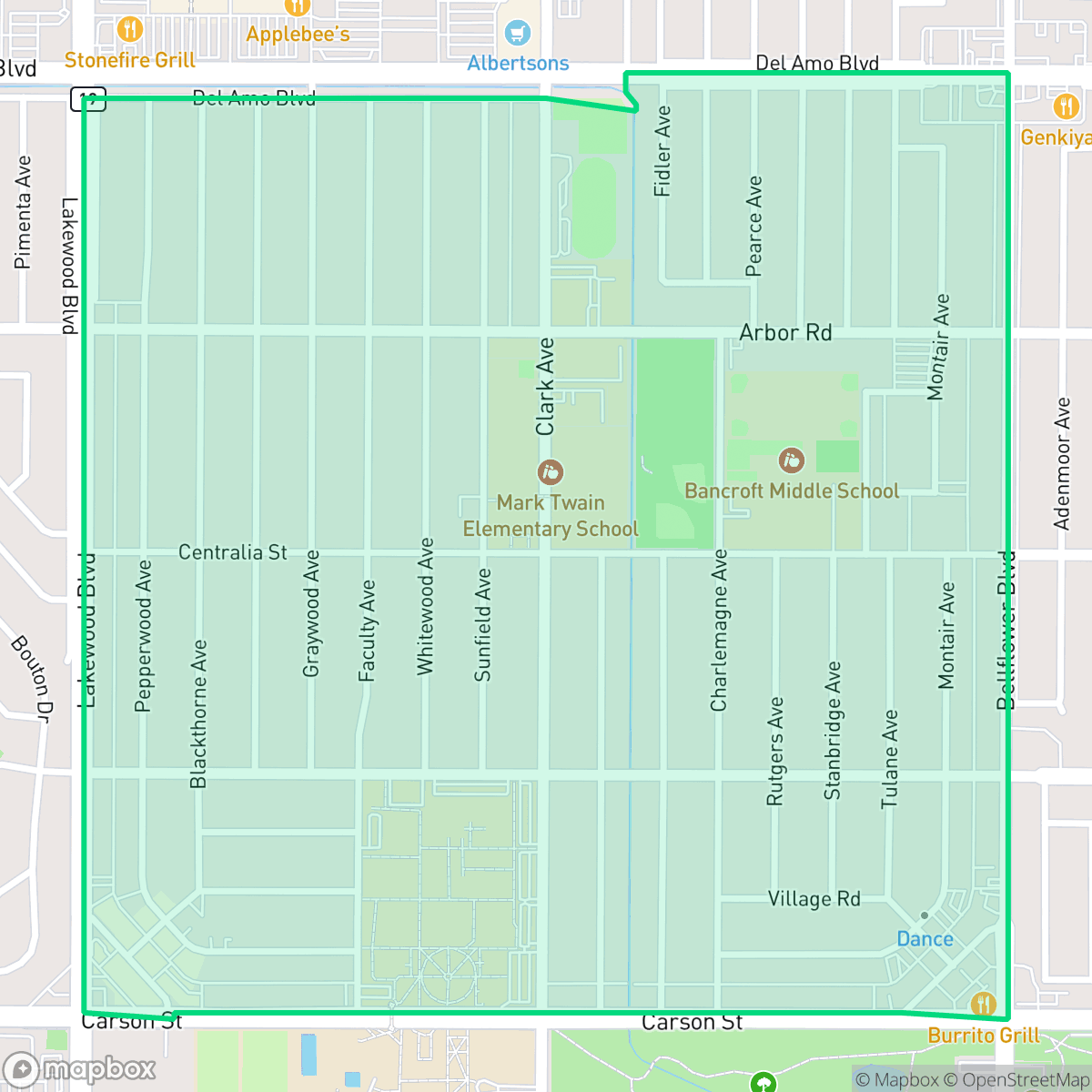
Lakewood Village is a highly walkable, residential neighborhood in northeast Long Beach known for its quiet, tree-lined streets and proximity to local parks. While the area offers a strong sense of community and dog-friendly spaces, residents should expect moderate noise levels primarily driven by local road traffic.
Key Highlights
About Lakewood Village
Developed on former Rancho Los Cerritos land acquired by the Montana Land Company, Lakewood Village in northeast Long Beach was planned in 1928 around a golf course to spur home sales during the Great Depression. Marketed as "semi-sustaining" small farms, early construction featured a 1934 model "Honeymoon Cottage" designed by famed architect Wallace Neff. The neighborhood experienced rapid growth during World War II, when homes and the 1941 Norse Way shopping center were built to support workers at the nearby Douglas Aircraft Company defense plant. In August 1953, Lakewood Village residents voted by a slim 79-vote margin to be annexed by Long Beach. This pivotal decision directly motivated surrounding unincorporated neighborhoods to incorporate as the independent City of Lakewood in 1954 to avoid further annexation.
The current character of the area is defined by a suburban layout that balances residential blocks with accessible green space. It is a highly walkable neighborhood where residents have easy access to community hubs like Pan American Park and various neighborhood-serving businesses. The visual appeal is consistently high, characterized by well-maintained streets and a lack of industrial encroachment, making it a stable environment for those seeking a traditional suburban lifestyle. According to iHuus data, the area maintains a distinct residential identity that separates it from the more commercialized sectors of Long Beach.
Living here involves certain trade-offs, particularly regarding noise levels from road traffic, which are slightly above the city average. While the neighborhood provides a high degree of privacy and excellent dog-friendliness, prospective residents should note the local school district's current fiscal challenges and the specific flood and fire risk profiles. The area is best suited for individuals or families who prioritize walkability and an established community atmosphere over proximity to major commercial centers.
Neighborhood Scores Across 15 Qualities
Homes in this area feature a moderate level of separation, providing more personal buffer than the Long Beach average. Residential structures are typically spaced with moderate density, offering a balance between suburban seclusion and standard neighborhood proximity according to iHuus data.
Pedestrian access is excellent due to a grid of tree-lined sidewalks and clear crosswalks on both residential and arterial streets. This connectivity is even more comprehensive than the average for Long Beach, according to iHuus data.
Spacious homes and frequent private pools contribute to a visual landscape that is more upscale than the Long Beach average. According to iHuus data, the area features large, well-maintained properties and premium amenities.
Abundant green spaces, including nearby golf courses and athletic fields, offer significantly more pet-friendly walking opportunities than the Long Beach average. Continuous sidewalks and wide street verges provide many safe routes for exercise, according to iHuus data.
Residential layouts consist of dense suburban housing tracts and commercial zones, providing slightly more open land than the Long Beach average according to iHuus data.
A mix of quiet, residential streets and accessible dining options provides a livelier atmosphere than the Long Beach average. While some blocks offer walkable access to cafes and eateries, other areas remain primarily suburban with fewer amenities within walking distance.
Frequent noise from nearby major freeways and rail lines characterizes the area. This level of acoustic disturbance is slightly higher than the Long Beach average, according to iHuus data.
Air quality remains consistently good with infrequent periods of elevated readings, though it sits slightly below the Long Beach average according to iHuus data.
Heavy industrial activity and large warehouses are absent from this area. According to iHuus data, this neighborhood offers a much higher level of separation from industrial hazards than the Long Beach average.
Health insurance accessibility is notably higher than the Long Beach average, according to iHuus data. Most residents in this area have access to medical coverage.
Political leanings in this area are predominantly liberal, though the community is slightly less progressive than the broader Long Beach average according to iHuus data.
Residents experience a balanced demographic mix of young adults, families, and seniors. This age distribution is consistent with the broader Long Beach area according to iHuus data.
Flood risk in this area is higher than the Long Beach average, though specific risk levels remain undetermined due to a lack of detailed FEMA studies. Residents should exercise standard precautions as the local terrain carries a moderate level of uncertainty regarding flood susceptibility.
Address-Level Insights for Lakewood Village


iHuus Neighborhood Intelligence Insights
Get address-level neighborhood insights for Lakewood Village
- Street-level scores — see how individual blocks compare, not just neighborhood averages
- Micro-zone boundaries — identify quiet pockets, flood boundaries, and walkable clusters before you visit
- 15 dimensions in full — walkability, noise, air quality, school quality, insurance coverage, population age profile, urban/rural index, and more
- Boundary risk alerts — know if your address sits near a block boundary where scores drop, the kind of detail no listing will ever mention
- School insights — individual school ratings and insights, not just district-level data
- Compare before you commit — side-by-side data across neighborhoods, down to block precision
No credit card required
Compare with Any Neighborhood
| Dimension | Lakewood Village | Airport Area |
|---|---|---|
| 🚶 Walkabilityavg 9.37 | ||
| 🔊 Acoustic Comfortavg 3.04 | ||
| 🤫 Privacy Indexavg 3.63 | ||
| 🎨 Visual Appealavg 6.3 | ||
| 🐕 Dog Friendlinessavg 5.35 | ||
| 🗺️ Urban-Rural Indexavg 6 | ||
| ✨ Neighborhood Vibeavg 5.01 | ||
| 🏥 Health Insurance Coverageavg 6.4 | ||
| 🌿 Air Qualityavg 8.69 | ||
| 🏭 Industrial Proximityavg 8.14 | ||
| 🌊 Flood Safetyavg 3.75 | ||
| 🗳️ Ideological Leanavg 9.2 | ||
| 👥 Population Age Profileavg 4.81 | ||
| 🔥 Fire Safety | ||
| 🏫 School Quality |
Lakewood Village Rankings
School Districts Serving Lakewood Village
School Insights for Lakewood Village
Below average outcomes; significant attendance and academic challenges.
School Insights
See what's really behind every school rating near Lakewood Village
- Individual school ratings — each school's own score with outcome context, not just a district average
- Enrollment & class size data — student-to-teacher ratio and how it compares to the state average
- Full demographics breakdown — ethnicity and gender composition for every school in the enrollment zone
- Every school in the district — all schools within the enrollment boundary ranked by rating, not just the closest one
- Grade levels & benchmarks — elementary through high school, with below/above state-average flags
No credit card required