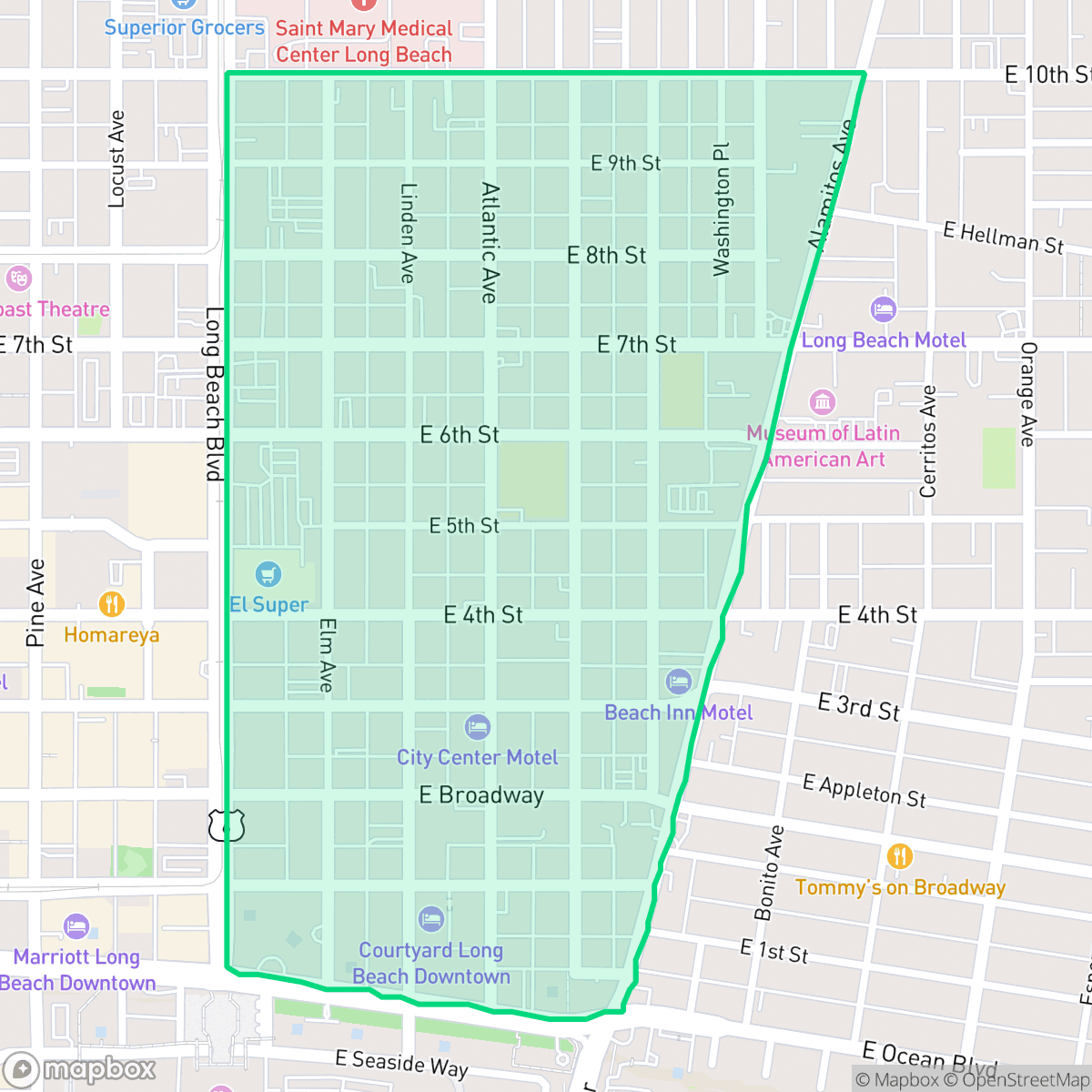
East Village, Long Beach
Updated · 10,635 residents
The East Village Arts District is a high-energy urban hub characterized by its dense, walkable grid and diverse local dining scene. Residents enjoy immediate access to cultural landmarks and a vibrant street life, though the area is defined by its compact, high-density residential buildings and significant road traffic noise.
Key Highlights
About East Village
The East Village Arts District in Long Beach, California, has a rich cultural history rooted in the early 20th century. Its identity as an arts center began after World War I when expatriate James Savery established the Wayside Art Colony, and the California Motion Picture Manufacturing Company operated nearby. Today, the neighborhood is celebrated as a "living dictionary" of architectural styles, showcasing a diverse mix of Art Deco, Renaissance Revival, Mid-Century Modern, and Streamline Moderne buildings. Notable historic landmarks include the 1923 Renaissance Revival Cooper Arms building and the Lafayette Complex. The neighborhood’s creative legacy continues through its thriving arts scene, anchored by the Museum of Latin American Art (MOLAA), local galleries, independent boutiques, and the popular monthly Second Saturday Art Walk.
The neighborhood serves as a dense, high-energy urban center where residents benefit from perfect walkability and a lack of nearby industrial activity. The landscape is dominated by multi-unit housing and commercial corridors, creating an environment where daily errands and social outings are easily accomplished on foot. While the area offers excellent air quality and a lively cultural atmosphere, the high-density layout results in limited privacy and minimal green space, making it a better fit for those prioritizing urban convenience over suburban seclusion. Living here involves navigating the realities of a bustling city environment, including consistent road traffic noise and a lack of private outdoor areas. Prospective residents should consider that the local school district is currently managing significant fiscal constraints, which may impact neighborhood school resources. According to iHuus data, the area is best suited for individuals or couples who value immediate access to amenities and a fast-paced, central location rather than families seeking traditional suburban amenities or quiet residential streets.
Neighborhood Scores Across 15 Qualities
Residential structures in this area are often adjacent or share walls with minimal separation between windows and neighbors. This level of density results in a lower privacy index compared to the Long Beach average, according to iHuus data.
Continuous sidewalks and clearly marked crosswalks exist on nearly every street, making pedestrian travel easier here than in most of Long Beach. A complete grid of well-defined paths and pedestrian-priority zones near the waterfront supports effortless navigation on foot.
Viewscapes consist primarily of mid-density apartment complexes and modest tract housing with limited private greenery. This area presents a slightly less varied visual landscape than the Long Beach average, characterized by functional rooftops and shared urban amenities.
Dense urban infrastructure and minimal sidewalk verges make finding open grass areas difficult. According to iHuus data, the availability of public parks and green spaces is below the Long Beach average.
High-density buildings and significant grey infrastructure dominate this area, making it notably more urban than the Long Beach average. According to iHuus data, the landscape consists primarily of multi-story structures and large commercial blocks with very little open green space.
Constant movement and dense commercial activity characterize this area, offering a significantly more active atmosphere than the Long Beach average. According to iHuus data, the landscape features a high concentration of diverse dining and social hubs within a concrete-dominant urban setting.
Frequent noise from nearby railroad tracks and major freeways characterizes the area. This level of acoustic disturbance is slightly higher than the Long Beach average, according to iHuus data.
Air quality in this area is exceptionally high, remaining significantly cleaner than the Long Beach average. Residents can expect minimal exposure to pollutants or health-related concerns related to air quality.
Residential and recreational uses dominate the area with no detectable heavy industrial hazards or large scale warehouses. According to iHuus data, this absence of industrial proximity is even more pronounced than the Long Beach average.
Health insurance coverage is significantly lower than the Long Beach average, according to iHuus data. Residents may face greater challenges accessing employer-sponsored or private healthcare plans within this area.
Voting patterns and census indicators reflect a highly progressive political landscape that is even more pronounced than the Long Beach average, according to iHuus data.
A balanced mix of young adults, families, and older residents characterizes the area. This demographic distribution is slightly lower than the Long Beach average, according to iHuus data.
Located within a designated floodplain, this area carries a significantly higher risk of flooding than most of Long Beach. Residents should be aware that flood insurance is typically required for properties here according to iHuus data.
Address-Level Insights for East Village


iHuus Neighborhood Intelligence Insights
Get address-level neighborhood insights for East Village
- Street-level scores — see how individual blocks compare, not just neighborhood averages
- Micro-zone boundaries — identify quiet pockets, flood boundaries, and walkable clusters before you visit
- 15 dimensions in full — walkability, noise, air quality, school quality, insurance coverage, population age profile, urban/rural index, and more
- Boundary risk alerts — know if your address sits near a block boundary where scores drop, the kind of detail no listing will ever mention
- School insights — individual school ratings and insights, not just district-level data
- Compare before you commit — side-by-side data across neighborhoods, down to block precision
No credit card required
Compare with Any Neighborhood
| Dimension | East Village | Airport Area |
|---|---|---|
| 🚶 Walkabilityavg 9.37 | ||
| 🔊 Acoustic Comfortavg 3.04 | ||
| 🤫 Privacy Indexavg 3.63 | ||
| 🎨 Visual Appealavg 6.3 | ||
| 🐕 Dog Friendlinessavg 5.35 | ||
| 🗺️ Urban-Rural Indexavg 6 | ||
| ✨ Neighborhood Vibeavg 5.01 | ||
| 🏥 Health Insurance Coverageavg 6.4 | ||
| 🌿 Air Qualityavg 8.69 | ||
| 🏭 Industrial Proximityavg 8.14 | ||
| 🌊 Flood Safetyavg 3.75 | ||
| 🗳️ Ideological Leanavg 9.2 | ||
| 👥 Population Age Profileavg 4.81 | ||
| 🔥 Fire Safety | ||
| 🏫 School Quality |
East Village Rankings
School Districts Serving East Village
School Insights for East Village
Below average outcomes; significant attendance and academic challenges.
School Insights
See what's really behind every school rating near East Village
- Individual school ratings — each school's own score with outcome context, not just a district average
- Enrollment & class size data — student-to-teacher ratio and how it compares to the state average
- Full demographics breakdown — ethnicity and gender composition for every school in the enrollment zone
- Every school in the district — all schools within the enrollment boundary ranked by rating, not just the closest one
- Grade levels & benchmarks — elementary through high school, with below/above state-average flags
No credit card required