East Side, Long Beach
Updated · 13,815 residents
The East Side of Long Beach is a highly walkable urban neighborhood defined by its dense residential grid and diverse culinary scene. While residents benefit from excellent air quality and immediate access to city amenities, the area is characterized by tightly packed housing and limited private outdoor space.
Key Highlights
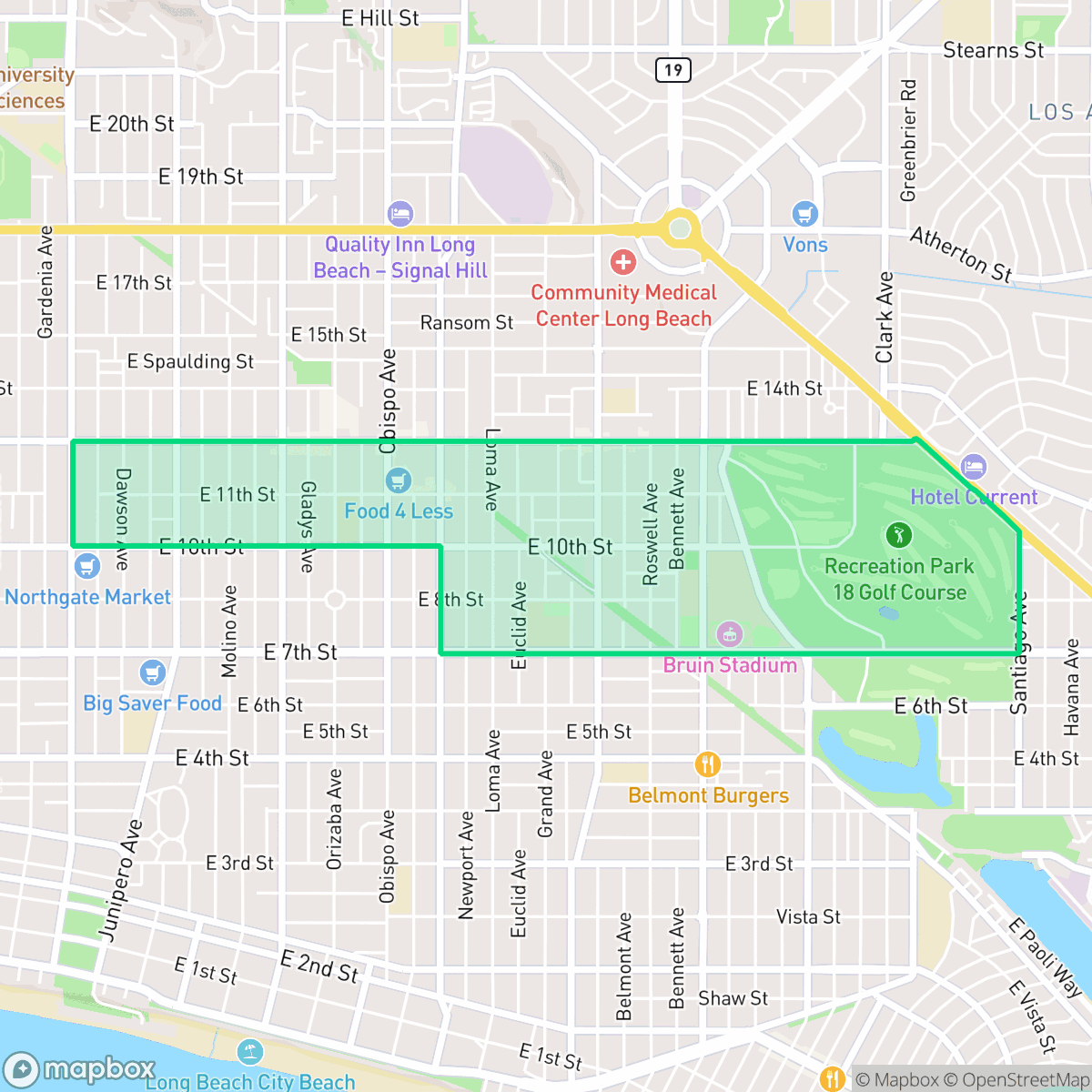
About East Side
The Eastside (or East Long Beach) neighborhood of Long Beach, California, traces its origins to the early 20th-century settlement of Zaferia, which began as a small village of Mexican farmhands working at Rancho Los Alamitos. In 1904, Henry Huntington established the Pacific Electric Railway's Newport Beach line with a depot at Anaheim Road and Redondo Avenue, naming it Zaferia Station. This transit link spurred a rapid transition from rural truck farms to a bustling commercial hub. Officially annexed into Long Beach on Labor Day in 1920, the neighborhood evolved into a diverse cultural hub. In the mid-20th century, it became a focal point for African American civil rights activism. Following the 1970s, an influx of Cambodian refugees fleeing the Khmer Rouge transformed the area, leading to the official designation of Cambodia Town along Anaheim Street in 2007.
This neighborhood serves as a central urban hub in Long Beach, featuring a robust grid of sidewalks that makes it exceptionally walkable for daily errands and commuting. The area maintains a lively atmosphere with a wide variety of dining options, ranging from local cafes to international eateries that reflect the cultural diversity of the region. Residents enjoy high air quality and a strong sense of connectivity, as the dense layout places essential services and social spots within easy reach of most homes.
Prospective residents should note that the high-density environment results in limited privacy, with many homes sharing walls or situated in close proximity to one another. While the area offers urban convenience, it features minimal green space for pets and experiences moderate noise levels from local road traffic. Families should consider the current operational climate of the local school district, which is navigating fiscal adjustments, alongside the neighborhood's overall urban profile that prioritizes accessibility and central positioning over suburban seclusion.
Neighborhood Scores Across 15 Qualities
Residential structures are tightly packed with minimal separation between properties; according to iHuus data, this lack of distance is more pronounced than in the rest of Long Beach.
A complete grid of sidewalks and frequent pedestrian crossings makes navigating the area on foot exceptionally easy. This level of connectivity is even higher than the Long Beach average, providing seamless access through both residential and commercial zones.
Standard tract housing and apartment blocks characterize the area, offering a modest level of greenery that is slightly below the Long Beach average. While some pockets near the golf course feature larger homes and private pools, much of the neighborhood consists of uniform, densely packed urban structures.
Access to large public parks and golf course green spaces provides ample area for pet owners. According to iHuus data, the availability of walkable green verges is slightly higher than the Long Beach average.
Residential streets and green spaces exist in roughly equal measure, offering a layout very similar to the Long Beach average. Residents will find a mix of single-family homes, multi-story apartments, and commercial corridors distributed throughout the area.
Social activity and dining options are notably more concentrated here than in the rest of Long Beach. Residents can access a variety of local cafes and eateries, though many areas remain suburban in character with limited walking access to businesses.
Steady sounds from nearby busy streets are present, though acoustic levels are notably more tranquil than the Long Beach city average according to iHuus data.
Air quality is consistently high with minimal health concerns. This level of air purity is notably better than the Long Beach average, according to iHuus data.
Residential and light commercial uses predominate the landscape, with no significant heavy industrial hazards or large-scale manufacturing visible. This level of industrial separation is consistent with the average for Long Beach.
Health insurance access is notably lower in this area compared to the Long Beach average, according to iHuus data. Residents may face more challenges accessing employer-sponsored or private coverage than those living in other parts of the city.
Voting patterns and census indicators show a predominantly liberal political leaning that is more pronounced than the Long Beach city average, according to iHuus data.
Residents live alongside a balanced mix of young adults, families, and seniors. This demographic spread is slightly lower than the average seen across Long Beach, according to iHuus data.
Significant flood risk exists here because parts of the neighborhood fall within a designated floodplain. According to iHuus data, this level of risk is notably higher than the Long Beach average and may necessitate flood insurance.
Address-Level Insights for East Side


iHuus Neighborhood Intelligence Insights
Get address-level neighborhood insights for East Side
- Street-level scores — see how individual blocks compare, not just neighborhood averages
- Micro-zone boundaries — identify quiet pockets, flood boundaries, and walkable clusters before you visit
- 15 dimensions in full — walkability, noise, air quality, school quality, insurance coverage, population age profile, urban/rural index, and more
- Boundary risk alerts — know if your address sits near a block boundary where scores drop, the kind of detail no listing will ever mention
- School insights — individual school ratings and insights, not just district-level data
- Compare before you commit — side-by-side data across neighborhoods, down to block precision
No credit card required
Compare with Any Neighborhood
| Dimension | East Side | Airport Area |
|---|---|---|
| 🚶 Walkabilityavg 9.37 | ||
| 🔊 Acoustic Comfortavg 3.04 | ||
| 🤫 Privacy Indexavg 3.63 | ||
| 🎨 Visual Appealavg 6.3 | ||
| 🐕 Dog Friendlinessavg 5.35 | ||
| 🗺️ Urban-Rural Indexavg 6 | ||
| ✨ Neighborhood Vibeavg 5.01 | ||
| 🏥 Health Insurance Coverageavg 6.4 | ||
| 🌿 Air Qualityavg 8.69 | ||
| 🏭 Industrial Proximityavg 8.14 | ||
| 🌊 Flood Safetyavg 3.75 | ||
| 🗳️ Ideological Leanavg 9.2 | ||
| 👥 Population Age Profileavg 4.81 | ||
| 🔥 Fire Safety | ||
| 🏫 School Quality |
East Side Rankings
School Districts Serving East Side
School Insights for East Side
Below average outcomes; significant attendance and academic challenges.
School Insights
See what's really behind every school rating near East Side
- Individual school ratings — each school's own score with outcome context, not just a district average
- Enrollment & class size data — student-to-teacher ratio and how it compares to the state average
- Full demographics breakdown — ethnicity and gender composition for every school in the enrollment zone
- Every school in the district — all schools within the enrollment boundary ranked by rating, not just the closest one
- Grade levels & benchmarks — elementary through high school, with below/above state-average flags
No credit card required