Downtown, Long Beach
Updated · 13,411 residents
Downtown Long Beach serves as the city's vibrant urban core, defined by a high-energy atmosphere, a dense architectural landscape, and exceptional walkability. Residents enjoy immediate access to coastal amenities and a diverse social scene, though the area is characterized by significant ambient noise and a highly compact, urban living environment.
Key Highlights
About Downtown
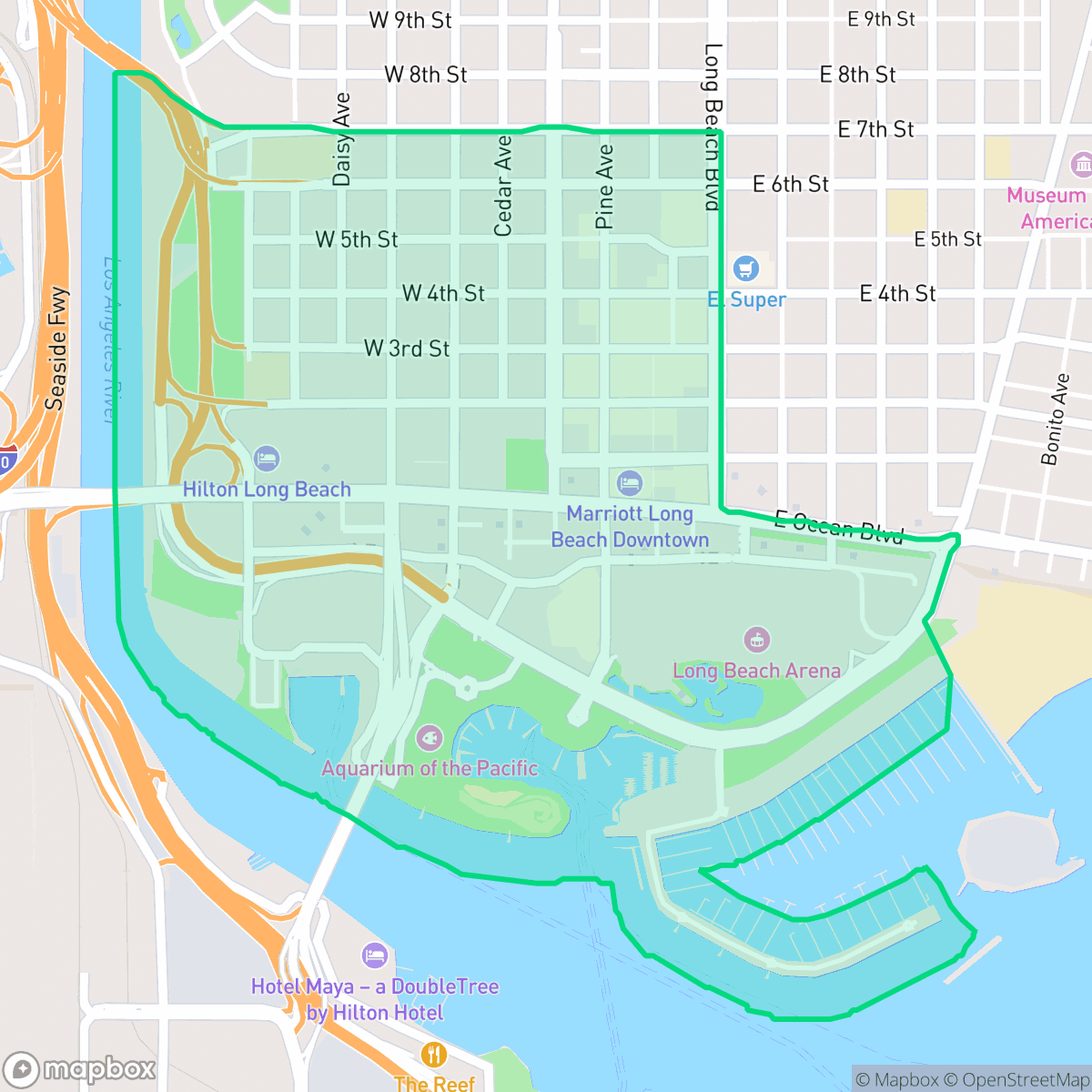
Downtown Long Beach, originally founded as Willmore City in 1882, evolved from a seaside resort into a bustling commercial hub fueled by the 1920s oil boom. A defining moment in its history was the 1933 Long Beach earthquake, which necessitated a massive reconstruction effort, resulting in the neighborhood's distinctive concentration of Art Deco and Streamline Moderne architecture, including landmarks like the Villa Riviera and the Breakers Hotel. Pine Avenue remains the neighborhood’s historic commercial spine, while the area south of Ocean Boulevard features significant land reclamation projects from the late 20th century, such as the Downtown Shoreline. Once a silent film production center and a prominent naval hub, Downtown Long Beach today retains its maritime character while serving as a revitalized urban and cultural heart of the city.
This neighborhood functions as the primary hub for commerce and entertainment, offering a dense, pedestrian-friendly grid that connects residents to the waterfront and major cultural venues. The area maintains a progressive social environment and benefits from consistently clean air, making it a focal point for those seeking an active lifestyle with minimal reliance on personal vehicles. The landscape is dominated by multi-unit housing and high-rise developments, fostering a lively, social atmosphere that stands out for its high density of dining and recreational options.
Prospective residents should account for the trade-offs of such a central location, including a high level of ambient noise from nearby transit corridors and a lack of private outdoor space. The area faces notable flood risks due to its coastal position and requires careful consideration of the local school district, which is currently navigating significant fiscal challenges. It is best suited for individuals or households who prioritize accessibility and urban engagement over quiet, suburban privacy.
Neighborhood Scores Across 15 Qualities
Dense urban layouts and shared walls result in very low privacy levels compared to the city average. Residents should expect close proximity to neighbors due to buildings being separated by narrow alleys or shared structures.
Extensive sidewalk networks and marked crosswalks make navigating the area on foot easy. This level of connectivity is slightly above the Long Beach average, particularly near the waterfront and convention center.
High-density apartment complexes and commercial structures define the area, offering fewer private yards or large estates than the Long Beach average. Shared amenities like rooftop pools are common, but the visual landscape is primarily composed of multi-unit housing and utility-focused architecture.
Access to large public parks and waterfront green space provides good opportunities for pets, though the dense urban grid contains areas with high concrete density and limited greenery. This level of dog friendliness is slightly above the Long Beach average according to iHuus data.
Dense multi-story buildings and extensive paved surfaces characterize this area, which is significantly more urban than the Long Beach average. According to iHuus data, the landscape features heavy infrastructure and minimal natural vegetation or open soil.
Constant movement and a high density of social hubs characterize this area, offering a significantly more active atmosphere than the Long Beach average. Residents can expect a concrete-dominant landscape defined by dense high-rises, diverse dining options, and much stronger commercial activity than most other parts of the city.
Persistent noise from nearby railroad tracks and heavy freeway traffic characterizes the area. According to iHuus data, acoustic comfort levels are slightly higher than the Long Beach average, though significant disturbances remain common.
Air quality in this area is consistently high and presents minimal health concerns. According to iHuus data, the air quality here is better than the Long Beach average.
Industrial exposure is notably lower than the Long Beach average, as the area is primarily composed of residential, commercial, and recreational zones. While some localized utility infrastructure exists near the waterfront, there is a lack of heavy warehouses or large-scale manufacturing plants.
Health insurance access among residents is slightly below the Long Beach average. According to iHuus data, a notable portion of the population remains uninsured.
Voting patterns and census indicators reflect a deeply progressive political environment that is more liberal than the Long Beach average, according to iHuus data.
Residents inhabit a demographic landscape featuring a balanced distribution of young professionals, families, and seniors. This age profile is roughly in line with the average seen across Long Beach.
Significant coastal flood hazards and wave action characterize this area, which presents a much higher risk than the Long Beach average. Residents should prepare for elevated or potentially prohibitive flood insurance costs according to iHuus data.
Address-Level Insights for Downtown


iHuus Neighborhood Intelligence Insights
Get address-level neighborhood insights for Downtown
- Street-level scores — see how individual blocks compare, not just neighborhood averages
- Micro-zone boundaries — identify quiet pockets, flood boundaries, and walkable clusters before you visit
- 15 dimensions in full — walkability, noise, air quality, school quality, insurance coverage, population age profile, urban/rural index, and more
- Boundary risk alerts — know if your address sits near a block boundary where scores drop, the kind of detail no listing will ever mention
- School insights — individual school ratings and insights, not just district-level data
- Compare before you commit — side-by-side data across neighborhoods, down to block precision
No credit card required
Compare with Any Neighborhood
| Dimension | Downtown | Airport Area |
|---|---|---|
| 🚶 Walkabilityavg 9.37 | ||
| 🔊 Acoustic Comfortavg 3.04 | ||
| 🤫 Privacy Indexavg 3.63 | ||
| 🎨 Visual Appealavg 6.3 | ||
| 🐕 Dog Friendlinessavg 5.35 | ||
| 🗺️ Urban-Rural Indexavg 6 | ||
| ✨ Neighborhood Vibeavg 5.01 | ||
| 🏥 Health Insurance Coverageavg 6.4 | ||
| 🌿 Air Qualityavg 8.69 | ||
| 🏭 Industrial Proximityavg 8.14 | ||
| 🌊 Flood Safetyavg 3.75 | ||
| 🗳️ Ideological Leanavg 9.2 | ||
| 👥 Population Age Profileavg 4.81 | ||
| 🔥 Fire Safety | ||
| 🏫 School Quality |
Downtown Rankings
School Districts Serving Downtown
School Insights for Downtown
Below average outcomes; significant attendance and academic challenges.
School Insights
See what's really behind every school rating near Downtown
- Individual school ratings — each school's own score with outcome context, not just a district average
- Enrollment & class size data — student-to-teacher ratio and how it compares to the state average
- Full demographics breakdown — ethnicity and gender composition for every school in the enrollment zone
- Every school in the district — all schools within the enrollment boundary ranked by rating, not just the closest one
- Grade levels & benchmarks — elementary through high school, with below/above state-average flags
No credit card required