Carroll Park, Long Beach
Updated · 864 residents
Carroll Park is a historic Long Beach neighborhood defined by its unique circular street layout and dense collection of early 20th-century architecture. Residents enjoy a highly walkable urban environment with excellent air quality, though the area is known for significant road traffic noise and limited private outdoor space.
Key Highlights
About Carroll Park
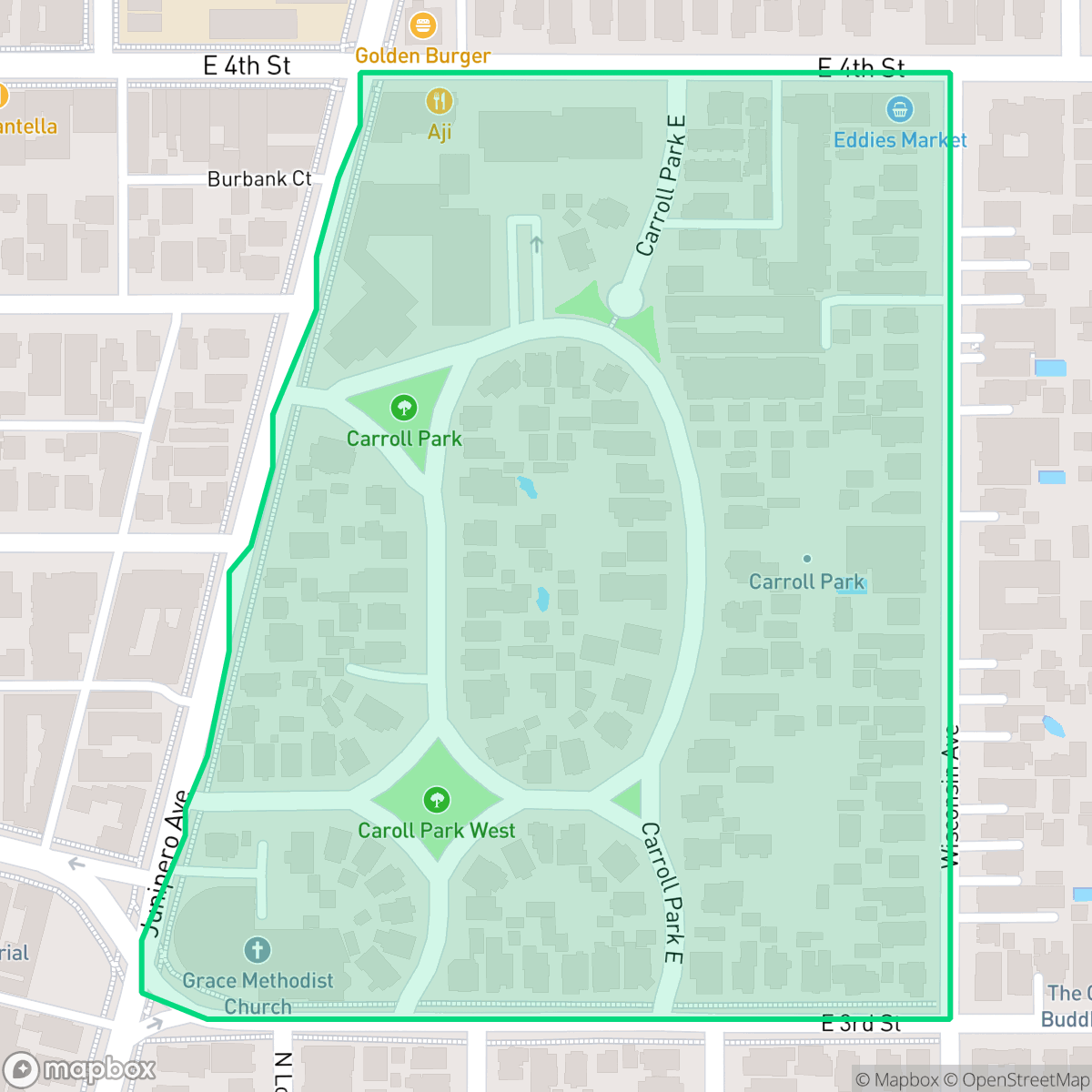
Developed starting in 1902 by John Carroll, Carroll Park was the first planned tract neighborhood in Long Beach. It is highly distinguished by its unique layout of looping, curving streets designed in a circular pattern around four small, landscaped island parks. This maze-like design was intentionally created to deter heavy farm and ranch wagons on their way to the downtown market, shielding the neighborhood from through-traffic and dust. The historic district contains a diverse array of architectural styles built primarily between 1898 and 1923, including Craftsman Bungalows, Colonial Revival, Queen Anne, and Spanish/Mediterranean Revival homes, alongside several preserved turn-of-the-century farmhouses. In 1982, Carroll Park was designated as one of Long Beach’s first historic landmark districts, preserving its peaceful, horse-and-buggy era character.
The neighborhood functions as a dense, urban residential enclave where the grid system supports high walkability and easy access to local amenities. Popular community spots like Rose Park Roasters and Gusto Bread contribute to a lively atmosphere that balances its quiet historic roots with active commercial engagement. The lack of nearby industrial hazards and high air quality ratings make the area a viable location for those seeking a clean, urban environment in Southern California.
Prospective residents should note that the area features tightly packed housing with minimal privacy, as homes are often spaced less than 10 meters apart. Acoustic comfort is a notable trade-off, with road traffic noise levels averaging 61 decibels. While the neighborhood is well-suited for those who prioritize walkability and proximity to cultural staples, the limited public green space and reliance on private yards may be a consideration for dog owners. The local school system, part of the Long Beach Unified School District, is currently managing significant budget transitions that may impact long-term planning for families.
Neighborhood Scores Across 15 Qualities
Residential structures in this area are positioned in close quarters with minimal setbacks between buildings. This density results in a lower level of privacy than is typical for Long Beach.
Pedestrian connectivity is exceptional due to a dense grid system with consistent sidewalks and frequent crosswalks. This level of walkability is notably higher than the Long Beach average, according to iHuus data.
Standard tract housing and dense urban layouts characterize the area, featuring boxy rooflines and small yards. According to iHuus data, the visual landscape is slightly less varied than the Long Beach average.
Limited public green space and narrow sidewalk verges make for fewer casual walking opportunities for pets compared to the Long Beach average. According to iHuus data, most available grassy areas are confined to private yards or nearby linear parks.
Residential streets and green spaces exist in roughly equal measure, providing a suburban character that is consistent with the Long Beach average. Some pockets of the area transition into a denser urban grid with multi-story apartments and tightly packed commercial structures.
A variety of local cafes, parks, and dining establishments create a social atmosphere that is notably more active than the Long Beach average. According to iHuus data, the area features a steady concentration of community gathering points ranging from coastal cultural sites to suburban eateries.
Steady sounds from nearby busy streets are present, though acoustic levels remain more tranquil than the average for Long Beach. According to iHuus data, the area experiences a consistent hum of local traffic.
Air quality remains consistently high with minimal health concerns for residents. This level of air purity is notably better than the Long Beach average, according to iHuus data.
No warehouses, heavy industrial facilities, or hazardous sites are present within the area. This neighborhood maintains a much lower level of industrial proximity than the Long Beach average, consisting almost entirely of residential and light commercial zones.
Health insurance coverage among residents is slightly above the Long Beach average, according to iHuus data. This indicates a relatively consistent level of access to medical coverage for the local population.
Voting patterns and census indicators reflect a highly liberal political leaning that is even more pronounced than the Long Beach average, according to iHuus data.
Residents live alongside a balanced spread of young adults, families, and older individuals. This demographic variety in Carroll Park is very similar to the broader Long Beach area according to iHuus data.
Some residual flood risk exists due to being located within a floodplain, though safety levels are notably higher than the Long Beach city average according to iHuus data.
Address-Level Insights for Carroll Park


iHuus Neighborhood Intelligence Insights
Get address-level neighborhood insights for Carroll Park
- Street-level scores — see how individual blocks compare, not just neighborhood averages
- Micro-zone boundaries — identify quiet pockets, flood boundaries, and walkable clusters before you visit
- 15 dimensions in full — walkability, noise, air quality, school quality, insurance coverage, population age profile, urban/rural index, and more
- Boundary risk alerts — know if your address sits near a block boundary where scores drop, the kind of detail no listing will ever mention
- School insights — individual school ratings and insights, not just district-level data
- Compare before you commit — side-by-side data across neighborhoods, down to block precision
No credit card required
Compare with Any Neighborhood
| Dimension | Carroll Park | Airport Area |
|---|---|---|
| 🚶 Walkabilityavg 9.37 | ||
| 🔊 Acoustic Comfortavg 3.04 | ||
| 🤫 Privacy Indexavg 3.63 | ||
| 🎨 Visual Appealavg 6.3 | ||
| 🐕 Dog Friendlinessavg 5.35 | ||
| 🗺️ Urban-Rural Indexavg 6 | ||
| ✨ Neighborhood Vibeavg 5.01 | ||
| 🏥 Health Insurance Coverageavg 6.4 | ||
| 🌿 Air Qualityavg 8.69 | ||
| 🏭 Industrial Proximityavg 8.14 | ||
| 🌊 Flood Safetyavg 3.75 | ||
| 🗳️ Ideological Leanavg 9.2 | ||
| 👥 Population Age Profileavg 4.81 | ||
| 🔥 Fire Safety | ||
| 🏫 School Quality |
Carroll Park Rankings
School Districts Serving Carroll Park
School Insights for Carroll Park
Below average outcomes; significant attendance and academic challenges.
School Insights
See what's really behind every school rating near Carroll Park
- Individual school ratings — each school's own score with outcome context, not just a district average
- Enrollment & class size data — student-to-teacher ratio and how it compares to the state average
- Full demographics breakdown — ethnicity and gender composition for every school in the enrollment zone
- Every school in the district — all schools within the enrollment boundary ranked by rating, not just the closest one
- Grade levels & benchmarks — elementary through high school, with below/above state-average flags
No credit card required