Cambodia Town, Long Beach
Updated · 8,791 residents
Cambodia Town is a highly walkable urban district defined by its dense residential grid and vibrant cultural identity. Residents benefit from excellent air quality, though the area experiences notable noise from road traffic and limited privacy due to closely spaced housing.
Key Highlights
About Cambodia Town
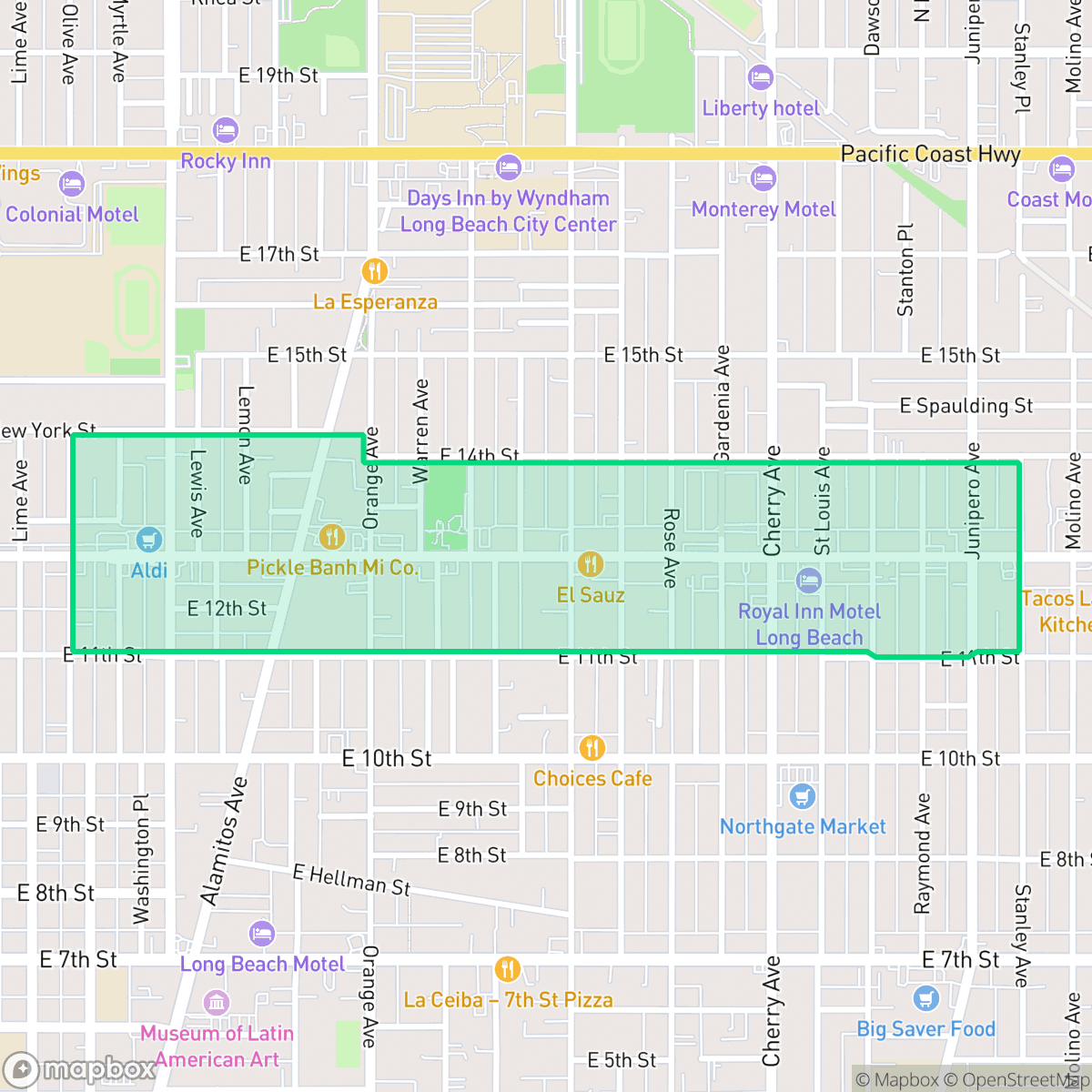
Cambodia Town in Long Beach, California, is a 1.2-mile business and cultural corridor along Anaheim Street, recognized as the "Capital of Cambodia" for hosting the largest concentration of Cambodians outside Southeast Asia. The neighborhood's origins date to the 1950s and 1960s, when Cambodian exchange students attended nearby California State University, Long Beach. Following the Khmer Rouge genocide in the late 1970s, waves of refugees settled in the area, drawn by affordable housing and community support organizations like the United Cambodian Community. Officially designated by the Long Beach City Council on July 3, 2007, as the nation's first Cambodia Town, the district is defined by its vibrant Khmer-owned restaurants, jewelry shops, and Buddhist temples. It remains a cultural hub, celebrated through the annual Cambodia Town Parade and Culture Festival.
Cambodia Town serves as a dense, low-rise urban hub characterized by a continuous grid of sidewalks and a mix of residential and commercial spaces. The area maintains a high level of walkability, allowing residents to access local businesses and essential services without relying on a vehicle. While the neighborhood lacks extensive public green space, it offers a unique, culturally concentrated environment that remains distinct within the broader Long Beach landscape.
Those considering a move to the area should weigh the benefits of its central location and pedestrian-friendly layout against the realities of high-density living. Housing units are positioned closely together, which reduces private outdoor space and contributes to a lower privacy index. Additionally, while air quality is high, the proximity to major roads and commercial warehouses results in elevated noise levels, making it a better fit for those who prioritize urban connectivity over quiet, secluded surroundings.
Neighborhood Scores Across 15 Qualities
Structures are positioned in very close proximity with frequent shared walls and minimal separation between buildings. This density is notably higher than the Long Beach average, according to iHuus data.
Continuous sidewalks and clearly marked crosswalks exist throughout the street grid. This level of accessibility for pedestrians is even higher than the Long Beach average, according to iHuus data.
Dense, uniform housing and apartment complexes characterize the landscape, offering less greenery than the Long Beach average. According to iHuus data, the area consists mainly of standard workforce housing with minimal private yard space.
Minimal public green space and narrow sidewalk verges make outdoor exercise difficult for pets. According to iHuus data, the neighborhood offers significantly less accessible vegetation and parkland than the Long Beach average.
Streetscapes feature a blend of residential and commercial density with a mix of multi-family units and small single-family homes. This area is slightly less dense with green space than the Long Beach average, as much of the landscape is comprised of a low-rise urban grid and significant grey infrastructure.
Concentrated social hubs and diverse dining options create a much more active environment than the Long Beach average. According to iHuus data, the area features a dense mix of mid-rise buildings, parks, and local eateries that foster constant movement.
Audible noise from nearby rail lines and heavy freeway traffic is common. According to iHuus data, acoustic levels in this area are slightly higher than the Long Beach average.
Air quality remains exceptionally high with minimal health concerns. According to iHuus data, the atmosphere in this area is notably cleaner than the Long Beach average.
Residential blocks are largely free from heavy industry, though some areas contain bus depots and warehouses that increase truck traffic. This level of industrial proximity is slightly lower than the Long Beach average according to iHuus data.
Health insurance access is notably lower than the Long Beach average. According to iHuus data, a significant portion of the resident population remains uninsured.
Voting patterns and census indicators show a predominantly liberal political leaning that is even more pronounced than the Long Beach average, according to iHuus data.
Residents experience a balanced demographic spread of young adults, families, and older adults. This age distribution is slightly more concentrated in certain age brackets than the Long Beach average, according to iHuus data.
Significant flood risk exists because parts of this area fall within a designated floodplain, making flood insurance highly likely to be required. This level of risk is notably higher than the Long Beach average according to iHuus data.
Address-Level Insights for Cambodia Town


iHuus Neighborhood Intelligence Insights
Get address-level neighborhood insights for Cambodia Town
- Street-level scores — see how individual blocks compare, not just neighborhood averages
- Micro-zone boundaries — identify quiet pockets, flood boundaries, and walkable clusters before you visit
- 15 dimensions in full — walkability, noise, air quality, school quality, insurance coverage, population age profile, urban/rural index, and more
- Boundary risk alerts — know if your address sits near a block boundary where scores drop, the kind of detail no listing will ever mention
- School insights — individual school ratings and insights, not just district-level data
- Compare before you commit — side-by-side data across neighborhoods, down to block precision
No credit card required
Compare with Any Neighborhood
| Dimension | Cambodia Town | Airport Area |
|---|---|---|
| 🚶 Walkabilityavg 9.37 | ||
| 🔊 Acoustic Comfortavg 3.04 | ||
| 🤫 Privacy Indexavg 3.63 | ||
| 🎨 Visual Appealavg 6.3 | ||
| 🐕 Dog Friendlinessavg 5.35 | ||
| 🗺️ Urban-Rural Indexavg 6 | ||
| ✨ Neighborhood Vibeavg 5.01 | ||
| 🏥 Health Insurance Coverageavg 6.4 | ||
| 🌿 Air Qualityavg 8.69 | ||
| 🏭 Industrial Proximityavg 8.14 | ||
| 🌊 Flood Safetyavg 3.75 | ||
| 🗳️ Ideological Leanavg 9.2 | ||
| 👥 Population Age Profileavg 4.81 | ||
| 🔥 Fire Safety | ||
| 🏫 School Quality |
Cambodia Town Rankings
School Districts Serving Cambodia Town
School Insights for Cambodia Town
Below average outcomes; significant attendance and academic challenges.
School Insights
See what's really behind every school rating near Cambodia Town
- Individual school ratings — each school's own score with outcome context, not just a district average
- Enrollment & class size data — student-to-teacher ratio and how it compares to the state average
- Full demographics breakdown — ethnicity and gender composition for every school in the enrollment zone
- Every school in the district — all schools within the enrollment boundary ranked by rating, not just the closest one
- Grade levels & benchmarks — elementary through high school, with below/above state-average flags
No credit card required