California Heights, Long Beach
Updated · 5,369 residents
California Heights is a highly walkable neighborhood defined by its dense grid of historic homes and proximity to local social hubs. While it offers a strong sense of community and high health insurance coverage, residents should expect notable noise levels from nearby traffic and limited privacy due to the close proximity of houses.
Key Highlights
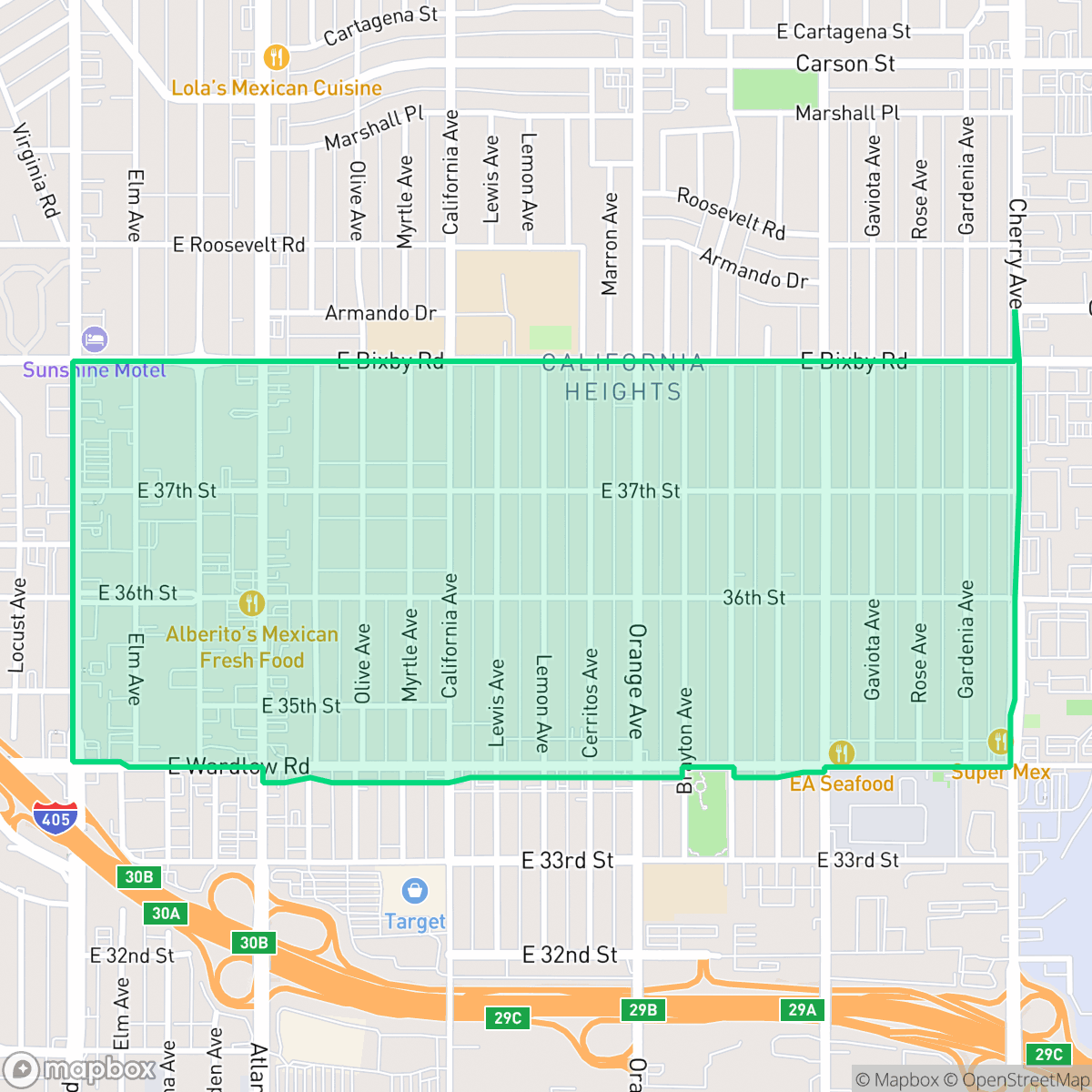
About California Heights
Established in 1929 by the Jotham Bixby Company, California Heights is Long Beach’s largest historic district. Originally grazing land for Rancho Los Cerritos, the area was subdivided following the 1921 Signal Hill oil boom. The neighborhood features approximately 1,500 homes, predominantly built between 1920 and 1950 in the Spanish Colonial Revival style, alongside Tudor Revival, Neo-Traditional, and relocated Craftsman bungalows. Its western section, known as Château-Thierry, occupies the former site of a 1919 airfield developed by aviator Earl S. Daugherty. Today, the neighborhood maintains its distinct character through preservation efforts led by the California Heights Neighborhood Association, including a signature historic lamppost restoration project.
The neighborhood functions as a dense suburban enclave where the grid layout supports frequent walking, though the presence of a nearby freeway contributes to a persistent ambient noise level. Residents enjoy access to local staples like Rad Coffee and various eateries, which provide a balanced social environment despite the area's industrial proximity. According to iHuus data, the area maintains a high level of health insurance coverage, reflecting a stable demographic profile that values established community infrastructure. Prospective residents should consider the trade-off between the area's historic charm and its acoustic environment. The tight spacing between structures results in limited private outdoor space, making it better suited for those who prioritize neighborhood connectivity and walkability over absolute quiet. While the local school district is undergoing a period of fiscal transition, the area remains a central, well-connected part of Long Beach for those seeking an active suburban lifestyle.
Neighborhood Scores Across 15 Qualities
Residential spacing is tighter than the Long Beach average, featuring various shared-wall structures and homes located in close proximity to one another. According to iHuus data, some areas contain high-density housing where houses are separated by very small distances.
Pedestrian movement is supported by a dense grid of sidewalks and marked crossings, though ease of walking is slightly lower than the Long Beach average due to the presence of a high traffic freeway. Many streets feature dedicated sidewalks on both sides of the road, according to iHuus data.
Large homes and well-maintained yards with private pools characterize much of the area. This visual quality is slightly above the Long Beach average according to iHuus data.
Limited access to large public parks and narrow sidewalk verges make pet walking less convenient than in other parts of Long Beach. Most yards are private and fenced, providing space for dogs but lacking widespread community green space according to iHuus data.
Residential grids here feature a mix of single-family homes and low-rise apartments that feel slightly more open than the dense urban core of Long Beach. This area maintains a suburban character with noticeable transitions toward commercial and industrial zones.
Lively pockets of dining and coffee shops coexist with quieter, industrial, and car-oriented zones. According to iHuus data, the area maintains a slightly higher level of activity and amenity access than the Long Beach average.
Frequent noise from nearby freeways and rail lines makes this area significantly louder than most of Long Beach. Residents can expect consistent acoustic disruptions throughout the day according to iHuus data.
Air quality remains consistently good with only rare instances of elevated readings. This level of cleanliness is slightly below the Long Beach city average according to iHuus data.
Residential streets and light commercial strips dominate the area, though some proximity to logistics hubs and airport runways exists. This level of industrial presence is slightly higher than the Long Beach average according to iHuus data.
Health insurance accessibility is notably higher in California Heights than in the rest of Long Beach, according to iHuus data.
Voting patterns and census indicators show a predominantly liberal leaning that is more pronounced than the Long Beach average, according to iHuus data.
Residents will find a balanced demographic ranging from young adults to older adults. This age distribution is slightly more varied than the average found across Long Beach, according to iHuus data.
Flood risk levels are higher than the Long Beach average, though the area lacks a detailed federal flood study. According to iHuus data, the specific risk level for this area remains undetermined.
Address-Level Insights for California Heights


iHuus Neighborhood Intelligence Insights
Get address-level neighborhood insights for California Heights
- Street-level scores — see how individual blocks compare, not just neighborhood averages
- Micro-zone boundaries — identify quiet pockets, flood boundaries, and walkable clusters before you visit
- 15 dimensions in full — walkability, noise, air quality, school quality, insurance coverage, population age profile, urban/rural index, and more
- Boundary risk alerts — know if your address sits near a block boundary where scores drop, the kind of detail no listing will ever mention
- School insights — individual school ratings and insights, not just district-level data
- Compare before you commit — side-by-side data across neighborhoods, down to block precision
No credit card required
Compare with Any Neighborhood
| Dimension | California Heights | Airport Area |
|---|---|---|
| 🚶 Walkabilityavg 9.37 | ||
| 🔊 Acoustic Comfortavg 3.04 | ||
| 🤫 Privacy Indexavg 3.63 | ||
| 🎨 Visual Appealavg 6.3 | ||
| 🐕 Dog Friendlinessavg 5.35 | ||
| 🗺️ Urban-Rural Indexavg 6 | ||
| ✨ Neighborhood Vibeavg 5.01 | ||
| 🏥 Health Insurance Coverageavg 6.4 | ||
| 🌿 Air Qualityavg 8.69 | ||
| 🏭 Industrial Proximityavg 8.14 | ||
| 🌊 Flood Safetyavg 3.75 | ||
| 🗳️ Ideological Leanavg 9.2 | ||
| 👥 Population Age Profileavg 4.81 | ||
| 🔥 Fire Safety | ||
| 🏫 School Quality |
California Heights Rankings
School Districts Serving California Heights
School Insights for California Heights
Below average outcomes; significant attendance and academic challenges.
School Insights
See what's really behind every school rating near California Heights
- Individual school ratings — each school's own score with outcome context, not just a district average
- Enrollment & class size data — student-to-teacher ratio and how it compares to the state average
- Full demographics breakdown — ethnicity and gender composition for every school in the enrollment zone
- Every school in the district — all schools within the enrollment boundary ranked by rating, not just the closest one
- Grade levels & benchmarks — elementary through high school, with below/above state-average flags
No credit card required