Bluff Park, Long Beach
Updated · 2,896 residents
Bluff Park is a highly walkable, coastal neighborhood in Long Beach known for its immediate access to the beach and linear park spaces. Residents benefit from excellent air quality and high levels of local health insurance coverage, though the area is densely populated with limited privacy between homes and noticeable road traffic noise.
Key Highlights
About Bluff Park
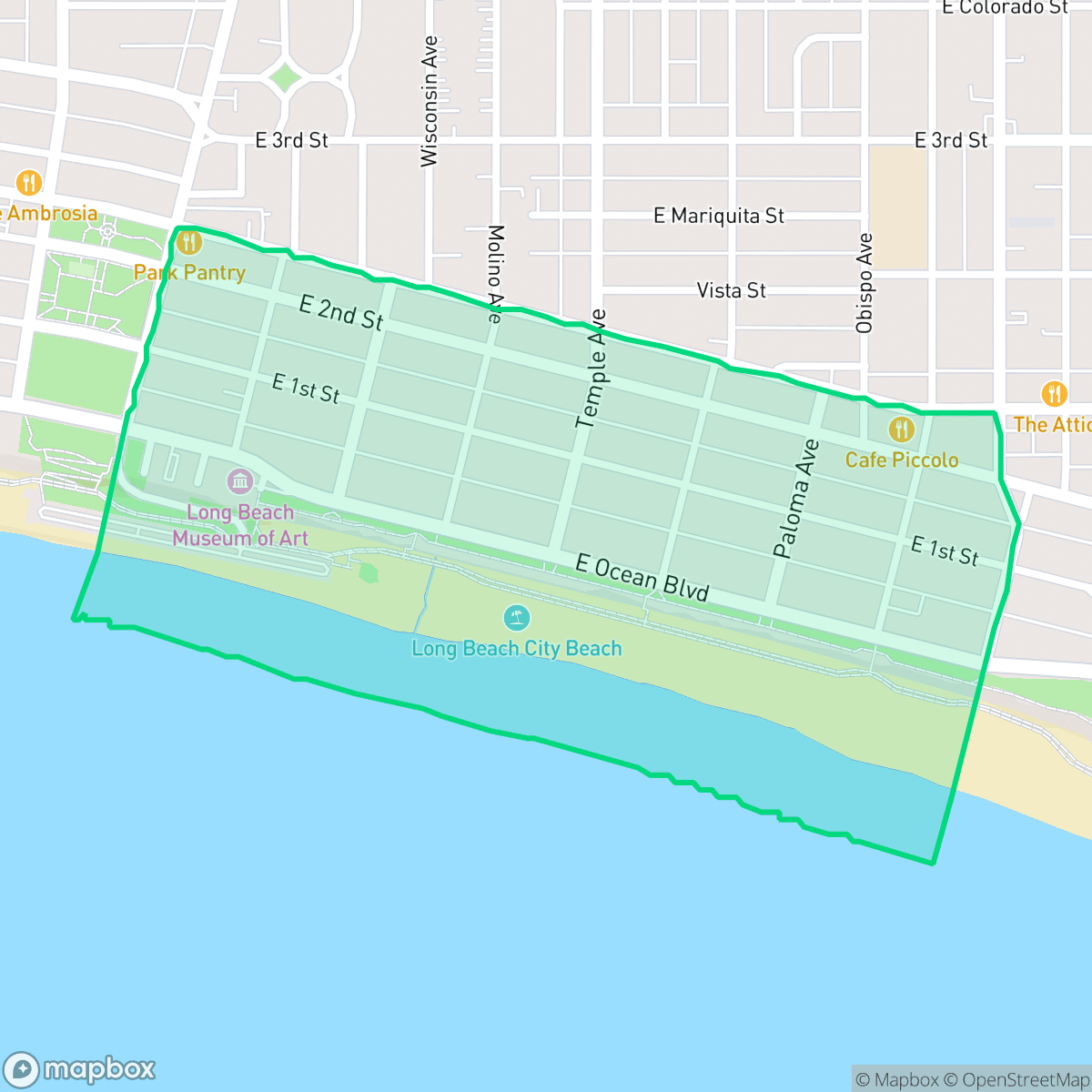
Established along the scenic ocean bluffs of Long Beach, California, the Bluff Park neighborhood grew around an 11-acre park donated by the Alamitos Land Company in 1919. In 1982, local residents successfully organized to make Bluff Park the city’s second official historic district to protect the area from high-rise development. The neighborhood is renowned for its stately, tree-lined streets featuring homes built between 1903 and 1949. Its architectural landscape is dominated by large Craftsman bungalows and Period Revival-style residences. Key local landmarks include the 1912 Elizabeth Milbank Anderson House, which now houses the Long Beach Museum of Art, and the Lone Sailor Memorial, a bronze statue commemorating the city's deep naval history.
The neighborhood functions as a quiet but active residential pocket, supported by local amenities like the Long Beach Museum of Art and various neighborhood eateries. Its layout follows a strict grid system that promotes high pedestrian connectivity, making it easy for residents to navigate the area on foot. With no industrial proximity and high health insurance coverage, the environment is well-supported for its residents, who share a strong sense of community and ideological alignment. The area maintains a calm, coastal vibe that balances urban density with convenient access to outdoor recreation along the shoreline.
Living here involves certain trade-offs, particularly regarding density and acoustic comfort. Because homes are situated closely together, private outdoor space is limited, and the average ambient noise level of 59 dB from road traffic is a factor for those sensitive to sound. Families should note that while the Long Beach Unified School District provides stable core academics, it is currently navigating budget volatility and administrative transitions. This neighborhood is best suited for individuals who prioritize walkability and coastal access over expansive private yards or total silence.
Neighborhood Scores Across 15 Qualities
Houses are situated in close quarters with very little separation between structures. This level of density and minimal distance between buildings is noticeably higher than the Long Beach average, according to iHuus data.
Extensive sidewalk networks and clear crosswalks facilitate easy movement on foot. This neighborhood offers superior pedestrian connectivity compared to the Long Beach average, according to iHuus data.
Standard dense housing with boxy rooflines and minimal private greenery characterizes the area. Visual variety is slightly lower than the Long Beach average according to iHuus data.
Nearby beach parks and linear green spaces offer frequent opportunities for exercise. According to iHuus data, the availability of connected grassy areas and walking paths is notably higher than the Long Beach average.
Residential streets and green spaces are distributed in roughly equal measure. This creates a suburban environment that is slightly less dense than the average for Long Beach.
A balanced blend of residential life and local services provides a consistent atmosphere that is largely in line with the city average. While some coastal blocks feature diverse cultural and dining spots, other areas remain more industrial or suburban with fewer businesses within walking distance.
Steady noise from nearby busy streets is present, though levels are notably calmer than the Long Beach average. According to iHuus data, this area experiences a consistent hum of local vehicle traffic.
Air quality in this area is exceptionally high with minimal health concerns. According to iHuus data, these levels are notably cleaner than the average recorded across Long Beach.
Residential and light commercial zones dominate the area with a notable absence of heavy industrial facilities or warehouses. While drilling rigs are visible on nearby offshore islands, the neighborhood remains much clearer of industrial activity than the Long Beach average, according to iHuus data.
Health insurance enrollment is exceptionally high among residents, significantly outpacing the Long Beach average according to iHuus data.
Voting patterns and census indicators show a highly liberal political leaning that is even more pronounced than the Long Beach average, according to iHuus data.
Residents live among a balanced spread of young adults, families, and older individuals. This demographic variety is more diverse than the typical age distribution found across Long Beach, according to iHuus data.
Flood risk levels remain difficult to determine because a detailed federal study has not been completed for this area. This level of uncertainty is slightly higher than the average seen across Long Beach, according to iHuus data.
Address-Level Insights for Bluff Park


iHuus Neighborhood Intelligence Insights
Get address-level neighborhood insights for Bluff Park
- Street-level scores — see how individual blocks compare, not just neighborhood averages
- Micro-zone boundaries — identify quiet pockets, flood boundaries, and walkable clusters before you visit
- 15 dimensions in full — walkability, noise, air quality, school quality, insurance coverage, population age profile, urban/rural index, and more
- Boundary risk alerts — know if your address sits near a block boundary where scores drop, the kind of detail no listing will ever mention
- School insights — individual school ratings and insights, not just district-level data
- Compare before you commit — side-by-side data across neighborhoods, down to block precision
No credit card required
Compare with Any Neighborhood
| Dimension | Bluff Park | Airport Area |
|---|---|---|
| 🚶 Walkabilityavg 9.37 | ||
| 🔊 Acoustic Comfortavg 3.04 | ||
| 🤫 Privacy Indexavg 3.63 | ||
| 🎨 Visual Appealavg 6.3 | ||
| 🐕 Dog Friendlinessavg 5.35 | ||
| 🗺️ Urban-Rural Indexavg 6 | ||
| ✨ Neighborhood Vibeavg 5.01 | ||
| 🏥 Health Insurance Coverageavg 6.4 | ||
| 🌿 Air Qualityavg 8.69 | ||
| 🏭 Industrial Proximityavg 8.14 | ||
| 🌊 Flood Safetyavg 3.75 | ||
| 🗳️ Ideological Leanavg 9.2 | ||
| 👥 Population Age Profileavg 4.81 | ||
| 🔥 Fire Safety | ||
| 🏫 School Quality |
Bluff Park Rankings
School Districts Serving Bluff Park
School Insights for Bluff Park
Below average outcomes; significant attendance and academic challenges.
School Insights
See what's really behind every school rating near Bluff Park
- Individual school ratings — each school's own score with outcome context, not just a district average
- Enrollment & class size data — student-to-teacher ratio and how it compares to the state average
- Full demographics breakdown — ethnicity and gender composition for every school in the enrollment zone
- Every school in the district — all schools within the enrollment boundary ranked by rating, not just the closest one
- Grade levels & benchmarks — elementary through high school, with below/above state-average flags
No credit card required