Bluff Heights, Long Beach
Updated · 4,422 residents
Bluff Heights is a highly walkable residential enclave defined by its dense collection of historic Craftsman bungalows and tree-lined streets. Residents benefit from excellent air quality and immediate access to the vibrant vintage shops and independent eateries of the nearby Fourth Street corridor. While the area offers a strong sense of community, the high-density layout means homes are situated closely together with limited private outdoor space.
Key Highlights
About Bluff Heights
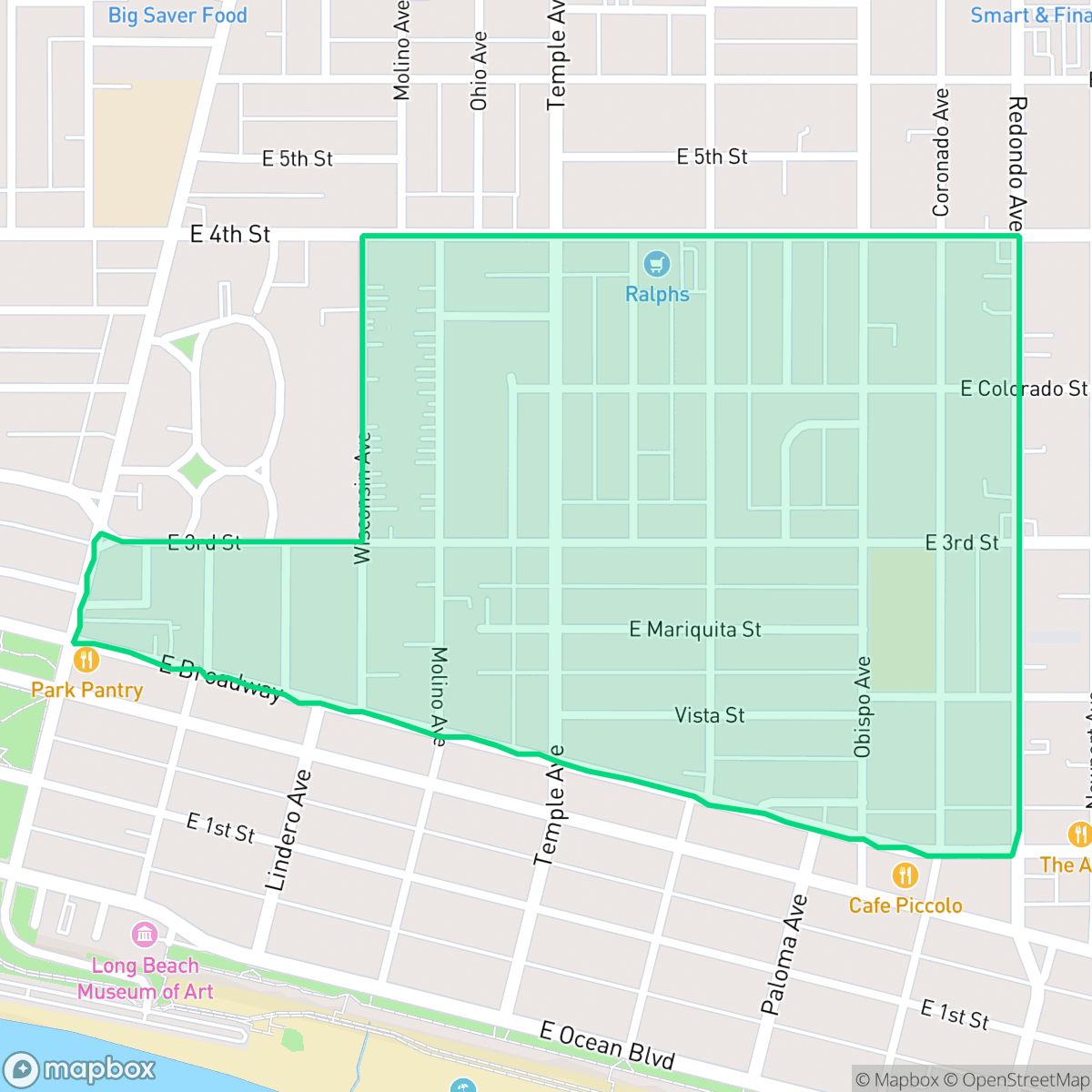
Designated as a historic district in 2004, Bluff Heights in Long Beach, California, was originally part of the Alamitos Beach Townsite, planned by pioneer John W. Bixby in 1886 and annexed to the city in 1905. The neighborhood experienced a rapid housing boom following the arrival of the Pacific Electric Railway. Today, more than half of the neighborhood’s homes are classic Craftsman bungalows constructed between 1910 and 1923, interspersed with Victorian farmhouses, Spanish Colonial Revival, and Tudor Revival residences. Bounded by Fourth Street, Redondo Avenue, Broadway, and Junipero Avenue, the neighborhood is celebrated for its pedestrian-friendly, tree-lined streets. It is highly integrated with the adjacent Fourth Street "Retro Row," a culturally vibrant corridor famous for its vintage shops, independent eateries, and the historic Art Theatre.
The neighborhood functions as a dense, pedestrian-oriented urban grid that prioritizes local connectivity. Its proximity to the Fourth Street corridor provides residents with a steady stream of cultural engagement, including access to galleries and independent theaters. According to iHuus data, the area maintains a high standard for air quality and remains free from industrial hazards, contributing to a stable and healthy living environment. The streets are well-maintained, and the overall atmosphere is characterized by a blend of historic charm and urban convenience.
Prospective residents should note that the neighborhood features a high building-to-land ratio, which results in minimal privacy between properties. While the streets are relatively quiet, the compact nature of the housing stock means that private yards are rare. The area is best suited for individuals who value walkability and historic aesthetics over the seclusion typically found in suburban or rural settings.
Neighborhood Scores Across 15 Qualities
Residential structures are situated in close proximity with minimal separation between homes. This level of density is slightly higher than the Long Beach average, characterized by houses and multi-unit buildings positioned near or even sharing walls.
A complete grid of sidewalks and highly visible crosswalks makes navigating the area on foot easy. This level of pedestrian connectivity is even higher than the Long Beach average, according to iHuus data.
Dense, middle-class housing characterizes this area with uniform lots and small yards. This level of visual variety is slightly below the Long Beach average according to iHuus data.
Proximity to the beach park and linear park belts offers decent walking opportunities, though some residential sections feature limited public green space. Overall access to pet-friendly areas remains slightly above the Long Beach average according to iHuus data.
Streetscapes feature a mix of residential density and paved surfaces that align closely with the city average. According to iHuus data, the area maintains a consistent balance between built structures and available green space.
Local activity levels are higher than the Long Beach average, characterized by a mix of quiet suburban streets and pockets of vibrant social hubs. While diverse dining and cultural landmarks are present, many amenities are concentrated in specific clusters rather than being widely accessible on foot.
A steady hum of local traffic from a nearby busy street characterizes the area, though acoustic comfort remains higher than the Long Beach average.
Air quality remains consistently high with minimal health concerns. According to iHuus data, the atmosphere in this area is notably cleaner than the Long Beach average.
Industrial activity and heavy manufacturing hazards are entirely absent from this area. According to iHuus data, this neighborhood maintains a much cleaner profile than the Long Beach average, consisting only of residential and light commercial zones.
Health insurance access among residents is notably higher than the Long Beach average. This indicates a strong level of-coverage stability within the community, according to iHuus data.
Voting patterns and census indicators show a deeply liberal leaning that is even more pronounced than the Long Beach average, according to iHuus data.
Residents live alongside a balanced mix of young professionals, families, and seniors. This demographic spread is slightly more varied than the average found across Long Beach, according to iHuus data.
Flood risk levels in this area are slightly above the Long Beach average, though official FEMA studies for this specific neighborhood remain incomplete. Residents should exercise caution as the precise risk of flooding is currently undetermined.
Address-Level Insights for Bluff Heights


iHuus Neighborhood Intelligence Insights
Get address-level neighborhood insights for Bluff Heights
- Street-level scores — see how individual blocks compare, not just neighborhood averages
- Micro-zone boundaries — identify quiet pockets, flood boundaries, and walkable clusters before you visit
- 15 dimensions in full — walkability, noise, air quality, school quality, insurance coverage, population age profile, urban/rural index, and more
- Boundary risk alerts — know if your address sits near a block boundary where scores drop, the kind of detail no listing will ever mention
- School insights — individual school ratings and insights, not just district-level data
- Compare before you commit — side-by-side data across neighborhoods, down to block precision
No credit card required
Compare with Any Neighborhood
| Dimension | Bluff Heights | Airport Area |
|---|---|---|
| 🚶 Walkabilityavg 9.37 | ||
| 🔊 Acoustic Comfortavg 3.04 | ||
| 🤫 Privacy Indexavg 3.63 | ||
| 🎨 Visual Appealavg 6.3 | ||
| 🐕 Dog Friendlinessavg 5.35 | ||
| 🗺️ Urban-Rural Indexavg 6 | ||
| ✨ Neighborhood Vibeavg 5.01 | ||
| 🏥 Health Insurance Coverageavg 6.4 | ||
| 🌿 Air Qualityavg 8.69 | ||
| 🏭 Industrial Proximityavg 8.14 | ||
| 🌊 Flood Safetyavg 3.75 | ||
| 🗳️ Ideological Leanavg 9.2 | ||
| 👥 Population Age Profileavg 4.81 | ||
| 🔥 Fire Safety | ||
| 🏫 School Quality |
Bluff Heights Rankings
School Districts Serving Bluff Heights
School Insights for Bluff Heights
Below average outcomes; significant attendance and academic challenges.
School Insights
See what's really behind every school rating near Bluff Heights
- Individual school ratings — each school's own score with outcome context, not just a district average
- Enrollment & class size data — student-to-teacher ratio and how it compares to the state average
- Full demographics breakdown — ethnicity and gender composition for every school in the enrollment zone
- Every school in the district — all schools within the enrollment boundary ranked by rating, not just the closest one
- Grade levels & benchmarks — elementary through high school, with below/above state-average flags
No credit card required