Bixby Knolls, Long Beach
Updated · 4,637 residents
Bixby Knolls is a dense, highly walkable neighborhood in Long Beach defined by its diverse historic architecture and a vibrant commercial corridor along Atlantic Avenue. While residents enjoy easy access to local dining and cafes, the area features tightly spaced homes and experiences moderate noise levels from road traffic.
Key Highlights
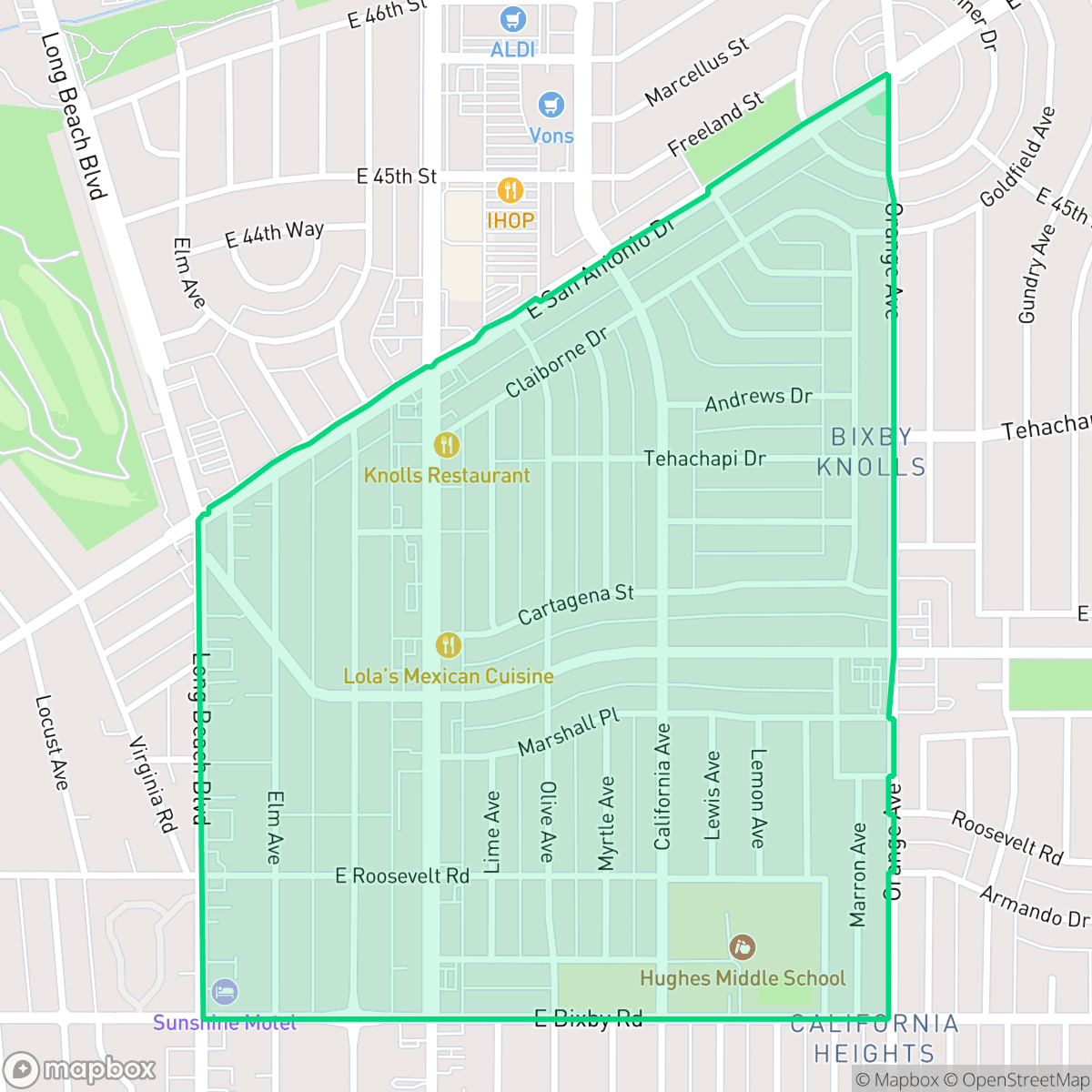
About Bixby Knolls
Bixby Knolls in Long Beach, California, traces its origins to the 19th-century Rancho Los Cerritos, which was acquired in 1866 by Jotham Bixby. In October 1929, the Bixby family announced plans to develop a 120-acre residential tract designed to be the "Wilshire section" of Long Beach, complete with an architectural committee to approve all construction. Developed primarily between the 1920s and 1950s, the neighborhood features custom-built homes in Spanish Colonial Revival, Tudor, Craftsman, and Mid-century Modern styles. Historically known as "Uptown," Bixby Knolls became a premier shopping and dining destination after the Bixby Knolls Shopping Center opened in 1952. The neighborhood is anchored by the commercial corridor of Atlantic Avenue and sits adjacent to the historic 1844 Rancho Los Cerritos adobe and the prestigious Virginia Country Club.
The neighborhood serves as a central hub for community life, anchored by a variety of independent businesses, coffee shops, and restaurants that contribute to its active atmosphere. The residential streets are characterized by well-manicured properties and a dense grid layout, which facilitates high walkability and convenient access to daily amenities. With a strong commitment to health insurance coverage and a lack of industrial encroachment, the area provides a stable environment for those who value proximity to urban conveniences.
Prospective residents should note that the neighborhood offers limited public green space, as the landscape is primarily composed of private backyards and narrow sidewalk verges. While the area is visually appealing, the high density and proximity to major roads result in noticeable traffic noise. It is best suited for individuals or families who prioritize a walkable, established residential setting over expansive personal outdoor space and are comfortable with the trade-offs of an active, urban-suburban environment.
Neighborhood Scores Across 15 Qualities
Housing structures offer more spacing and buffer between neighbors than the Long Beach average. According to iHuus data, the area features a mix of dense residential pockets and standard suburban layouts with private backyards.
A dense grid of sidewalks and marked crosswalks makes most errands easy to complete on foot. This network of pedestrian-priority paths and consistent street crossings is even more comprehensive than the Long Beach average, according to iHuus data.
Well-maintained properties and a high density of private backyard pools contribute to a visual quality that is above the Long Beach average. According to iHuus data, many residential lots feature mature landscaping and spacious driveways.
Sidewalk verges and nearby sports parks provide adequate space for pet owners. According to iHuus data, the area offers more accessible walking options than the Long Beach average.
Developed suburban landscapes characterize this area, featuring a blend of single-family homes and low-rise commercial clusters. This density is slightly higher than the Long Beach average, providing a balance of residential privacy and accessible infrastructure according to iHuus data.
Active social pockets and a diverse range of eateries provide a higher level of energy than the typical Long Beach neighborhood. While some residential blocks remain serene, the area features a notable concentration of cafes and dining destinations according to iHuus data.
Frequent acoustic disturbances from nearby rail lines and heavy freeway traffic are common in this area. According to iHuus data, noise levels are slightly higher than the Long Beach average.
Air quality remains mostly clean with only rare instances of elevated readings, though it stays slightly below the Long Beach city average according to iHuus data.
Industrial presence is virtually nonexistent here, offering a cleaner environment than much of the Long Beach area. According to iHuus data, the neighborhood is comprised of residential and light commercial zones with no detectable warehouses or heavy industrial hazards.
Health insurance accessibility is notably higher here than the Long Beach average, according to iHuus data. This level of coverage suggests more stable access to medical services for the local population.
Voting patterns and census indicators show a deeply progressive leaning that is even more pronounced than the Long Beach average. Residents will find a community aligned with strong liberal political values according to iHuus data.
Residents live alongside a balanced range of young professionals, families, and seniors. According to iHuus data, this demographic spread is slightly more varied than the typical Long Beach profile.
Flood risk in this area is slightly higher than the Long Beach average, though official FEMA studies for this specific zone remain incomplete. Residents should exercise caution as the precise level of vulnerability is currently undetermined.
Address-Level Insights for Bixby Knolls


iHuus Neighborhood Intelligence Insights
Get address-level neighborhood insights for Bixby Knolls
- Street-level scores — see how individual blocks compare, not just neighborhood averages
- Micro-zone boundaries — identify quiet pockets, flood boundaries, and walkable clusters before you visit
- 15 dimensions in full — walkability, noise, air quality, school quality, insurance coverage, population age profile, urban/rural index, and more
- Boundary risk alerts — know if your address sits near a block boundary where scores drop, the kind of detail no listing will ever mention
- School insights — individual school ratings and insights, not just district-level data
- Compare before you commit — side-by-side data across neighborhoods, down to block precision
No credit card required
Compare with Any Neighborhood
| Dimension | Bixby Knolls | Airport Area |
|---|---|---|
| 🚶 Walkabilityavg 9.37 | ||
| 🔊 Acoustic Comfortavg 3.04 | ||
| 🤫 Privacy Indexavg 3.63 | ||
| 🎨 Visual Appealavg 6.3 | ||
| 🐕 Dog Friendlinessavg 5.35 | ||
| 🗺️ Urban-Rural Indexavg 6 | ||
| ✨ Neighborhood Vibeavg 5.01 | ||
| 🏥 Health Insurance Coverageavg 6.4 | ||
| 🌿 Air Qualityavg 8.69 | ||
| 🏭 Industrial Proximityavg 8.14 | ||
| 🌊 Flood Safetyavg 3.75 | ||
| 🗳️ Ideological Leanavg 9.2 | ||
| 👥 Population Age Profileavg 4.81 | ||
| 🔥 Fire Safety | ||
| 🏫 School Quality |
Bixby Knolls Rankings
School Districts Serving Bixby Knolls
School Insights for Bixby Knolls
Below average outcomes; significant attendance and academic challenges.
School Insights
See what's really behind every school rating near Bixby Knolls
- Individual school ratings — each school's own score with outcome context, not just a district average
- Enrollment & class size data — student-to-teacher ratio and how it compares to the state average
- Full demographics breakdown — ethnicity and gender composition for every school in the enrollment zone
- Every school in the district — all schools within the enrollment boundary ranked by rating, not just the closest one
- Grade levels & benchmarks — elementary through high school, with below/above state-average flags
No credit card required