Bixby Area, Long Beach
Updated · 15,385 residents
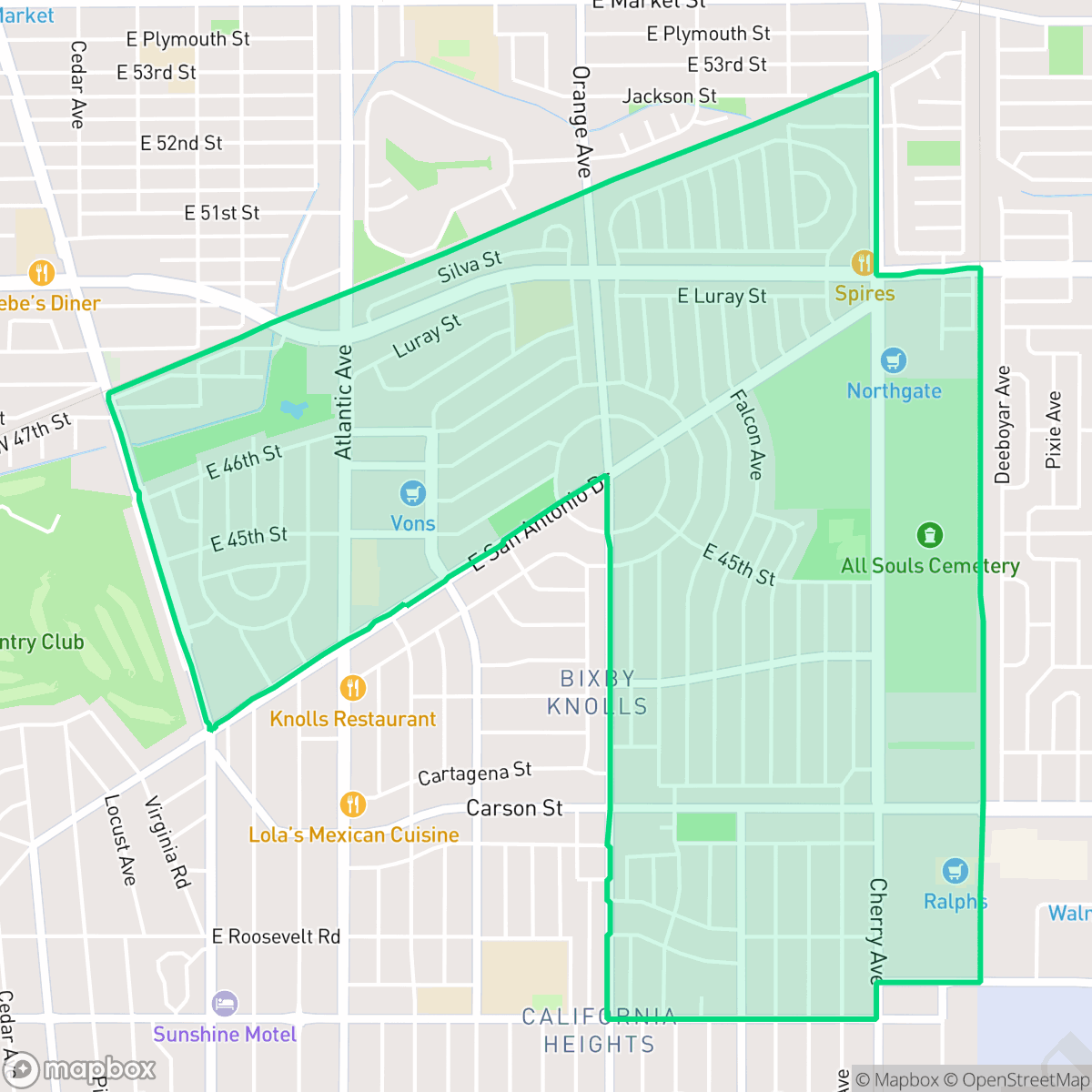
The Bixby Area is a highly walkable residential enclave in northern Long Beach, defined by its dense suburban layout and diverse architectural character. While the neighborhood offers convenient access to local amenities and pedestrian-friendly streets, residents should anticipate significant noise from road traffic and a dense living environment with limited privacy between homes.
Key Highlights
About Bixby Area
The Bixby Area in northern Long Beach traces its origins to the historic Rancho Los Cerritos. In 1866, the sheep-raising firm of Flint, Bixby & Co. purchased the rancho, and Jotham Bixby—often called the “Father of Long Beach”—managed the land. The area’s centerpiece, the 1844 Monterey-style Rancho Los Cerritos adobe, remains a National Historic Landmark. Prompted by the 1921 Signal Hill oil boom, the former ranch lands were subdivided into upscale residential neighborhoods between the 1920s and 1940s. Today, the area is characterized by its tree-lined streets, spacious lots, and a rich blend of architectural styles, including Spanish Colonial Revival, Tudor, Craftsman, and mid-century ranch homes. Atlantic Avenue serves as the neighborhood's walkable commercial heart, while the historic Virginia Country Club and Los Cerritos Park remain prominent local landmarks.
The neighborhood functions as a dense suburban hub, characterized by a consistent grid of streets and a high level of walkability that allows residents to access local shops and services on foot. Its aesthetic appeal is rooted in a mix of mid-century and traditional housing styles, often featuring private backyard pools and well-maintained landscaping. The area maintains a stable, middle-class character with strong health insurance coverage and a consistent ideological lean, making it a settled community for those seeking proximity to essential services without the constant need for a vehicle.
Prospective residents should weigh these benefits against specific environmental factors. The area experiences elevated noise levels primarily due to road traffic, and the high density of housing results in close proximity between neighbors. While the neighborhood provides a serene atmosphere with nearby green spaces, it faces challenges regarding flood safety and fire risk, which are important considerations for long-term property maintenance. The local school district is currently navigating a period of fiscal transition, and families should investigate specific school performance metrics when evaluating the area for their needs.
Neighborhood Scores Across 15 Qualities
Residential spacing provides a moderate level of separation between neighbors, offering more seclusion than the typical density found across Long Beach. While some areas feature closely situated homes with shared property lines, many lots maintain small private yards and distinct buffers.
Continuous sidewalk networks and clear crosswalks make navigating the area on foot easy. This level of pedestrian connectivity is slightly higher than the Long Beach average.
Well-maintained properties and a high density of private backyard pools contribute to a visual landscape that is more polished than the Long Beach average. Many residential lots feature manicured landscaping and spacious driveways, according to iHuus data.
Extensive green spaces, including a central park and large cemetery grounds, offer many paths for exercise. According to iHuus data, the availability of these continuous walking areas and connected green belts is significantly higher than the Long Beach average.
Residential layouts consist of dense suburban grids and single-family homes with slightly more open land than the Long Beach average. This landscape features a mix of low-rise housing and small commercial clusters according to iHuus data.
A mix of quiet residential streets and lively pockets of dining and parks provides a steady rhythm. This level of activity and amenity access is consistent with the rest of Long Beach.
Frequent noise from nearby freeways and rail lines makes this area significantly louder than the Long Beach average. According to iHuus data, residents can expect persistent acoustic disturbances due to the proximity of major transportation corridors.
Air quality remains mostly clean with rare instances of elevated readings, though levels are slightly lower than the Long Beach average according to iHuus data.
Industrial presence is minimal in this area, offering a cleaner environment than the Long Beach average. Residents will find a lack of heavy warehouses or hazardous facilities, as the neighborhood consists almost entirely of residential and light commercial spaces.
Health insurance accessibility is notably higher in this area than the Long Beach average, according to iHuus data. Most residents have access to employer-sponsored or private medical coverage.
Voting patterns and census indicators show a predominantly liberal leaning that is slightly more pronounced than the Long Beach average.
A balanced distribution of young adults, families, and seniors defines the area. This demographic spread is slightly more varied than the average found across Long Beach.
Flood risk levels remain undetermined because detailed federal studies have not been completed for this area. According to iHuus data, the potential for flooding is higher than the average found in other parts of Long Beach.
Address-Level Insights for Bixby Area


iHuus Neighborhood Intelligence Insights
Get address-level neighborhood insights for Bixby Area
- Street-level scores — see how individual blocks compare, not just neighborhood averages
- Micro-zone boundaries — identify quiet pockets, flood boundaries, and walkable clusters before you visit
- 15 dimensions in full — walkability, noise, air quality, school quality, insurance coverage, population age profile, urban/rural index, and more
- Boundary risk alerts — know if your address sits near a block boundary where scores drop, the kind of detail no listing will ever mention
- School insights — individual school ratings and insights, not just district-level data
- Compare before you commit — side-by-side data across neighborhoods, down to block precision
No credit card required
Compare with Any Neighborhood
| Dimension | Bixby Area | Airport Area |
|---|---|---|
| 🚶 Walkabilityavg 9.37 | ||
| 🔊 Acoustic Comfortavg 3.04 | ||
| 🤫 Privacy Indexavg 3.63 | ||
| 🎨 Visual Appealavg 6.3 | ||
| 🐕 Dog Friendlinessavg 5.35 | ||
| 🗺️ Urban-Rural Indexavg 6 | ||
| ✨ Neighborhood Vibeavg 5.01 | ||
| 🏥 Health Insurance Coverageavg 6.4 | ||
| 🌿 Air Qualityavg 8.69 | ||
| 🏭 Industrial Proximityavg 8.14 | ||
| 🌊 Flood Safetyavg 3.75 | ||
| 🗳️ Ideological Leanavg 9.2 | ||
| 👥 Population Age Profileavg 4.81 | ||
| 🔥 Fire Safety | ||
| 🏫 School Quality |
Bixby Area Rankings
School Districts Serving Bixby Area
School Insights for Bixby Area
Below average outcomes; significant attendance and academic challenges.
School Insights
See what's really behind every school rating near Bixby Area
- Individual school ratings — each school's own score with outcome context, not just a district average
- Enrollment & class size data — student-to-teacher ratio and how it compares to the state average
- Full demographics breakdown — ethnicity and gender composition for every school in the enrollment zone
- Every school in the district — all schools within the enrollment boundary ranked by rating, not just the closest one
- Grade levels & benchmarks — elementary through high school, with below/above state-average flags
No credit card required