Belmont Shore, Long Beach
Updated · 6,922 residents
Belmont Shore is a highly walkable coastal neighborhood in Long Beach defined by its dense grid of historic homes and the vibrant commercial corridor of East Second Street. While the area offers excellent access to local dining and the beach, residents experience limited privacy due to the tightly packed housing and moderate noise levels from road traffic.
Key Highlights
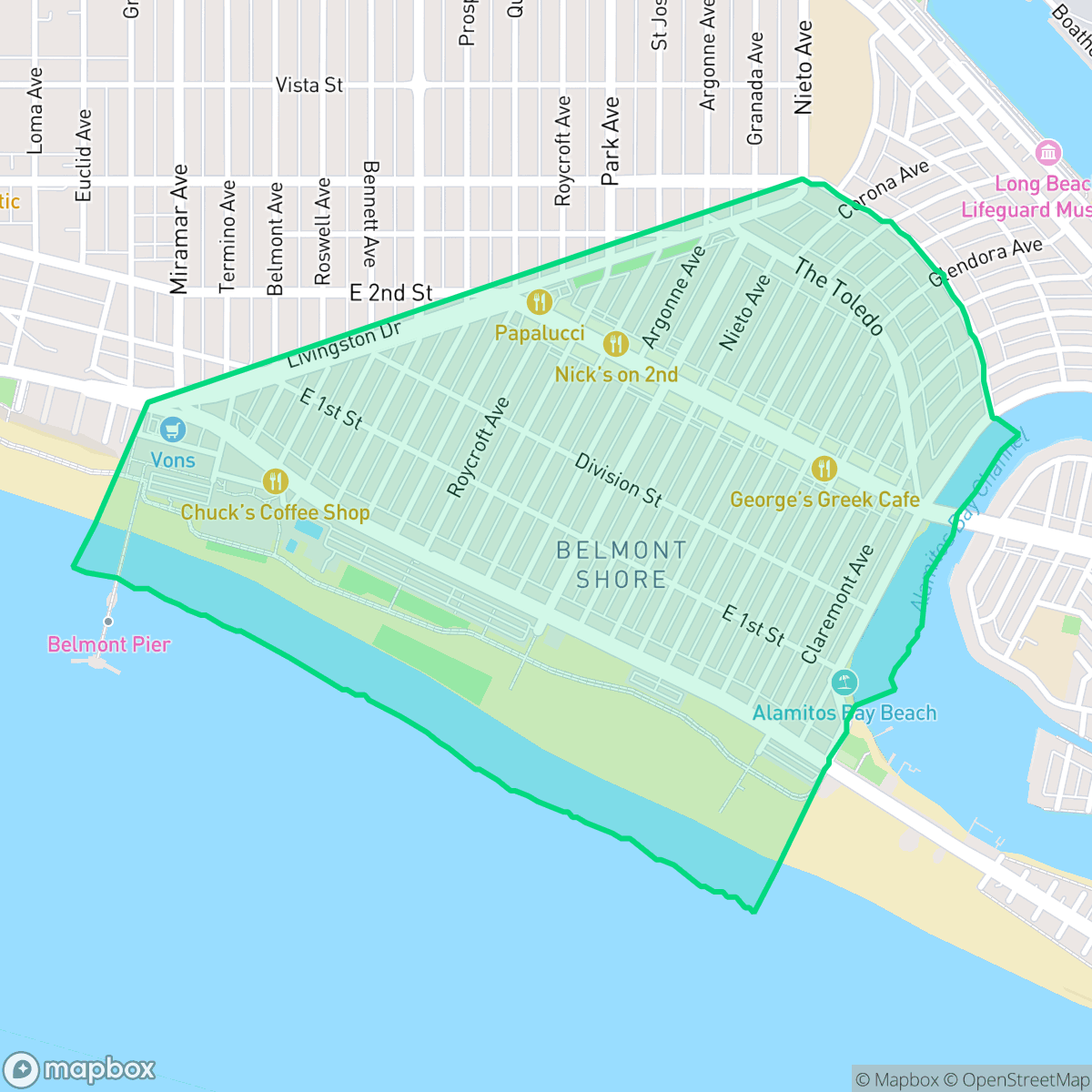
About Belmont Shore
Originally part of the Naples tract purchased by Henry Huntington in 1903, Belmont Shore’s development began in earnest in 1920 when developers McGrath & Selover transformed the tidal swamp using extensive grading and fill. To attract buyers from the hot Inland Empire, developers named the neighborhood's streets after inland towns like Covina, Pomona, and Redlands. Annexed to Long Beach in the mid-1920s, the neighborhood quickly filled with its signature Spanish Colonial Revival bungalows, built on modest 30-by-80-foot lots. East Second Street emerged as the primary commercial corridor, famously boasting whimsical 1920s architecture, including the 1927 Egyptian Drug Store. Today, Belmont Shore is defined by its vibrant beach-town culture, the historic Belmont Pier, and local landmarks like the popular "Horny Corner" beach, originally named after developer Thomas Hornet.
The area serves as a premier destination for those seeking a coastal lifestyle with immediate access to urban amenities. The neighborhood maintains a distinct identity through its rigid grid layout, which supports high walkability and consistent pedestrian access to local cafes, restaurants, and the shoreline. Residents benefit from high air quality and a lack of industrial proximity, contributing to a clean, residential environment that remains well-connected to the broader Long Beach community.
Prospective residents should consider the trade-offs associated with such a dense urban environment. According to iHuus data, the neighborhood features tightly clustered homes with minimal separation, resulting in lower levels of acoustic comfort and limited individual privacy. The area is best suited for individuals who prioritize walkability and a social, beach-adjacent lifestyle over expansive private outdoor space or total quiet.
Neighborhood Scores Across 15 Qualities
Residential structures are closely packed with minimal separation between properties. According to iHuus data, this high-density layout provides less privacy than the Long Beach average.
Continuous sidewalks and dedicated waterfront paths make navigating the area on foot exceptionally easy. This pedestrian-friendly infrastructure is even more comprehensive than the Long Beach average.
High-end residential architecture and waterfront properties with private docks provide a more polished aesthetic than the Long Beach average. According to iHuus data, the area features large, modern homes and significant coastal amenities.
Access to the expansive beach boardwalk and large coastal parks provides significantly more pet-friendly space than the Long Beach average. While some densely packed residential pockets lack green verges, the waterfront paths offer excellent opportunities for long walks.
Mixed-use coastal infrastructure and a dense residential grid create a suburban environment that is slightly more urbanized than the Long Beach average. According to iHuus data, the area features a balanced blend of paved streetscapes and integrated green spaces.
A mix of lively social pockets and quiet suburban blocks provides a character similar to the Long Beach average. Residents can access diverse dining and local amenities, though many business clusters are concentrated in specific walkable areas rather than throughout the entire neighborhood.
Localized traffic noise from nearby busy streets is a consistent presence, though levels remain more tranquil than the typical experience across Long Beach according to iHuus data.
Air quality remains consistently high with minimal health concerns; this level of air purity is notably better than the Long Beach average according to iHuus data.
Industrial activity and warehouses are entirely absent from this area, making it significantly cleaner of industrial hazards than the Long Beach average. According to iHuus data, the neighborhood consists exclusively of residential and recreational zones with no detectable manufacturing or warehouse facilities.
Health insurance access is exceptionally high among residents, significantly surpassing the Long Beach average according to iHuus data.
Political leanings in this area are predominantly liberal, though the concentration is slightly less pronounced than the Long Beach city average according to iHuus data.
Residents live alongside a varied mix of young professionals, families, and seniors. This demographic spread is slightly more diverse than the Long Beach average, according to iHuus data.
Properties within this area are located inside a designated floodplain, which may necessitate flood insurance. According to iHuus data, the risk of flooding here is higher than the Long Beach average.
Address-Level Insights for Belmont Shore


iHuus Neighborhood Intelligence Insights
Get address-level neighborhood insights for Belmont Shore
- Street-level scores — see how individual blocks compare, not just neighborhood averages
- Micro-zone boundaries — identify quiet pockets, flood boundaries, and walkable clusters before you visit
- 15 dimensions in full — walkability, noise, air quality, school quality, insurance coverage, population age profile, urban/rural index, and more
- Boundary risk alerts — know if your address sits near a block boundary where scores drop, the kind of detail no listing will ever mention
- School insights — individual school ratings and insights, not just district-level data
- Compare before you commit — side-by-side data across neighborhoods, down to block precision
No credit card required
Compare with Any Neighborhood
| Dimension | Belmont Shore | Airport Area |
|---|---|---|
| 🚶 Walkabilityavg 9.37 | ||
| 🔊 Acoustic Comfortavg 3.04 | ||
| 🤫 Privacy Indexavg 3.63 | ||
| 🎨 Visual Appealavg 6.3 | ||
| 🐕 Dog Friendlinessavg 5.35 | ||
| 🗺️ Urban-Rural Indexavg 6 | ||
| ✨ Neighborhood Vibeavg 5.01 | ||
| 🏥 Health Insurance Coverageavg 6.4 | ||
| 🌿 Air Qualityavg 8.69 | ||
| 🏭 Industrial Proximityavg 8.14 | ||
| 🌊 Flood Safetyavg 3.75 | ||
| 🗳️ Ideological Leanavg 9.2 | ||
| 👥 Population Age Profileavg 4.81 | ||
| 🔥 Fire Safety | ||
| 🏫 School Quality |
Belmont Shore Rankings
School Districts Serving Belmont Shore
School Insights for Belmont Shore
Below average outcomes; significant attendance and academic challenges.
School Insights
See what's really behind every school rating near Belmont Shore
- Individual school ratings — each school's own score with outcome context, not just a district average
- Enrollment & class size data — student-to-teacher ratio and how it compares to the state average
- Full demographics breakdown — ethnicity and gender composition for every school in the enrollment zone
- Every school in the district — all schools within the enrollment boundary ranked by rating, not just the closest one
- Grade levels & benchmarks — elementary through high school, with below/above state-average flags
No credit card required