Belmont Heights, Long Beach
Updated · 12,789 residents
Belmont Heights is defined by its historic Craftsman bungalows and tree-lined streets, offering an exceptionally pedestrian-friendly environment. Residents enjoy high air quality and a balanced suburban atmosphere that remains free from industrial activity.
Key Highlights
About Belmont Heights
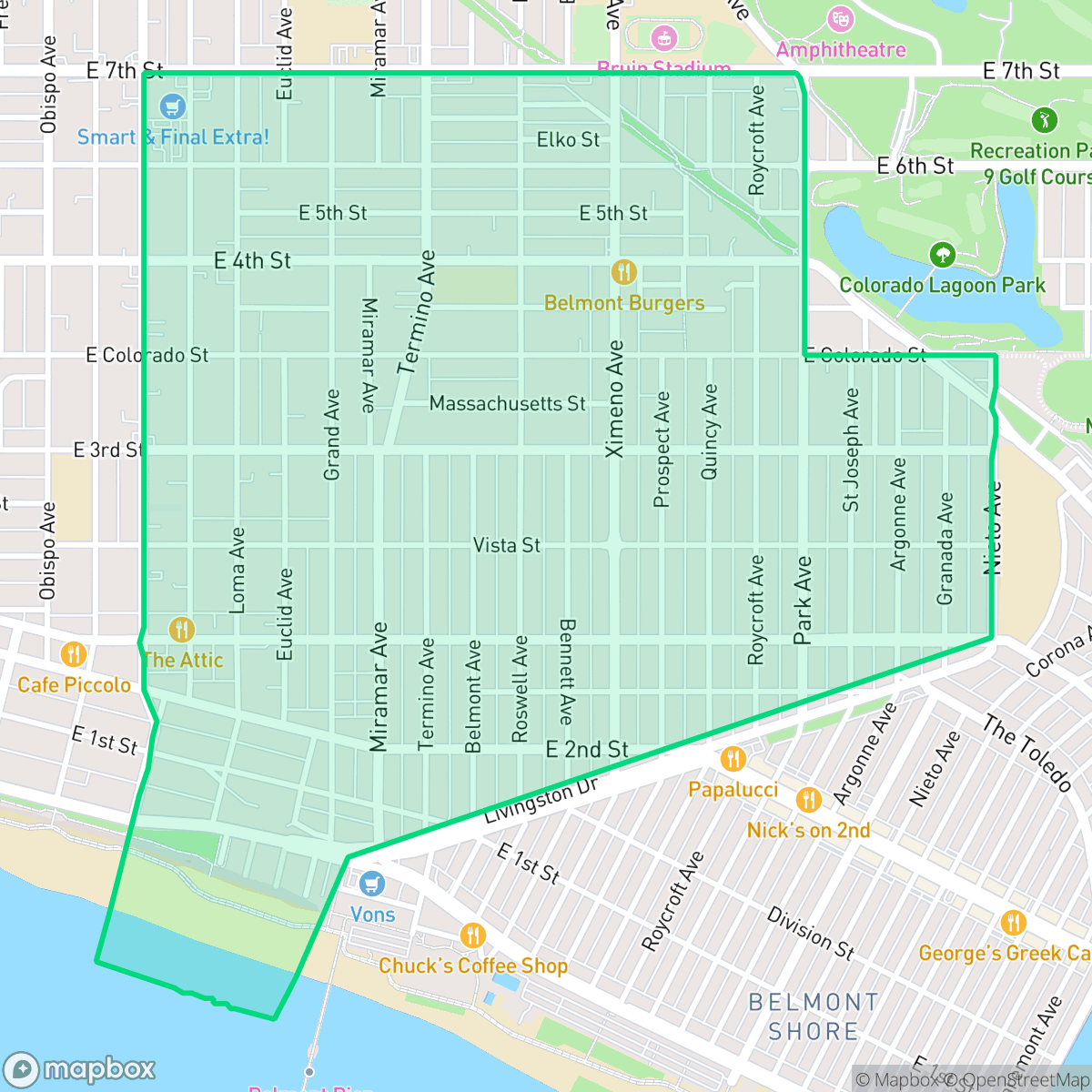
Belmont Heights, originally incorporated as an independent city in 1908 before its annexation by Long Beach in 1909, maintains a distinct historical identity. During its early years, the neighborhood served as a popular destination for Long Beach residents seeking taverns, as Belmont Heights remained 'wet' while Long Beach was a 'dry' town. The neighborhood is celebrated for its architectural significance, particularly its high concentration of Craftsman bungalows built between 1905 and 1939. Beyond these signature bungalows, the area features preserved Victorian, Spanish Colonial Revival, and Tudor Revival homes. Today, the community is defined by its historic districts, such as the Belmont Heights Historic District and the intimate, pedestrian-scaled Eliot Lane, which reflect the neighborhood's early 20th-century origins and its enduring commitment to architectural preservation.
The area serves as a tranquil residential enclave characterized by its commitment to architectural preservation and a highly walkable street grid. With continuous sidewalks and frequent crosswalks, the neighborhood encourages active transit while maintaining a clean, industrial-free environment. The demographic landscape is notably diverse, fostering an intergenerational mix of families, professionals, and long-term residents who value the area's upscale coastal charm and aesthetic consistency.
Prospective residents should note that the neighborhood features tightly packed housing, which can limit personal privacy between properties. While the community is generally quieter than other parts of the city, traffic noise remains audible near major thoroughfares. Families should consider that the local school district is currently navigating significant fiscal transitions and operational changes. Overall, the area is best suited for those prioritizing walkability and a strong sense of community over expansive private outdoor space.
Neighborhood Scores Across 15 Qualities
Residential structures are situated in close proximity with minimal separation between property lines. According to iHuus data, this level of density results in lower privacy compared to the Long Beach average.
Continuous sidewalks on both sides of every street and frequent, visible crosswalks make navigating the area on foot easy. This level of connectivity is even more prominent here than in the rest of Long Beach, according to iHuus data.
Larger, modern homes and premium amenities provide a visual landscape that is slightly more polished than the Long Beach average. According to iHuus data, the presence of coastal real estate and architectural features like rooftop decks contributes to the area's aesthetic appeal.
Access to green space for pets is slightly above the Long Beach average, featuring a continuous park belt and proximity to beach parks. While some residential streets have narrow sidewalk verges, the neighborhood benefits from nearby sports fields and accessible public parks.
Streetscapes consist of an even distribution of residential structures and green space, mirroring the general density found across Long Beach. This mix of single-family homes and low-rise apartments creates a consistent suburban character.
Mixed-use pockets offer diverse dining and social hubs, though many residential blocks remain quiet and suburban. According to iHuus data, the area provides a level of activity that is very similar to the Long Beach average.
Audible traffic noise persists near major thoroughfares, though acoustic conditions are notably more tranquil than the Long Beach average according to iHuus data.
Air quality remains consistently high with minimal health concerns. This level of cleanliness is notably better than the Long Beach average, according to iHuus data.
Industrial activity and hazardous facilities are absent from the neighborhood, offering a significantly cleaner environment than the Long Beach average. According to iHuus data, the area consists exclusively of residential, educational, and light commercial uses, though some drilling infrastructure is visible on nearby offshore islands.
Health insurance access among residents is notably higher than the Long Beach average, according to iHuus data.
Voting patterns and census indicators show a deeply liberal political leaning that is slightly more pronounced than the Long Beach average. According to iHuus data, the area maintains a very high concentration of progressive-leaning residents.
A diverse range of age groups resides here, providing a demographic balance that is slightly more even than the Long Beach average. This distribution includes a comparable mix of young professionals, families, and older adults, according to iHuus data.
Flood risk levels in this area are currently undetermined because detailed federal studies have not been completed. According to iHuus data, the potential for flooding is slightly higher than the Long Beach average.
Address-Level Insights for Belmont Heights


iHuus Neighborhood Intelligence Insights
Get address-level neighborhood insights for Belmont Heights
- Street-level scores — see how individual blocks compare, not just neighborhood averages
- Micro-zone boundaries — identify quiet pockets, flood boundaries, and walkable clusters before you visit
- 15 dimensions in full — walkability, noise, air quality, school quality, insurance coverage, population age profile, urban/rural index, and more
- Boundary risk alerts — know if your address sits near a block boundary where scores drop, the kind of detail no listing will ever mention
- School insights — individual school ratings and insights, not just district-level data
- Compare before you commit — side-by-side data across neighborhoods, down to block precision
No credit card required
Compare with Any Neighborhood
| Dimension | Belmont Heights | Airport Area |
|---|---|---|
| 🚶 Walkabilityavg 9.37 | ||
| 🔊 Acoustic Comfortavg 3.04 | ||
| 🤫 Privacy Indexavg 3.63 | ||
| 🎨 Visual Appealavg 6.3 | ||
| 🐕 Dog Friendlinessavg 5.35 | ||
| 🗺️ Urban-Rural Indexavg 6 | ||
| ✨ Neighborhood Vibeavg 5.01 | ||
| 🏥 Health Insurance Coverageavg 6.4 | ||
| 🌿 Air Qualityavg 8.69 | ||
| 🏭 Industrial Proximityavg 8.14 | ||
| 🌊 Flood Safetyavg 3.75 | ||
| 🗳️ Ideological Leanavg 9.2 | ||
| 👥 Population Age Profileavg 4.81 | ||
| 🔥 Fire Safety | ||
| 🏫 School Quality |
Belmont Heights Rankings
School Districts Serving Belmont Heights
School Insights for Belmont Heights
Below average outcomes; significant attendance and academic challenges.
School Insights
See what's really behind every school rating near Belmont Heights
- Individual school ratings — each school's own score with outcome context, not just a district average
- Enrollment & class size data — student-to-teacher ratio and how it compares to the state average
- Full demographics breakdown — ethnicity and gender composition for every school in the enrollment zone
- Every school in the district — all schools within the enrollment boundary ranked by rating, not just the closest one
- Grade levels & benchmarks — elementary through high school, with below/above state-average flags
No credit card required