Alamitos Heights, Long Beach
Updated · 2,810 residents
Alamitos Heights is a quiet, coastal-adjacent neighborhood known for its mix of residential streets and proximity to green spaces like Marina Vista Park. While the area offers excellent air quality and a strong sense of community, residents should expect notable noise levels from nearby road traffic and a dense housing layout.
Key Highlights
About Alamitos Heights
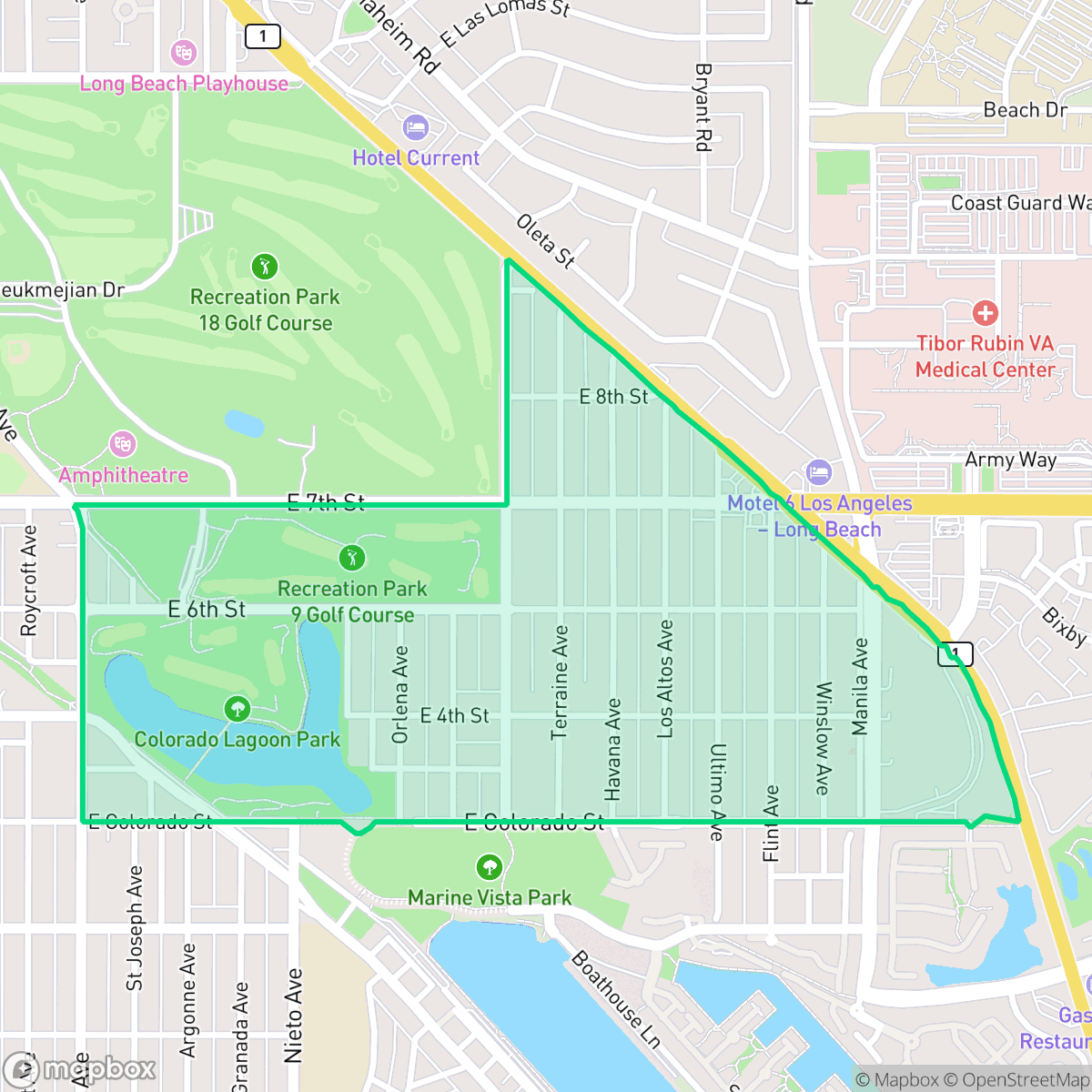
Originally subdivided in 1924 as "Lakeview Terrace," the Alamitos Heights neighborhood of Long Beach experienced a dramatic shift when oil was discovered in 1926. A massive "town-lot" drilling boom ensued, packing 160 wells onto just 83 acres and temporarily halting residential development. Building resumed in the 1930s and flourished after World War II, establishing a diverse architectural landscape bordered by the Colorado Lagoon and Alamitos Bay. A key architectural landmark is the Kimpson-Nixon House (1940), a designated city landmark and the only residence in Long Beach designed by renowned modernist architect Raphael Soriano. Today, the neighborhood is highly regarded for its quiet, coastal-adjacent character.
The area features a diverse landscape of single-family homes and multi-story apartments, creating a dense suburban environment. Residents benefit from high health insurance coverage and a lack of industrial hazards, contributing to a clean and safe living atmosphere. Local amenities such as 49rs Tavern, Banda Burrito, and Ubuntu The Greatest Neighborhood Cafe provide neighborhood-specific dining options, while the presence of wide grassy verges and accessible park space makes the community particularly welcoming for dog owners. Living here involves certain trade-offs, particularly regarding acoustic comfort. According to iHuus data, the proximity to major roadways results in elevated traffic noise, which may impact those sensitive to sound. While the grid of sidewalks supports moderate walkability, the neighborhood remains largely car-dependent for daily errands. Families should be aware that local schools within the Long Beach Unified School District are currently navigating significant budget adjustments and operational transitions, which may influence the educational landscape for students.
Neighborhood Scores Across 15 Qualities
Residential spacing offers more separation between neighbors than the Long Beach average. Some blocks feature high density housing with shared walls or closely spaced homes.
Pedestrian travel is highly efficient due to a complete sidewalk grid and clear crossings on nearly every street. This level of accessibility is consistent with the broader Long Beach area.
Large homes and frequent upscale amenities contribute to a visual environment that is more polished than the Long Beach average. According to iHuus data, the presence of spacious driveways and well-maintained properties defines the area's streetscape.
Abundant green verges, large public parks, and expansive golf course grounds offer significantly more space for pets than the Long Beach average. According to iHuus data, the presence of connected grassy areas and wide paths provides safe environments for walking dogs away from traffic.
Residential layouts feature a dense mix of single-family homes and multi-story apartments alongside large institutional campuses. This area maintains a slightly more open feel than much of the surrounding Long Beach urban landscape.
Diverse dining options and lively pockets coexist with quiet, green residential blocks. This level of activity and amenity access is higher than the Long Beach average, though many areas remain car dependent.
Frequent disturbances from nearby freeway traffic and railroad lines characterize the area. This level of acoustic disruption is significantly higher than the Long Beach average, according to iHuus data.
Air quality remains exceptionally clear with very few pollutants. This level of air purity is notably higher than the Long Beach average, according to iHuus data.
Industrial activity is entirely absent from this area, providing a landscape of residential, educational, and recreational land uses. This lack of warehouses or heavy industrial facilities is notably higher than the Long Beach average, according to iHuus data.
Health insurance access among residents is notably higher than the Long Beach average, according to iHuus data.
Voting patterns and census indicators show a predominantly liberal political leaning that is slightly lower than the Long Beach average.
A balanced distribution of young adults, families, and seniors defines the local demographic. According to iHuus data, this age variety is slightly more diverse than the Long Beach average.
Flood risk levels remain uncertain because FEMA has not yet finalized a detailed study for this area. According to iHuus data, the potential for flooding is slightly higher than the Long Beach average.
Address-Level Insights for Alamitos Heights


iHuus Neighborhood Intelligence Insights
Get address-level neighborhood insights for Alamitos Heights
- Street-level scores — see how individual blocks compare, not just neighborhood averages
- Micro-zone boundaries — identify quiet pockets, flood boundaries, and walkable clusters before you visit
- 15 dimensions in full — walkability, noise, air quality, school quality, insurance coverage, population age profile, urban/rural index, and more
- Boundary risk alerts — know if your address sits near a block boundary where scores drop, the kind of detail no listing will ever mention
- School insights — individual school ratings and insights, not just district-level data
- Compare before you commit — side-by-side data across neighborhoods, down to block precision
No credit card required
Compare with Any Neighborhood
| Dimension | Alamitos Heights | Airport Area |
|---|---|---|
| 🚶 Walkabilityavg 9.37 | ||
| 🔊 Acoustic Comfortavg 3.04 | ||
| 🤫 Privacy Indexavg 3.63 | ||
| 🎨 Visual Appealavg 6.3 | ||
| 🐕 Dog Friendlinessavg 5.35 | ||
| 🗺️ Urban-Rural Indexavg 6 | ||
| ✨ Neighborhood Vibeavg 5.01 | ||
| 🏥 Health Insurance Coverageavg 6.4 | ||
| 🌿 Air Qualityavg 8.69 | ||
| 🏭 Industrial Proximityavg 8.14 | ||
| 🌊 Flood Safetyavg 3.75 | ||
| 🗳️ Ideological Leanavg 9.2 | ||
| 👥 Population Age Profileavg 4.81 | ||
| 🔥 Fire Safety | ||
| 🏫 School Quality |
Alamitos Heights Rankings
School Districts Serving Alamitos Heights
School Insights for Alamitos Heights
Below average outcomes; significant attendance and academic challenges.
School Insights
See what's really behind every school rating near Alamitos Heights
- Individual school ratings — each school's own score with outcome context, not just a district average
- Enrollment & class size data — student-to-teacher ratio and how it compares to the state average
- Full demographics breakdown — ethnicity and gender composition for every school in the enrollment zone
- Every school in the district — all schools within the enrollment boundary ranked by rating, not just the closest one
- Grade levels & benchmarks — elementary through high school, with below/above state-average flags
No credit card required