Twin Peaks, Lake Arrowhead
Updated · 2,525 residents
Twin Peaks is a quiet, rural mountain community defined by its scenic alpine beauty and dog-friendly atmosphere. Residents enjoy pristine air quality and a remote, serene environment, though the area is notably distant from commercial centers and carries a high risk of wildfire.
Key Highlights
About Twin Peaks
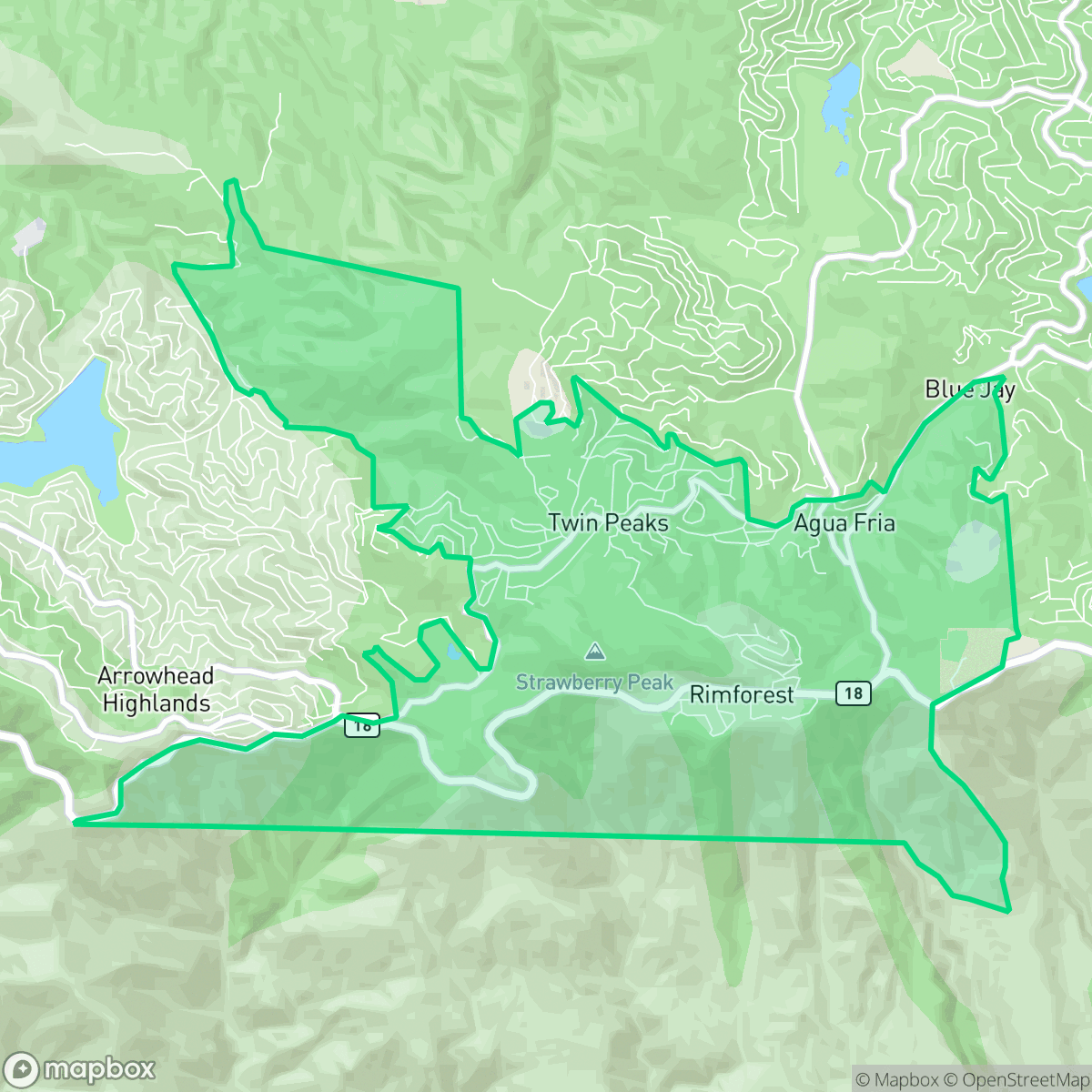
Originally settled in the 1860s as a strawberry farming hub known as "Strawberry Flat," the unincorporated mountain community of Twin Peaks serves as a historic gateway to Lake Arrowhead along State Route 189. Unlike neighboring towns built on logging, Twin Peaks developed around early tourism and conservation. In the early 1900s, the U.S. Forest Service established its regional headquarters here, a site that later evolved into the historic Arrowhead Pine Rose Cabins. Other enduring landmarks include the Antlers Inn, constructed in 1919 as the Alpine Terrace Resort, which still operates today as a rustic restaurant. The area once hosted Clark Gable's weekend fishing cabin. Today, Twin Peaks retains its vintage alpine character, highlighted by "Julie's Project," a seasonal display of over 10,000 daffodils planted along Highway 189 as a community cancer memorial.
The neighborhood functions as a tranquil, residential enclave that prioritizes natural surroundings over urban convenience. With a rural character that emphasizes open green spaces and quiet streets, the area offers a high degree of visual appeal for those seeking a retreat from metropolitan life. Local amenities are limited, consisting primarily of a few select dining establishments and community gathering points that support a slow-paced lifestyle.
Prospective residents should account for the trade-offs inherent in this remote mountain setting, including a reliance on vehicle travel for daily needs and a significant exposure to fire hazards. While the environment is exceptionally welcoming for pet owners, the local school district faces systemic challenges in academic performance. This area is best suited for individuals who prioritize environmental quality and a secluded atmosphere over proximity to retail or robust public infrastructure.
Neighborhood Scores Across 15 Qualities
Large lots with significant separation between homes provide a greater sense of seclusion than the typical Lake Arrowhead area. According to iHuus data, residents can expect more privacy due to the wide spacing between properties.
Low traffic volumes make the streets suitable for walking, though the absence of sidewalks is a notable feature. According to iHuus data, walkability levels in this area are slightly higher than the Lake Arrowhead average.
Spacious properties and upscale amenities characterize the local landscape, though visual variety is slightly lower than the Lake Arrowhead average according to iHuus data.
Extensive networks of trails and large open spaces provide exceptional opportunities for pet owners. This level of access to outdoor space is notably higher than the Lake Arrowhead average, according to iHuus data.
Dense forest canopy and scattered low-density housing define this mountainous setting. This area is even more remote and undeveloped than the surrounding city average, according to iHuus data.
A serene and sparsely developed landscape offers vast open spaces with very few local businesses or social hubs. This area is slightly less active than the rest of Lake Arrowhead, characterized by a quiet, rural rhythm and a reliance on a few scattered dining and service spots along major roads.
Steady traffic sounds from a nearby busy street are present, though acoustic levels are slightly more noticeable than the average for Lake Arrowhead.
Air quality remains consistently high with minimal health concerns for residents. This level of purity is on par with the city average, according to iHuus data.
Residential areas and open green spaces dominate the landscape, with only a localized water treatment facility present. This lack of industrial activity is nearly identical to the broader Lake Arrowhead area, ensuring a landscape free of warehouses or heavy manufacturing.
Health insurance access is prevalent among residents, sitting slightly above the Lake Arrowhead average according to iHuus data.
Conservative values represent the majority of the community, though a modest opposing presence exists. This political landscape is slightly more conservative than the Lake Arrowhead average according to iHuus data.
Residents live among a diverse demographic of young adults, families, and seniors. This distribution is largely consistent with the broader Lake Arrowhead area, according to iHuus data.
Properties in this area are located within a known floodplain, which may necessitate the purchase of flood insurance. According to iHuus data, this level of risk is higher than the average found throughout Lake Arrowhead.
Fire hazard levels are extreme in this area, matching the high risk levels seen across the rest of Lake Arrowhead. Residents must prioritize maximum protection measures and-continuous monitoring according to iHuus data.
Address-Level Insights for Twin Peaks


iHuus Neighborhood Intelligence Insights
Get address-level neighborhood insights for Twin Peaks
- Street-level scores — see how individual blocks compare, not just neighborhood averages
- Micro-zone boundaries — identify quiet pockets, flood boundaries, and walkable clusters before you visit
- 15 dimensions in full — walkability, noise, air quality, school quality, insurance coverage, population age profile, urban/rural index, and more
- Boundary risk alerts — know if your address sits near a block boundary where scores drop, the kind of detail no listing will ever mention
- School insights — individual school ratings and insights, not just district-level data
- Compare before you commit — side-by-side data across neighborhoods, down to block precision
No credit card required
Compare with Any Neighborhood
| Dimension | Twin Peaks | Cedar Glen |
|---|---|---|
| 🚶 Walkabilityavg 5.7 | ||
| 🔊 Acoustic Comfortavg 5.4 | ||
| 🤫 Privacy Indexavg 6.15 | ||
| 🎨 Visual Appealavg 7.97 | ||
| 🐕 Dog Friendlinessavg 8.58 | ||
| 🗺️ Urban-Rural Indexavg 9.73 | ||
| ✨ Neighborhood Vibeavg 3.81 | ||
| 🏥 Health Insurance Coverageavg 7.19 | ||
| 🌿 Air Qualityavg 9.96 | ||
| 🏭 Industrial Proximityavg 9.96 | ||
| 🌊 Flood Safetyavg 3.32 | ||
| 🗳️ Ideological Leanavg 1.78 | ||
| 👥 Population Age Profileavg 5.5 | ||
| 🔥 Fire Safetyavg 0.18 | ||
| 🏫 School Quality |
Twin Peaks Rankings
School Districts Serving Twin Peaks
School Insights for Twin Peaks
Below average outcomes; significant attendance and academic challenges.
School Insights
See what's really behind every school rating near Twin Peaks
- Individual school ratings — each school's own score with outcome context, not just a district average
- Enrollment & class size data — student-to-teacher ratio and how it compares to the state average
- Full demographics breakdown — ethnicity and gender composition for every school in the enrollment zone
- Every school in the district — all schools within the enrollment boundary ranked by rating, not just the closest one
- Grade levels & benchmarks — elementary through high school, with below/above state-average flags
No credit card required