Pleasant Hills and Valleys, Lafayette
Updated · 696 residents
Pleasant Hills and Valleys is a low-density, visually stunning neighborhood in Lafayette characterized by its quiet atmosphere and abundant open space. While it offers high levels of privacy, the area is largely car-dependent and carries significant fire safety risks that residents must navigate.
Key Highlights
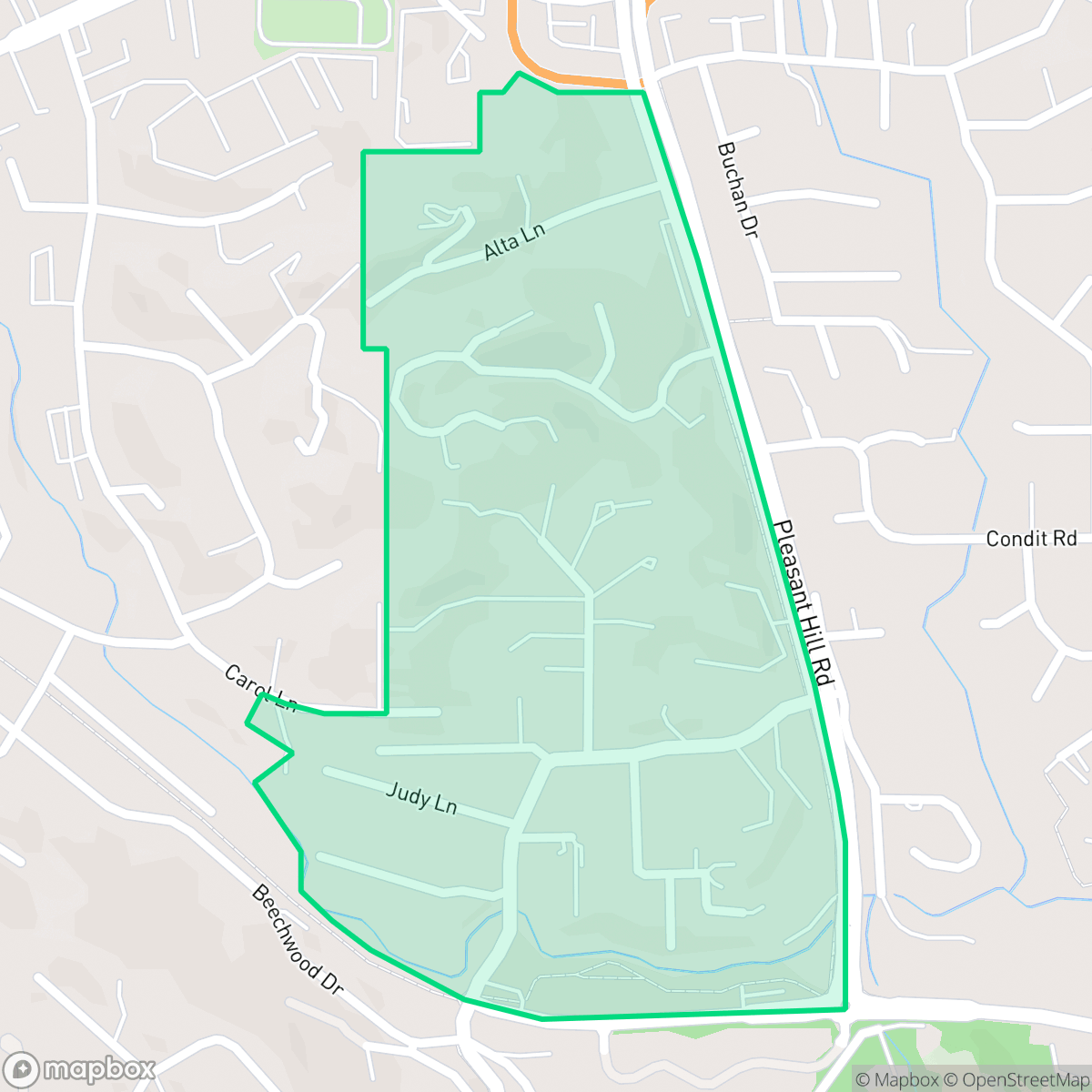
About Pleasant Hills and Valleys
Located in a serene pocket of Lafayette, this neighborhood is defined by its rural character and exceptional visual appeal. The area features scattered, low-density housing integrated into a landscape of significant green space, providing a tranquil environment far removed from urban congestion. It is a quiet, residential enclave where the primary noise source is localized road traffic, maintaining a peaceful atmosphere for those who prioritize seclusion over proximity to commercial amenities.
Prospective residents should consider the trade-offs of this remote-feeling setting, as the area has limited walkability and moderate dog friendliness. While the neighborhood is served by top-tier school districts, including the Acalanes Union High School District and the Lafayette Elementary School District, families should be aware of the notably high fire safety risks present in the region. It is best suited for those who value privacy and natural beauty and who are comfortable with a car-oriented lifestyle in a low-activity setting.
Neighborhood Scores Across 15 Qualities
Spacious lots with significant separation between homes provide a greater sense of seclusion than is typical for Lafayette. According to iHuus data, this area offers more privacy than the city average.
Low traffic volumes make for a peaceful environment for strolls, though the lack of sidewalks means walking often occurs along the shoulder of the road. This level of walkability is slightly below the average for Lafayette, according to iHuus data.
Low density estates feature custom architecture and significant privacy buffers. According to iHuus data, the visual landscape is notably more manicured and open than the Lafayette average.
Connected green spaces and wide paths offer safe areas for walking pets, though overall accessibility for dogs is slightly lower than the Lafayette average according to iHuus data.
Predominantly forested and agricultural land characterizes this area, offering a more secluded environment than the typical Lafayette landscape. According to iHuus data, the terrain contains very little residential or commercial development.
Low density and significant open space define this serene area, which offers less social activity than the Lafayette average. Residents will find a practical, car-oriented environment with limited local businesses and few social hubs available nearby.
A steady hum of local traffic from a nearby busy street is present. According to iHuus data, the acoustic environment is notably more active than the average for the rest of Lafayette.
Air quality fluctuates between acceptable and unhealthy levels, appearing slightly lower than the Lafayette average according to iHuus data. Sensitive groups should monitor occasional periods of concern.
Residential tranquility is maintained by the total absence of warehouses, industrial facilities, or hazard sites, making the area even more secluded than the Lafayette average. According to iHuus data, the landscape consists solely of homes and open green spaces.
Health insurance coverage is nearly universal among residents, appearing slightly higher than the Lafayette average according to iHuus data.
Voting patterns and census indicators in this area reflect a predominantly liberal orientation, which is consistent with the broader Lafayette community according to iHuus data.
Residents encounter a varied demographic of young adults, families, and seniors. This age distribution is slightly more balanced than the typical profile seen across Lafayette, according to iHuus data.
Flood risk in this area is difficult to determine because FEMA has not completed a detailed study for this specific location; however, the level of risk appears higher than the average for Lafayette.
Extreme fire hazards characterize this area, representing a much higher level of risk than the rest of Lafayette. Residents must prioritize maximum protection measures and rigorous safety protocols due to the intense vulnerability identified in iHuus data.
Address-Level Insights for Pleasant Hills and Valleys


iHuus Neighborhood Intelligence Insights
Get address-level neighborhood insights for Pleasant Hills and Valleys
- Street-level scores — see how individual blocks compare, not just neighborhood averages
- Micro-zone boundaries — identify quiet pockets, flood boundaries, and walkable clusters before you visit
- 15 dimensions in full — walkability, noise, air quality, school quality, insurance coverage, population age profile, urban/rural index, and more
- Boundary risk alerts — know if your address sits near a block boundary where scores drop, the kind of detail no listing will ever mention
- School insights — individual school ratings and insights, not just district-level data
- Compare before you commit — side-by-side data across neighborhoods, down to block precision
No credit card required
Compare with Any Neighborhood
| Dimension | Pleasant Hills and Valleys | Brown Avenue |
|---|---|---|
| 🚶 Walkabilityavg 6.34 | ||
| 🔊 Acoustic Comfortavg 4.16 | ||
| 🤫 Privacy Indexavg 6.76 | ||
| 🎨 Visual Appealavg 9.2 | ||
| 🐕 Dog Friendlinessavg 8.8 | ||
| 🗺️ Urban-Rural Indexavg 8.78 | ||
| ✨ Neighborhood Vibeavg 3.4 | ||
| 🏥 Health Insurance Coverageavg 9.45 | ||
| 🌿 Air Qualityavg 6.32 | ||
| 🏭 Industrial Proximityavg 9.81 | ||
| 🌊 Flood Safetyavg 5.34 | ||
| 🗳️ Ideological Leanavg 9.57 | ||
| 👥 Population Age Profileavg 5.48 | ||
| 🔥 Fire Safetyavg 2.16 | ||
| 🏫 School Quality |
Pleasant Hills and Valleys Rankings
School Districts Serving Pleasant Hills and Valleys
School Insights for Pleasant Hills and Valleys
Below average outcomes; significant attendance and academic challenges.
School Insights
See what's really behind every school rating near Pleasant Hills and Valleys
- Individual school ratings — each school's own score with outcome context, not just a district average
- Enrollment & class size data — student-to-teacher ratio and how it compares to the state average
- Full demographics breakdown — ethnicity and gender composition for every school in the enrollment zone
- Every school in the district — all schools within the enrollment boundary ranked by rating, not just the closest one
- Grade levels & benchmarks — elementary through high school, with below/above state-average flags
No credit card required