North La Verne, La Verne
Updated · 4,888 residents
North La Verne is a quiet, low-density residential community characterized by its scenic hillside landscape and expansive views. While the area offers exceptional air quality and a peaceful environment, it lacks significant commercial activity and requires residents to commute for most daily errands.
Key Highlights
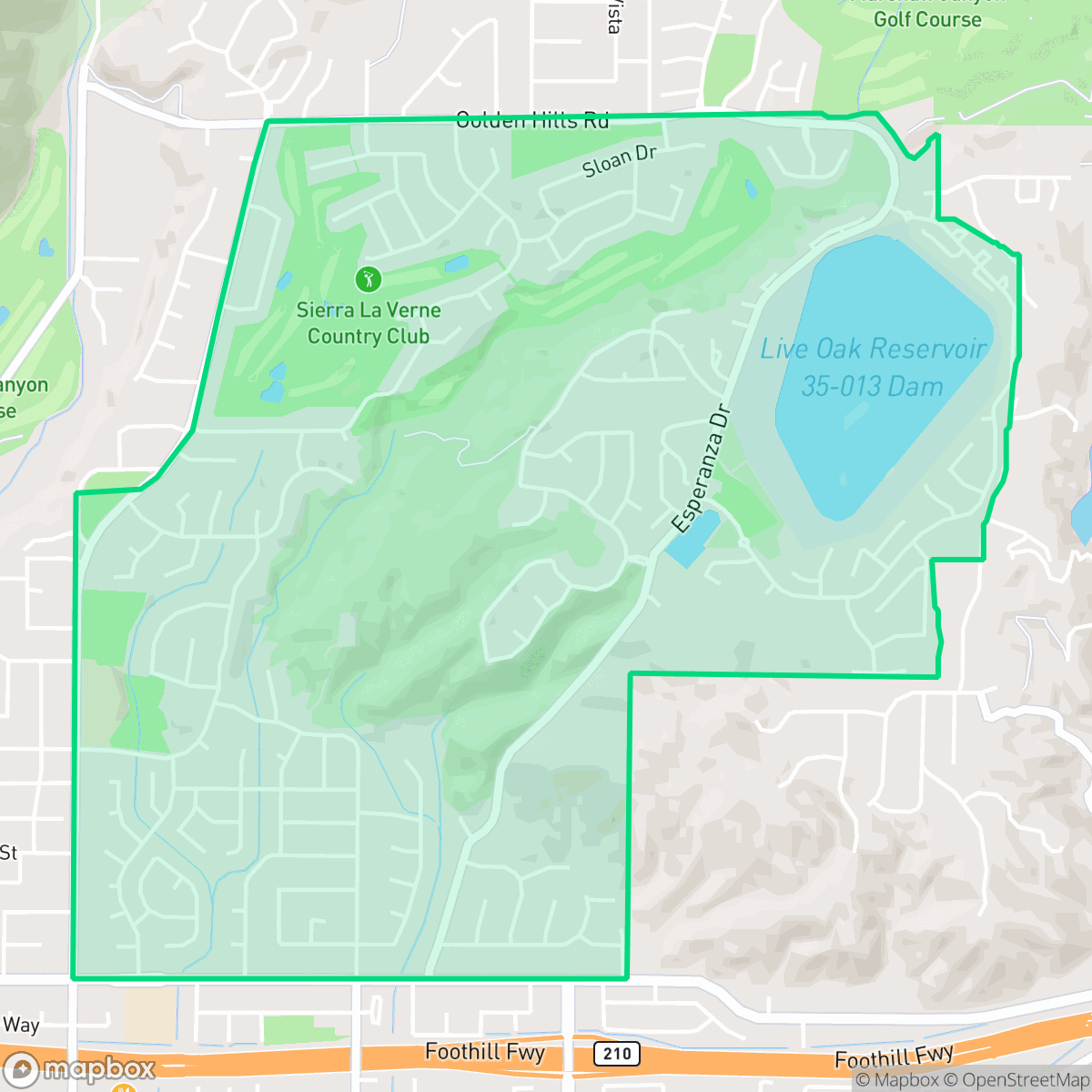
About North La Verne
North La Verne’s foothill region is the namesake of the entire city; the L.H. Bixby family of ranchers first coined "La Verne" (believing it meant "growing green") for this northern area. Historically dominated by citrus and lemon groves, as well as dry-land farming, the area transitioned to residential tracts in the late 20th century. Prominent master-planned developments like Sierra La Verne, La Verne Heights, and Marshall Canyon Estates now sit on these former agricultural lands. The neighborhood is home to notable local landmarks such as the Sierra La Verne Country Club, Heritage Park—which preserves one of the city's last historic orange groves—and the historic Dewenter Ranch, which is listed on the National Register of Historic Places.
The neighborhood functions as a tranquil, low-density enclave that prioritizes natural beauty and suburban space. It features high visual appeal and a strong connection to the surrounding canyon landscape, making it well-suited for those seeking a retreat from urban density. According to iHuus data, the area maintains excellent air quality and is entirely free from heavy industrial proximity, which contributes to a serene and clean living environment. The streets are calm and rarely busy, providing a consistent rhythm of residential life that is distinct from the more active corridors of the city.
Living in this area requires a trade-off between seclusion and immediate convenience, as the neighborhood lacks a high concentration of walkable businesses. Families are well-served by the highly-rated Bonita Unified School District, which provides robust academic and extracurricular opportunities. Prospective residents should note the elevated fire risk inherent to the foothill location and plan accordingly for home maintenance and emergency preparedness, as the neighborhood's remote nature and reliance on natural surroundings are defining features of the local experience.
Neighborhood Scores Across 15 Qualities
Residential spacing provides a moderate level of separation between neighbors, which is slightly higher than the average for La Verne. This layout offers a balance of community connection and individual buffer zones.
Safe crossings and sidewalks on one side of the street facilitate easy pedestrian movement. This level of walkability is slightly above the La Verne average, according to iHuus data.
Large homes and frequent upscale amenities provide a more aesthetically pleasing environment than the La Verne average, according to iHuus data. Spacious driveways and well-maintained properties contribute to a premium streetscape.
Connected green spaces and wide, low-traffic paths make this area slightly more dog friendly than the rest of La Verne, according to iHuus data.
Low-density development and vast hilly open spaces create a semi-rural feel that is more prominent than the La Verne average. According to iHuus data, the area features significant natural canyon landscapes and integrated woodland surroundings.
Residential streets and green spaces offer a calm atmosphere with a slight increase in activity compared to the La Verne average. While some areas near major roadways provide access to local dining, much of the neighborhood is low-density and requires a car for most commercial needs.
Frequent noise from nearby railroad tracks and heavy freeway traffic defines the acoustic environment. This level of disturbance is slightly higher than the average found throughout La Verne.
Air quality remains consistently high with minimal health concerns. According to iHuus data, the atmosphere in North La Verne is cleaner than the average for the rest of the city.
No warehouses, industrial facilities, or hazardous sites are present within this area. According to iHuus data, this neighborhood is notably more free of industrial activity than the La Verne average.
Health insurance accessibility is high among residents, sitting slightly above the La Verne average according to iHuus data.
Political leanings in this area trend more conservative than the La Verne average. According to iHuus data, the neighborhood maintains a conservative majority with a smaller presence of opposing viewpoints.
Residents live alongside a balanced mix of young professionals, families, and seniors. This demographic spread is slightly more varied than the average found throughout the rest of La Verne, according to iHuus data.
Flood risk in this area is notably higher than the La Verne average. According to iHuus data, a detailed FEMA study has not yet been completed for this specific location, leaving the precise level of risk undetermined.
Extreme fire hazards are present in this area, representing a significantly higher risk level than the La Verne city average according to iHuus data.
Address-Level Insights for North La Verne


iHuus Neighborhood Intelligence Insights
Get address-level neighborhood insights for North La Verne
- Street-level scores — see how individual blocks compare, not just neighborhood averages
- Micro-zone boundaries — identify quiet pockets, flood boundaries, and walkable clusters before you visit
- 15 dimensions in full — walkability, noise, air quality, school quality, insurance coverage, population age profile, urban/rural index, and more
- Boundary risk alerts — know if your address sits near a block boundary where scores drop, the kind of detail no listing will ever mention
- School insights — individual school ratings and insights, not just district-level data
- Compare before you commit — side-by-side data across neighborhoods, down to block precision
No credit card required
Compare with Any Neighborhood
| Dimension | North La Verne | Foothill Boulevard Corridor |
|---|---|---|
| 🚶 Walkabilityavg 8.19 | ||
| 🔊 Acoustic Comfortavg 2.95 | ||
| 🤫 Privacy Indexavg 5.37 | ||
| 🎨 Visual Appealavg 6.87 | ||
| 🐕 Dog Friendlinessavg 6.38 | ||
| 🗺️ Urban-Rural Indexavg 6.78 | ||
| ✨ Neighborhood Vibeavg 4.03 | ||
| 🏥 Health Insurance Coverageavg 7.95 | ||
| 🌿 Air Qualityavg 9.42 | ||
| 🏭 Industrial Proximityavg 7.94 | ||
| 🌊 Flood Safetyavg 2.78 | ||
| 🗳️ Ideological Leanavg 5.37 | ||
| 👥 Population Age Profileavg 5.28 | ||
| 🔥 Fire Safetyavg 0.34 | ||
| 🏫 School Quality |
North La Verne Rankings
School Districts Serving North La Verne
School Insights for North La Verne
Below average outcomes; significant attendance and academic challenges.
School Insights
See what's really behind every school rating near North La Verne
- Individual school ratings — each school's own score with outcome context, not just a district average
- Enrollment & class size data — student-to-teacher ratio and how it compares to the state average
- Full demographics breakdown — ethnicity and gender composition for every school in the enrollment zone
- Every school in the district — all schools within the enrollment boundary ranked by rating, not just the closest one
- Grade levels & benchmarks — elementary through high school, with below/above state-average flags
No credit card required