Lordsburg, La Verne
Updated · 7,345 residents
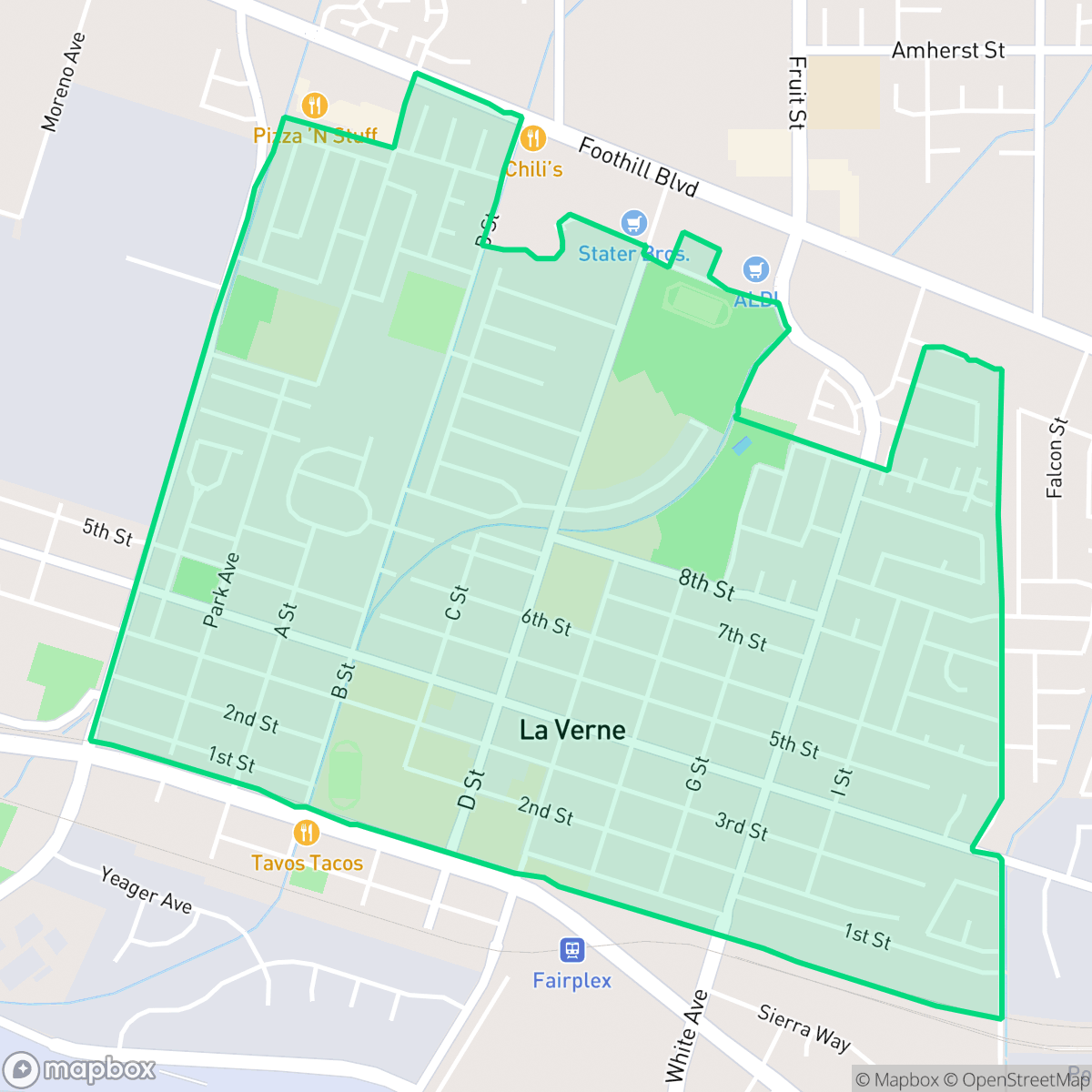
Lordsburg is a highly walkable neighborhood in La Verne featuring historic architecture and mature Deodar cedar trees. Residents benefit from access to top-rated schools within the Bonita Unified School District and a calm suburban environment.
Key Highlights
About Lordsburg
Founded in 1887 by entrepreneur Isaac W. Lord as a Santa Fe Railroad boomtown, the historic Lordsburg neighborhood—now known as Old Town La Verne—serves as the cultural heart of La Verne, California. Its defining landmark, the 1887 Lordsburg Hotel, never hosted a paying guest but was repurposed in 1891 by the Church of the Brethren to house Lordsburg College, today’s University of La Verne. Centered around D Street and Third Street, the neighborhood features historic century-old homes, towering Deodar cedar trees, and Mainiero Square. Architectural highlights include the Gothic Moderne tower of the Brethren Church on E Street and the nearby 1868 Carrion Adobe. Following Lord’s death, residents officially changed the town's name to La Verne in 1917, celebrating with a symbolic wedding between "Miss Lordsburg" and "Mr. La Verne."
Lordsburg is a dense suburban area characterized by a balanced mix of residential streets and localized commercial clusters. The neighborhood maintains a quiet atmosphere with consistent sidewalk infrastructure, making it one of the more pedestrian-friendly areas in the region. While it retains a traditional suburban feel, residents have access to diverse dining options and community leisure spaces like local parks. The architectural landscape is defined by century-old homes and well-manicured properties, contributing to a stable and established residential character.
The area offers a high quality of life for families, particularly those prioritizing education, given the proximity to high-performing institutions like Bonita High and Grace Miller Elementary. Potential residents should note the moderate noise levels from road traffic and the presence of light industrial infrastructure near the railway. While the neighborhood provides a cohesive and accessible setting, it remains a car-oriented environment for most daily errands beyond the immediate vicinity.
Neighborhood Scores Across 15 Qualities
Residential spacing is relatively average for La Verne, featuring a mix of standard suburban yards and areas where houses sit closer together. According to iHuus data, some neighbors maintain a moderate buffer, while other pockets exhibit higher density with less distance between structures.
Continuous sidewalks on both sides of most streets and pedestrian paths in nearby park areas make navigating the area on foot easy. According to iHuus data, this level of pedestrian accessibility is higher than the average for La Verne.
Residences feature a mix of large homes with private pools and more standard multi-family housing. According to iHuus data, the overall visual quality is slightly below the La Verne city average.
While the area features a large public park with sports fields and grassy verges, limited access to green space within residential blocks makes the neighborhood slightly less dog friendly than the La Verne average, according to iHuus data.
Residential grids and commercial warehouses create a suburban landscape that is slightly less open than the La Verne average. According to iHuus data, the area features a blend of single-family homes, industrial infrastructure, and utility clusters.
A mix of residential streets and industrial corridors creates a functional, steady atmosphere that is slightly more active than the La Verne average. While dining options are diverse, many services are scattered throughout the area, necessitating a car for most errands.
Steady traffic sounds from a nearby busy street are common here; however, acoustic comfort levels remain slightly higher than the average for La Verne, according to iHuus data.
Air quality remains consistently high with only infrequent periods of elevated readings. According to iHuus data, the air quality in Lordsburg is slightly lower than the La Verne city average.
Industrial presence is minimal within the neighborhood, though some light commercial activity and water treatment infrastructure are located nearby. This level of industrial proximity is slightly higher than the average for the city of La Verne, according to iHuus data.
Health insurance enrollment is widespread among residents, performing nearly in line with the La Verne city average according to iHuus data.
Political leanings in this area trend more liberal than the La Verne average. According to iHuus data, the neighborhood contains a liberal majority with a modest opposing presence.
Residents live alongside a varied mix of young adults, families, and seniors. This demographic spread is slightly more varied than the average found elsewhere in La Verne, according to iHuus data.
Flood risk in Lordsburg is notably higher than the La Verne average due to its location within a designated floodplain. According to iHuus data, properties in this area may require mandatory flood insurance.
Address-Level Insights for Lordsburg


iHuus Neighborhood Intelligence Insights
Get address-level neighborhood insights for Lordsburg
- Street-level scores — see how individual blocks compare, not just neighborhood averages
- Micro-zone boundaries — identify quiet pockets, flood boundaries, and walkable clusters before you visit
- 15 dimensions in full — walkability, noise, air quality, school quality, insurance coverage, population age profile, urban/rural index, and more
- Boundary risk alerts — know if your address sits near a block boundary where scores drop, the kind of detail no listing will ever mention
- School insights — individual school ratings and insights, not just district-level data
- Compare before you commit — side-by-side data across neighborhoods, down to block precision
No credit card required
Compare with Any Neighborhood
| Dimension | Lordsburg | Foothill Boulevard Corridor |
|---|---|---|
| 🚶 Walkabilityavg 8.19 | ||
| 🔊 Acoustic Comfortavg 2.95 | ||
| 🤫 Privacy Indexavg 5.37 | ||
| 🎨 Visual Appealavg 6.87 | ||
| 🐕 Dog Friendlinessavg 6.38 | ||
| 🗺️ Urban-Rural Indexavg 6.78 | ||
| ✨ Neighborhood Vibeavg 4.03 | ||
| 🏥 Health Insurance Coverageavg 7.95 | ||
| 🌿 Air Qualityavg 9.42 | ||
| 🏭 Industrial Proximityavg 7.94 | ||
| 🌊 Flood Safetyavg 2.78 | ||
| 🗳️ Ideological Leanavg 5.37 | ||
| 👥 Population Age Profileavg 5.28 | ||
| 🔥 Fire Safetyavg 0.34 | ||
| 🏫 School Quality |
Lordsburg Rankings
School Districts Serving Lordsburg
School Insights for Lordsburg
Below average outcomes; significant attendance and academic challenges.
School Insights
See what's really behind every school rating near Lordsburg
- Individual school ratings — each school's own score with outcome context, not just a district average
- Enrollment & class size data — student-to-teacher ratio and how it compares to the state average
- Full demographics breakdown — ethnicity and gender composition for every school in the enrollment zone
- Every school in the district — all schools within the enrollment boundary ranked by rating, not just the closest one
- Grade levels & benchmarks — elementary through high school, with below/above state-average flags
No credit card required