Foothill Boulevard Corridor, La Verne
Updated · 6,603 residents
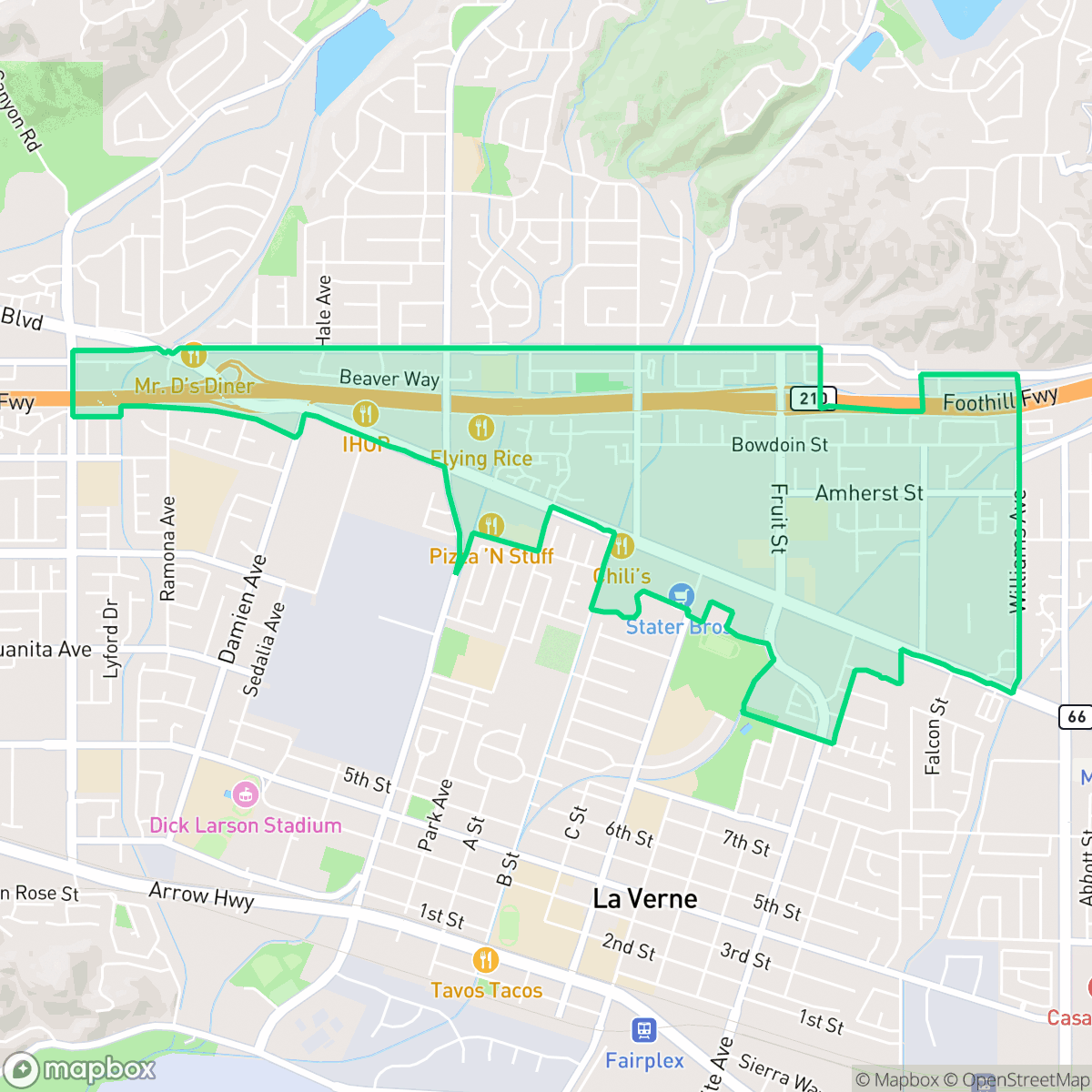
The Foothill Boulevard Corridor is a highly walkable neighborhood in La Verne known for its dense concentration of local restaurants, cafes, and services. While the area offers excellent air quality and access to top-rated schools, residents should be prepared for significant noise levels caused by heavy road traffic along the main thoroughfare.
Key Highlights
About Foothill Boulevard Corridor
The Foothill Boulevard Corridor in La Verne, California, has a rich history deeply rooted in early California transit and the citrus industry. Originally tracing the National Old Trails Highway, the corridor was incorporated into the iconic U.S. Route 66 in 1926. For decades, the surrounding landscape was dominated by sprawling orange and lemon groves until suburban development took over in the 1970s. Historically significant landmarks define the corridor, including the Carrion Adobe, an L-shaped home built in 1868 for Saturnino Carrion on a portion of the Rancho San Jose land grant. The neighborhood also features classic Route 66 roadside culture, highlighted by long-standing local businesses like the La Paloma Restaurant, which opened in 1966 on the former site of a 1920s sandwich shop.
The neighborhood functions as a central hub for social and culinary activity, characterized by a vibrant mix of dining options and local businesses that line the historic corridor. With a walkability score that ranks among the highest in the region, the area encourages an active lifestyle where daily errands and social outings are easily accomplished on foot. Educational opportunities are a primary draw, as the community is served by the highly regarded Bonita Unified School District, which is recognized for its strong academic performance and robust extracurricular programs. According to iHuus data, the area maintains a lively suburban atmosphere that successfully balances urban accessibility with residential convenience.
Prospective residents should note that the neighborhood experiences elevated noise levels due to its proximity to major transit routes, which is a notable trade-off for its central location. While the area boasts high air quality and a lack of industrial hazards, it is situated in a zone with significant fire safety risks. This makes the corridor an ideal location for those who prioritize walkability and proximity to services over absolute acoustic tranquility.
Neighborhood Scores Across 15 Qualities
Residential spacing is consistent with the La Verne average, though density varies significantly between apartment clusters and detached suburban homes. While many houses feature fenced yards for individual separation, some areas contain closely situated structures.
Sidewalk networks are comprehensive throughout much of the area, featuring safe crossings and continuous paths in park zones. This accessibility to pedestrian infrastructure is slightly better than the La Verne average, according to iHuus data.
Scenic elements like manicured yards and private pools are contrasted by high-density apartment clusters and mobile home parks. This variety in landscape and housing density is largely in line with the broader La Verne area according to iHuus data.
Varied access to walking spaces exists here, ranging from large public parks and wide green parkways to areas with minimal public verges. According to iHuus data, the availability of pet-friendly green space is slightly below the La Verne average.
Predominantly dense suburban layouts define this area, featuring a blend of single-family homes, apartments, and commercial clusters. This level of development is slightly more built-up than the typical landscape found elsewhere in La Verne.
A moderate variety of dining and local services creates a more active atmosphere than the La Verne average. Residents will find a balanced mix of suburban streets and social hubs, though many amenities remain car-dependent.
Frequent noise from nearby transit corridors and rail lines characterizes this area. According to iHuus data, acoustic comfort is slightly lower than the La Verne average.
Air quality remains consistently high with very few health concerns, performing slightly above the La Verne average according to iHuus data.
Industrial activity is minimal throughout most of the area, consisting primarily of residential zones and light commercial use. While some utility infrastructure exists in the southeast, the lack of heavy industry is more pronounced here than in the rest of La Verne.
Health insurance accessibility is strong in this area, with coverage rates appearing higher than the La Verne average according to iHuus data.
Political perspectives in this area are fairly evenly split between conservative and liberal leanings, closely mirroring the broader distribution seen across La Verne.
A diverse mix of young adults, families, and seniors resides here, mirroring the broader age distribution seen across La Verne. This demographic variety creates a stable residential environment according to iHuus data.
Flood risk is significant in this area as it falls within a designated 100 year floodplain. According to iHuus data, this level of risk is consistent with the city average and often necessitates the purchase of flood insurance.
Fire risk levels in this area are exceptionally high, representing a much greater danger than the average for La Verne. Residents should prioritize maximum protection measures and remain vigilant according to iHuus data.
Address-Level Insights for Foothill Boulevard Corridor


iHuus Neighborhood Intelligence Insights
Get address-level neighborhood insights for Foothill Boulevard Corridor
- Street-level scores — see how individual blocks compare, not just neighborhood averages
- Micro-zone boundaries — identify quiet pockets, flood boundaries, and walkable clusters before you visit
- 15 dimensions in full — walkability, noise, air quality, school quality, insurance coverage, population age profile, urban/rural index, and more
- Boundary risk alerts — know if your address sits near a block boundary where scores drop, the kind of detail no listing will ever mention
- School insights — individual school ratings and insights, not just district-level data
- Compare before you commit — side-by-side data across neighborhoods, down to block precision
No credit card required
Compare with Any Neighborhood
| Dimension | Foothill Boulevard Corridor | Foxglen |
|---|---|---|
| 🚶 Walkabilityavg 8.19 | ||
| 🔊 Acoustic Comfortavg 2.95 | ||
| 🤫 Privacy Indexavg 5.37 | ||
| 🎨 Visual Appealavg 6.87 | ||
| 🐕 Dog Friendlinessavg 6.38 | ||
| 🗺️ Urban-Rural Indexavg 6.78 | ||
| ✨ Neighborhood Vibeavg 4.03 | ||
| 🏥 Health Insurance Coverageavg 7.95 | ||
| 🌿 Air Qualityavg 9.42 | ||
| 🏭 Industrial Proximityavg 7.94 | ||
| 🌊 Flood Safetyavg 2.78 | ||
| 🗳️ Ideological Leanavg 5.37 | ||
| 👥 Population Age Profileavg 5.28 | ||
| 🔥 Fire Safetyavg 0.34 | ||
| 🏫 School Quality |
Foothill Boulevard Corridor Rankings
School Districts Serving Foothill Boulevard Corridor
School Insights for Foothill Boulevard Corridor
Below average outcomes; significant attendance and academic challenges.
School Insights
See what's really behind every school rating near Foothill Boulevard Corridor
- Individual school ratings — each school's own score with outcome context, not just a district average
- Enrollment & class size data — student-to-teacher ratio and how it compares to the state average
- Full demographics breakdown — ethnicity and gender composition for every school in the enrollment zone
- Every school in the district — all schools within the enrollment boundary ranked by rating, not just the closest one
- Grade levels & benchmarks — elementary through high school, with below/above state-average flags
No credit card required