Southgate, Hayward
Updated · 7,159 residents
Southgate is a highly walkable residential community defined by its mid-century tract housing and proximity to major regional retail hubs. While the area offers convenient pedestrian access to local amenities, residents often experience elevated noise levels from nearby freeways and must account for significant flood risks associated with the coastal landscape.
Key Highlights
About Southgate
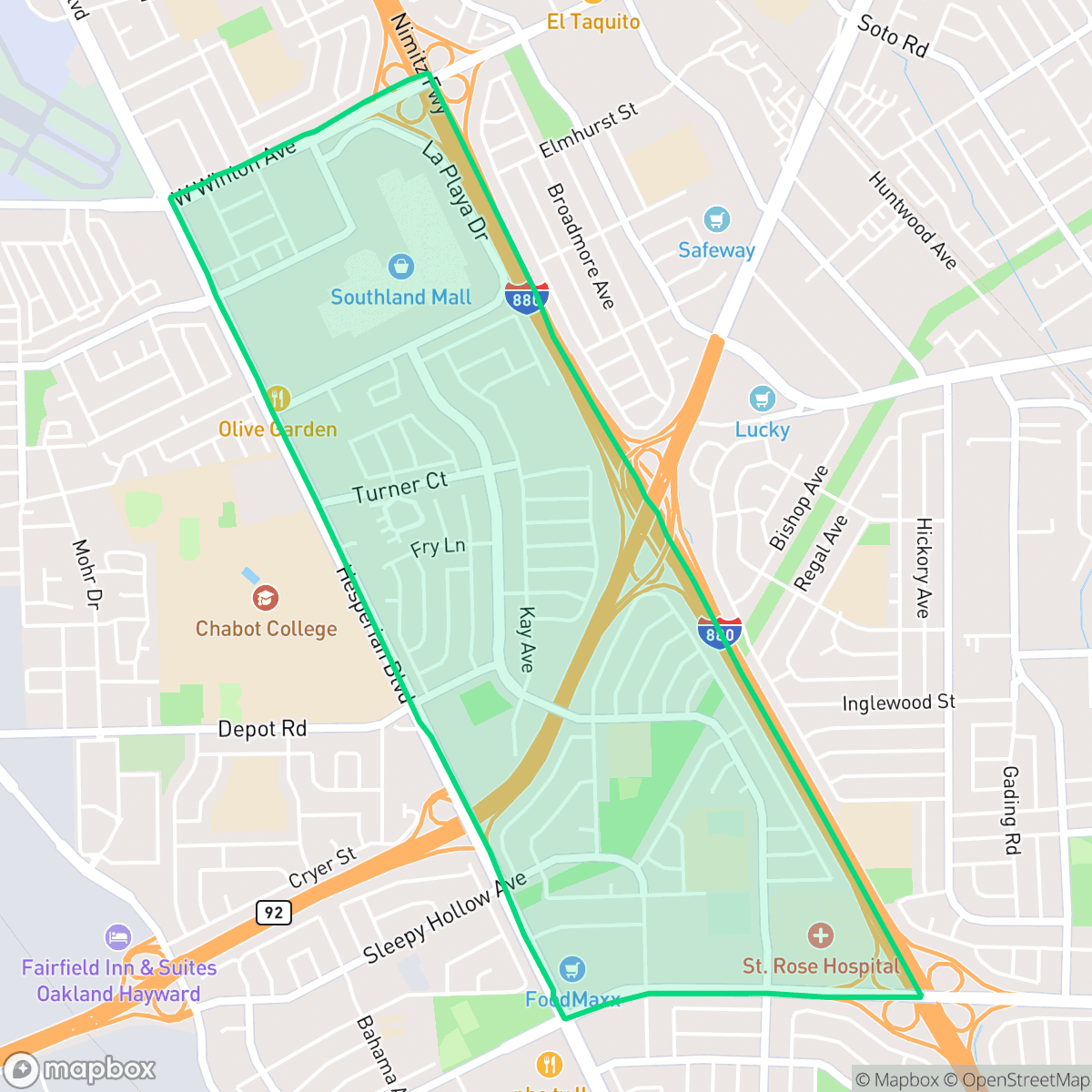
The Southgate neighborhood in Hayward, California, transitioned from an agricultural landscape of orchards to a residential community during the post-war building boom of the 1950s. Historically influenced by the nearby Hunt’s Cannery, the area was largely developed by the early 1960s. The neighborhood is bounded by West Winton Avenue, West Tennyson Road, Hesperian Boulevard, and Interstate 880, with State Route 92 bisecting the area. A significant landmark in the neighborhood's development is the Southland Mall, which opened in the late 1950s as one of the East Bay's first regional shopping centers. Today, Southgate remains a primarily residential, "built-out" district characterized by its mid-century housing stock and proximity to major regional transit corridors.
Southgate maintains a steady suburban rhythm characterized by a diverse mix of families and long-term residents. The area's layout emphasizes accessibility, with extensive sidewalk networks that facilitate easy movement throughout the district. According to iHuus data, the environment is notably free from heavy industrial activity, contributing to a cleaner residential atmosphere compared to many other parts of the city. The neighborhood provides a consistent, uniform aesthetic that reflects its post-war development roots while offering a balanced social environment for its diverse population.
Prospective residents should carefully consider the trade-offs of living in this coastal zone, specifically the higher flood hazard and the persistent acoustic impact of nearby transit corridors. The local school district currently faces significant fiscal and operational challenges that may impact families with school-aged children. This area is best suited for those who prioritize high walkability and central access to the East Bay over absolute quietude or proximity to top-tier educational institutions.
Neighborhood Scores Across 15 Qualities
Residential spacing varies between shared-wall apartment complexes and closely packed houses, though the level of separation between neighbors is roughly comparable to the Hayward average.
Extensive sidewalk networks and clear crosswalks make most areas easy to navigate on foot, performing slightly better than the Hayward average. While the residential streets are well-connected, the presence of a major highway and nearby airport interchange can impact pedestrian comfort in certain sections.
Standard tract housing and multi-unit complexes characterize the area, featuring uniform rooflines and small yards. This visual landscape is largely consistent with the average found throughout Hayward.
Access to multiple large public parks, school fields, and green corridors provides ample space for pets. According to iHuus data, the availability of connected green spaces and wide verges in Southgate is slightly above the Hayward average.
Dense suburban layouts featuring single-family homes and commercial clusters define this area. The landscape is slightly more developed than the surrounding Hayward average, showing more concentrated residential and retail infrastructure.
A balanced mix of residential life and essential services provides a more active atmosphere than the Hayward average. While dining and social hubs are available, many locations require a car due to the suburban, light industrial layout of the area.
Frequent disturbances from nearby railroad tracks and heavy freeway traffic characterize this area. According to iHuus data, acoustic comfort is significantly lower than the average for Hayward.
Air quality in Southgate fluctuates between acceptable and unhealthy levels, which may cause occasional concern for sensitive groups. According to iHuus data, these conditions are largely consistent with the average found across Hayward.
Primarily residential and institutional, this area lacks heavy industrial hazards or large warehouses. According to iHuus data, the neighborhood enjoys a cleaner environment than the Hayward average due to the absence of significant industrial activity.
Health insurance coverage among residents is high, though slightly lower than the Hayward city average according to iHuus data.
Voting patterns and census indicators reflect a deeply liberal political leaning that is consistent with the broader Hayward area, according to iHuus data.
A balanced mix of young adults, families, and older residents characterizes the area. This demographic spread is very similar to the broader Hayward population, according to iHuus data.
Significant flood hazards exist here due to the coastal high-hazard zone and wave action, which represents a much higher risk than the Hayward average. Residents should prepare for potential challenges with elevated or prohibitive insurance costs according to iHuus data.
Address-Level Insights for Southgate


iHuus Neighborhood Intelligence Insights
Get address-level neighborhood insights for Southgate
- Street-level scores — see how individual blocks compare, not just neighborhood averages
- Micro-zone boundaries — identify quiet pockets, flood boundaries, and walkable clusters before you visit
- 15 dimensions in full — walkability, noise, air quality, school quality, insurance coverage, population age profile, urban/rural index, and more
- Boundary risk alerts — know if your address sits near a block boundary where scores drop, the kind of detail no listing will ever mention
- School insights — individual school ratings and insights, not just district-level data
- Compare before you commit — side-by-side data across neighborhoods, down to block precision
No credit card required
Compare with Any Neighborhood
| Dimension | Southgate | Burbank |
|---|---|---|
| 🚶 Walkabilityavg 8.68 | ||
| 🔊 Acoustic Comfortavg 3.07 | ||
| 🤫 Privacy Indexavg 4.49 | ||
| 🎨 Visual Appealavg 6.11 | ||
| 🐕 Dog Friendlinessavg 6.49 | ||
| 🗺️ Urban-Rural Indexavg 6.69 | ||
| ✨ Neighborhood Vibeavg 4.15 | ||
| 🏥 Health Insurance Coverageavg 7.62 | ||
| 🌿 Air Qualityavg 5.88 | ||
| 🏭 Industrial Proximityavg 7.6 | ||
| 🌊 Flood Safetyavg 1.94 | ||
| 🗳️ Ideological Leanavg 9.75 | ||
| 👥 Population Age Profileavg 4.77 | ||
| 🔥 Fire Safetyavg 0.2 | ||
| 🏫 School Quality |
Southgate Rankings
School Districts Serving Southgate
School Insights for Southgate
Below average outcomes; significant attendance and academic challenges.
School Insights
See what's really behind every school rating near Southgate
- Individual school ratings — each school's own score with outcome context, not just a district average
- Enrollment & class size data — student-to-teacher ratio and how it compares to the state average
- Full demographics breakdown — ethnicity and gender composition for every school in the enrollment zone
- Every school in the district — all schools within the enrollment boundary ranked by rating, not just the closest one
- Grade levels & benchmarks — elementary through high school, with below/above state-average flags
No credit card required