Mission-Garin, Hayward
Updated · 7,698 residents
Mission-Garin is a dense suburban community in Hayward defined by its proximity to the expansive Garin Regional Park. While the area offers high walkability and convenient access to local transit corridors, residents experience significant road noise and limited privacy due to the close spacing of residential complexes.
Key Highlights
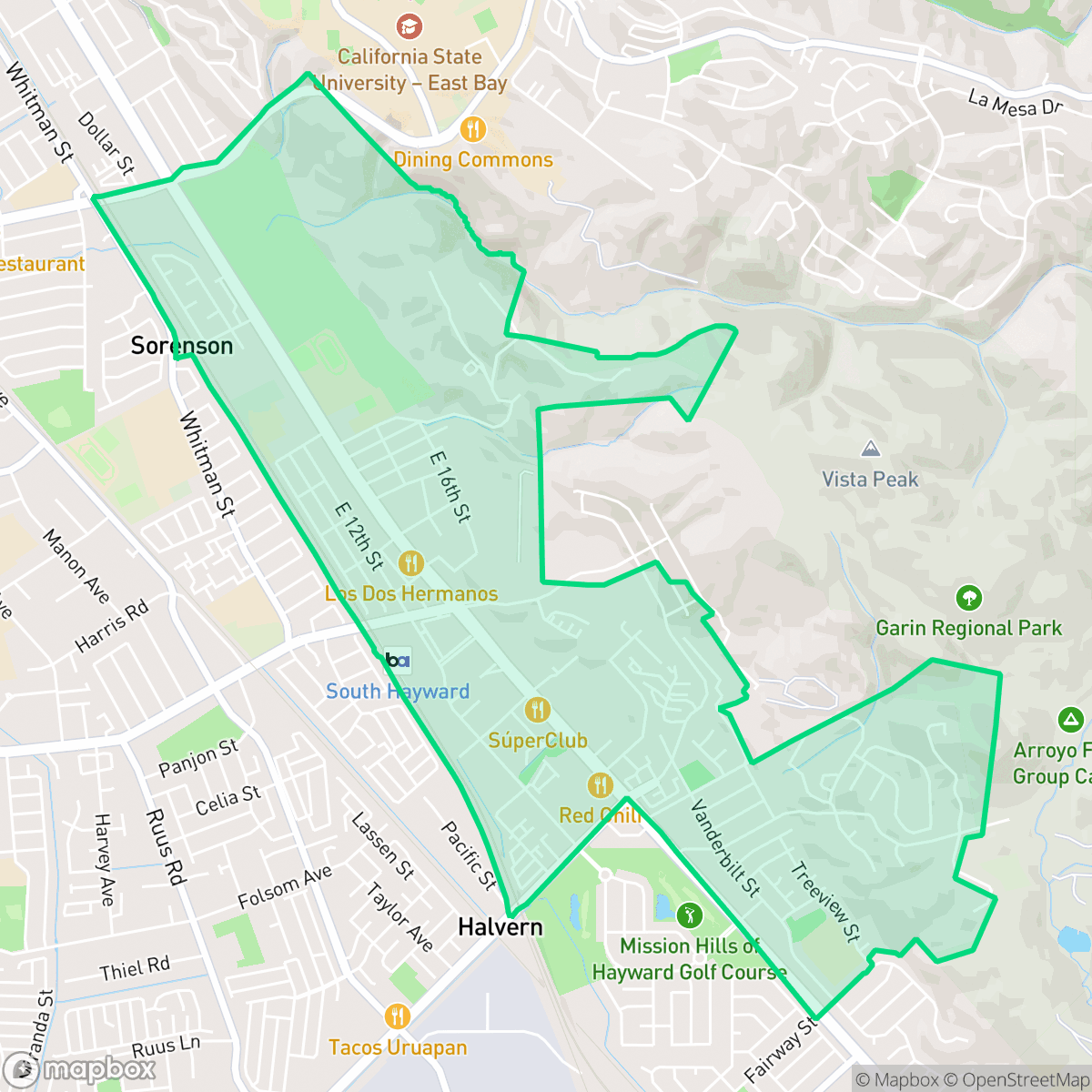
About Mission-Garin
Nestled in the rolling hills of Hayward, California, the Mission-Garin neighborhood transitioned from historic agricultural lands and ranching into a residential community during the post-World War II suburban boom, with most homes built between 1950 and 1970. The neighborhood is defined by its proximity to Garin Regional Park, formerly the 19th-century Garin Ranch sold by Andrew J. Garin in 1966. Within the park, the historic Garin Barn Visitor Center preserves the area's agricultural heritage, showcasing antique farm machinery and a historic apple orchard. The park also hosts 'Ukraina,' a California Historical Landmark that served as the 19th-century homestead and final resting place of exiled Ukrainian patriot and priest Father Agapius Honcharenko.
This neighborhood serves as a transition zone between residential living and industrial utility, characterized by a mix of mid-century tract housing and higher-density apartment complexes. The area maintains a quiet, low-key atmosphere that prioritizes functional access over commercial bustle, with local dining options scattered near the railway and light industrial zones. Its primary appeal lies in the immediate access to regional green space, providing a natural escape from the surrounding suburban density.
Prospective residents should consider the trade-offs of living in this environment, which includes elevated noise levels from nearby road traffic and a lack of private outdoor space. The local school district faces significant academic and operational challenges, which may influence housing decisions for families. While the area is highly walkable with a robust network of sidewalks, it is best suited for those who value proximity to transit and parklands over the quietude and privacy found in lower-density suburban settings.
Neighborhood Scores Across 15 Qualities
Residential spacing is relatively tight with many homes situated close to neighbors or sharing walls in apartment complexes. This density is roughly in line with the typical layout found across Hayward.
Pedestrians benefit from continuous sidewalks on both sides of most streets and clearly marked crossings at major intersections. This network of accessible paths is notably more comprehensive than the average found across Hayward.
Landscapes range from modern homes near golf courses to dense apartment complexes and industrial zones. According to iHuus data, the overall visual variety sits slightly above the Hayward city average.
Extensive greenways, golf courses, and public school fields provide ample space for exercise. According to iHuus data, the availability of connected trails and parks makes this area more dog friendly than the Hayward average.
Open land and scattered homes provide a semi-rural atmosphere that is slightly more spread out than the Hayward average. While much of the area features dense suburban layouts and commercial centers, some edges of the neighborhood retain significant green space and low-density development.
Low-density residential blocks and vast open spaces create a tranquil environment, though the area lacks the commercial activity found in most of Hayward. Access to local dining and essential services is limited and often requires a car due to the sparse distribution of businesses.
Audible disturbances from nearby railroad tracks and major freeway corridors are common in this area. According to iHuus data, acoustic comfort is slightly lower than the Hayward average.
Air quality in this area fluctuates between acceptable and unhealthy levels, appearing slightly lower than the Hayward average. Sensitive groups should monitor local conditions for occasional periods of concern.
Most of the area consists of quiet residential streets and light commercial use, though some western edges near rail lines and warehouses may experience increased truck traffic. This level of industrial separation is slightly higher than the Hayward average, according to iHuus data.
Health insurance accessibility is notably higher here than the Hayward average, according to iHuus data. Most residents in this area are covered by a health insurance plan.
Voting patterns and census indicators reflect a highly liberal political leaning that is consistent with the rest of Hayward.
Residents live alongside a diverse demographic of young adults, families, and older individuals. According to iHuus data, the age distribution is relatively consistent with the broader Hayward area.
Properties are situated within a designated floodplain, which typically necessitates the purchase of flood insurance. According to iHuus data, the risk of flooding in this area is notably higher than the Hayward city average.
Fire risk in this area is significantly higher than the Hayward average, necessitating extreme caution and robust protection measures. According to iHuus data, the neighborhood faces an exceptionally severe level of fire danger.
Address-Level Insights for Mission-Garin


iHuus Neighborhood Intelligence Insights
Get address-level neighborhood insights for Mission-Garin
- Street-level scores — see how individual blocks compare, not just neighborhood averages
- Micro-zone boundaries — identify quiet pockets, flood boundaries, and walkable clusters before you visit
- 15 dimensions in full — walkability, noise, air quality, school quality, insurance coverage, population age profile, urban/rural index, and more
- Boundary risk alerts — know if your address sits near a block boundary where scores drop, the kind of detail no listing will ever mention
- School insights — individual school ratings and insights, not just district-level data
- Compare before you commit — side-by-side data across neighborhoods, down to block precision
No credit card required
Compare with Any Neighborhood
| Dimension | Mission-Garin | Burbank |
|---|---|---|
| 🚶 Walkabilityavg 8.68 | ||
| 🔊 Acoustic Comfortavg 3.07 | ||
| 🤫 Privacy Indexavg 4.49 | ||
| 🎨 Visual Appealavg 6.11 | ||
| 🐕 Dog Friendlinessavg 6.49 | ||
| 🗺️ Urban-Rural Indexavg 6.69 | ||
| ✨ Neighborhood Vibeavg 4.15 | ||
| 🏥 Health Insurance Coverageavg 7.62 | ||
| 🌿 Air Qualityavg 5.88 | ||
| 🏭 Industrial Proximityavg 7.6 | ||
| 🌊 Flood Safetyavg 1.94 | ||
| 🗳️ Ideological Leanavg 9.75 | ||
| 👥 Population Age Profileavg 4.77 | ||
| 🔥 Fire Safetyavg 0.2 | ||
| 🏫 School Quality |
Mission-Garin Rankings
School Districts Serving Mission-Garin
School Insights for Mission-Garin
Below average outcomes; significant attendance and academic challenges.
School Insights
See what's really behind every school rating near Mission-Garin
- Individual school ratings — each school's own score with outcome context, not just a district average
- Enrollment & class size data — student-to-teacher ratio and how it compares to the state average
- Full demographics breakdown — ethnicity and gender composition for every school in the enrollment zone
- Every school in the district — all schools within the enrollment boundary ranked by rating, not just the closest one
- Grade levels & benchmarks — elementary through high school, with below/above state-average flags
No credit card required