Mission-Foothill, Hayward
Updated · 8,606 residents
Mission-Foothill is a densely developed neighborhood defined by its rugged, hilly terrain and proximity to local landmarks like Memorial Park. Residents benefit from high walkability and access to diverse green spaces, though the area experiences significant road noise and limited privacy due to its high-density residential layout.
Key Highlights
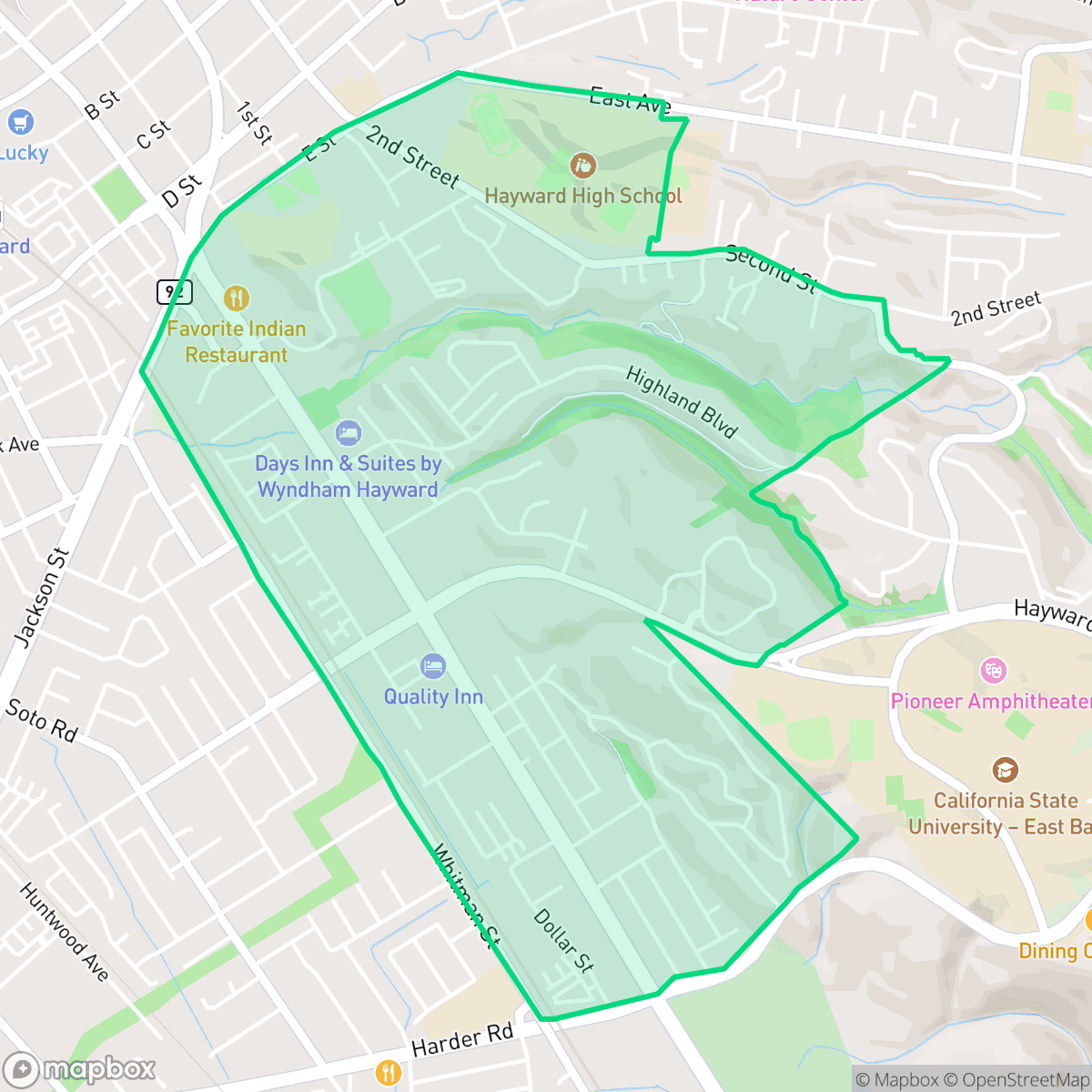
About Mission-Foothill
The rugged topography of Hayward’s Mission-Foothill neighborhood historically made development challenging, preserving a natural landscape of creeks, canyons, and fault-related springs. In the late 19th century, Ward Creek Canyon served as the scenic picnic terminus for the Oakland, San Leandro, and Hayward’s Electric Railway. This canyon eventually became Hayward’s first public park, Memorial Park, which is anchored by "The Plunge," a landmark indoor swimming pool built in 1936. Historically, natural springs near Spring Drive watered the area's early apricot groves. Today, the neighborhood is home to local institutions like Hayward High School and Bret Harte Middle School, maintaining a distinct character shaped by its unique geography and early recreational history.
Mission-Foothill functions as a dense suburban environment that balances residential clusters with institutional facilities and light industrial zones. The area is characterized by a mix of single-family homes and apartment complexes, creating a varied density that integrates with the surrounding hilly landscape. Notable local features include Hayward High School and various community hubs that anchor the neighborhood social life, while the consistent sidewalk network ensures that residents can easily navigate between residential zones and nearby green spaces.
Living in this area requires navigating certain trade-offs, particularly regarding acoustic comfort and privacy. The neighborhood experiences elevated noise levels primarily from road traffic, and the close proximity of housing units often results in limited personal space. While the school district faces ongoing academic and fiscal challenges, the area remains a practical choice for those prioritizing walkability and access to regional recreational amenities over quiet, low-density living.
Neighborhood Scores Across 15 Qualities
Housing layouts vary from tightly packed townhomes to single-family homes with moderate buffers. According to iHuus data, the spacing between neighbors is slightly higher than the Hayward city average.
Extensive sidewalk networks and clear pedestrian crossings are available throughout both residential and commercial zones, matching the city average for ease of movement. Dedicated paths through greenbelts and parks further support pedestrian activity, though a major railway corridor bisects some sections of the area.
Residential views consist primarily of uniform tract housing and mid-density apartment complexes with modest yards. This landscape is slightly more visually consistent than the Hayward average, featuring shared community amenities like pools and sports courts.
Abundant forest trails, large parks, and open fields provide ample space for pets, making the area slightly more dog friendly than the Hayward average according to iHuus data.
Residential pockets feature a blend of single-family homes and apartment complexes alongside preserved greenbelts and hilly terrain. This landscape offers a slightly higher presence of open land and woodland than the typical Hayward area, according to iHuus data.
Daily activity levels are consistent with the rest of Hayward, featuring a mix of quiet residential streets and light industrial zones. While diverse dining and essential services are available, the area is primarily car-dependent with limited pedestrian-friendly commercial density.
Steady sounds from nearby busy streets create a consistent background hum, though this level of acoustic activity remains more tranquil than the average found throughout Hayward.
Air quality in this area fluctuates between acceptable and unhealthy levels, presenting occasional concerns for sensitive groups. According to iHuus data, conditions are largely in line with the average for Hayward.
Largely residential streets and open green spaces define this area, though proximity to a railway corridor and some commercial warehouses may introduce occasional noise. According to iHuus data, the presence of industrial activity is lower here than the city average.
Health insurance access is more prevalent in this area than in the rest of Hayward, according to iHuus data. Most residents possess reliable medical coverage.
Voting patterns and census indicators in this area align closely with the broader Hayward political landscape. According to iHuus data, the neighborhood reflects the same predominant liberal leaning seen across the rest of the city.
A balanced mix of young adults, families, and older residents defines the local population. This distribution is largely consistent with the broader Hayward area according to iHuus data.
Flood risk levels are higher here than in most of Hayward; however, current FEMA assessments lack a detailed study to fully determine the long-term risk for this area.
High levels of wildfire risk exist within this area, matching the elevated fire danger found throughout the rest of Hayward. Residents should be prepared for stringent fire prevention measures and emergency preparedness protocols.
Address-Level Insights for Mission-Foothill


iHuus Neighborhood Intelligence Insights
Get address-level neighborhood insights for Mission-Foothill
- Street-level scores — see how individual blocks compare, not just neighborhood averages
- Micro-zone boundaries — identify quiet pockets, flood boundaries, and walkable clusters before you visit
- 15 dimensions in full — walkability, noise, air quality, school quality, insurance coverage, population age profile, urban/rural index, and more
- Boundary risk alerts — know if your address sits near a block boundary where scores drop, the kind of detail no listing will ever mention
- School insights — individual school ratings and insights, not just district-level data
- Compare before you commit — side-by-side data across neighborhoods, down to block precision
No credit card required
Compare with Any Neighborhood
| Dimension | Mission-Foothill | Burbank |
|---|---|---|
| 🚶 Walkabilityavg 8.68 | ||
| 🔊 Acoustic Comfortavg 3.07 | ||
| 🤫 Privacy Indexavg 4.49 | ||
| 🎨 Visual Appealavg 6.11 | ||
| 🐕 Dog Friendlinessavg 6.49 | ||
| 🗺️ Urban-Rural Indexavg 6.69 | ||
| ✨ Neighborhood Vibeavg 4.15 | ||
| 🏥 Health Insurance Coverageavg 7.62 | ||
| 🌿 Air Qualityavg 5.88 | ||
| 🏭 Industrial Proximityavg 7.6 | ||
| 🌊 Flood Safetyavg 1.94 | ||
| 🗳️ Ideological Leanavg 9.75 | ||
| 👥 Population Age Profileavg 4.77 | ||
| 🔥 Fire Safetyavg 0.2 | ||
| 🏫 School Quality |
Mission-Foothill Rankings
School Districts Serving Mission-Foothill
School Insights for Mission-Foothill
Below average outcomes; significant attendance and academic challenges.
School Insights
See what's really behind every school rating near Mission-Foothill
- Individual school ratings — each school's own score with outcome context, not just a district average
- Enrollment & class size data — student-to-teacher ratio and how it compares to the state average
- Full demographics breakdown — ethnicity and gender composition for every school in the enrollment zone
- Every school in the district — all schools within the enrollment boundary ranked by rating, not just the closest one
- Grade levels & benchmarks — elementary through high school, with below/above state-average flags
No credit card required