Hayward Highland, Hayward
Updated · 7,243 residents
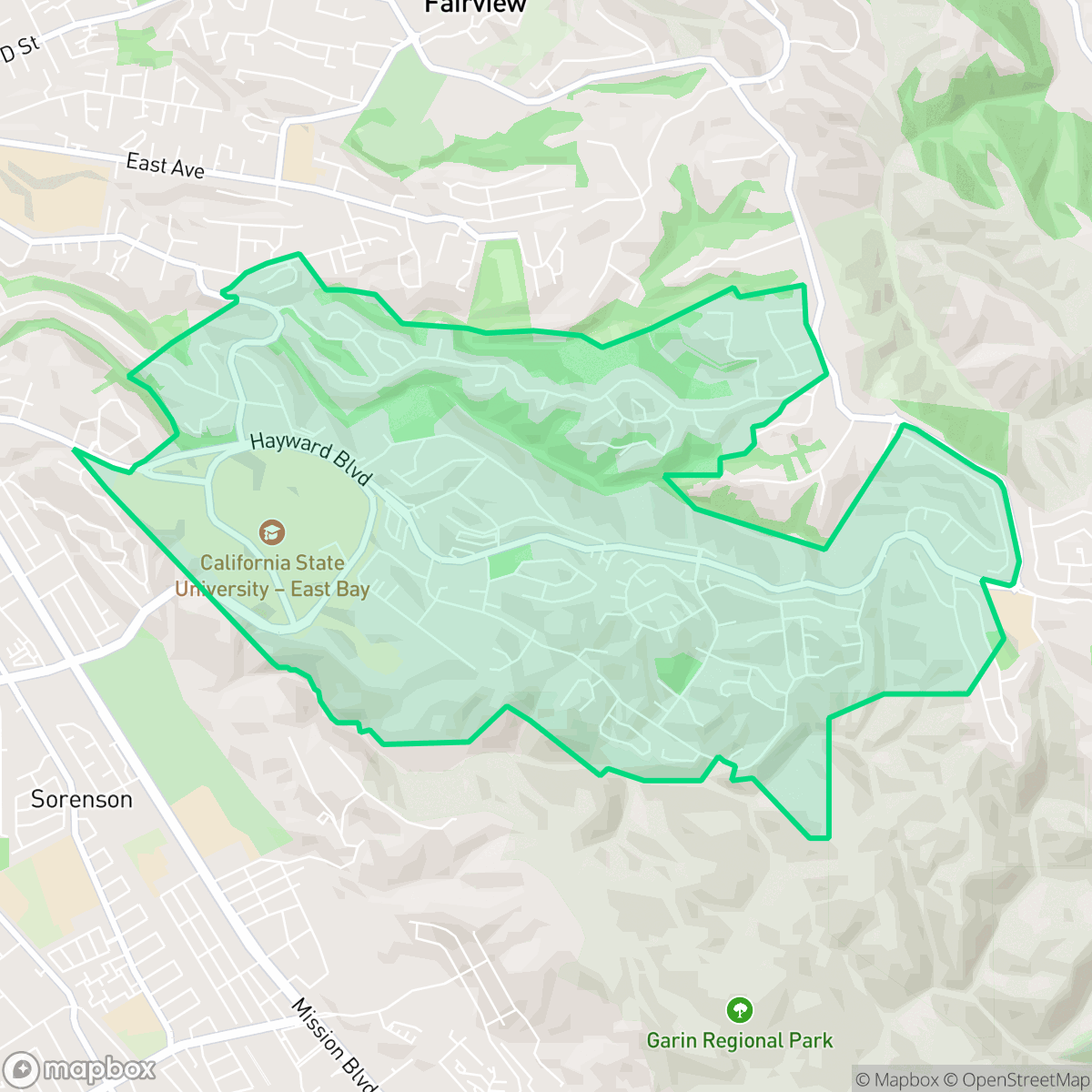
Hayward Highland is a quiet, residential community characterized by its hilly terrain and proximity to California State University, East Bay. The area offers a serene, suburban environment with significant green space and high dog-friendliness, though it remains largely car-dependent due to a limited commercial presence. Residents enjoy a peaceful atmosphere that stands in contrast to the more bustling urban centers of the city.
Key Highlights
About Hayward Highland
The Hayward Highland neighborhood, historically known as "Goat Hill," was originally subdivided in 1914 as the "Hayward Home Farm Tract". Early homesteaders faced a rugged terrain, dirt paths, and a lack of reliable water, keeping livestock like goats to manage weeds—a practice that earned the area its long-standing nickname. In 1933, twenty-three local residents formed the Hayward Highlands Association to establish their own water and volunteer fire districts. The neighborhood underwent dramatic changes in the 1960s when the adjacent hills were selected as the site for California State University, East Bay (then Cal State Hayward). This prompted annexation into the city of Hayward, the installation of modern municipal utilities, and a transition from rural homesteads to a residential college community with homes built primarily between the late 1960s and the 1990s.
The neighborhood serves as a tranquil, low-density residential enclave that balances suburban living with natural landscapes. While it lacks a distinct commercial core, the area provides a scenic, quiet setting for those who prioritize privacy and access to nature over proximity to retail or nightlife. According to iHuus data, the community maintains high visual appeal and is exceptionally welcoming to pet owners, making it a popular choice for those seeking a slower pace of life within the larger Hayward region.
Prospective residents should consider the trade-offs of living in this hillside location. The area faces significant fire safety concerns typical of its topography, and the local school district currently struggles with academic performance and fiscal instability. Because the neighborhood is primarily residential and car-oriented, daily errands typically require a vehicle. It is best suited for individuals or families who value a quiet, remote atmosphere and are comfortable navigating the challenges of a hilly, suburban landscape.
Neighborhood Scores Across 15 Qualities
Housing layouts range from tightly packed townhomes to single-family homes with moderate backyard buffers. According to iHuus data, this level of privacy and spacing is higher than the average for Hayward.
Continuous sidewalks and dedicated pedestrian paths through greenbelts make much of the area accessible on foot, though the neighborhood is slightly less walkable than the Hayward average.
Large homes and frequent upscale amenities contribute to a visual landscape that is more polished than the Hayward average. Residents can expect spacious driveways and various shared community features throughout the area.
Extensive forest trails, open fields, and large parks with tennis and baseball courts offer ample space for pet owners. According to iHuus data, the availability of these green spaces and walking areas is significantly higher than the Hayward average.
Frequent open land and significant forest cover provide a more semi-rural feel than the typical Hayward residential area. According to iHuus data, the landscape features a blend of hilly terrain and preserved greenbelts alongside suburban clusters.
Primarily composed of low-density residential blocks and open green spaces, this area lacks a central commercial hub and offers significantly less social activity than the Hayward average. Most residents will find the environment serene but will need to drive to access a variety of businesses or dining options.
Steady noise from nearby busy streets is a common feature here, though levels remain more tranquil than the city average according to iHuus data.
Air quality fluctuates between acceptable and unhealthy levels, with occasional concerns for sensitive groups. This pattern is largely in line with the average seen across Hayward.
Primarily residential and green spaces define this area, which lacks the heavy industrial presence found in other parts of Hayward. While some large-scale warehouse activity exists, the neighborhood remains significantly clearer of industrial hazards than the city average according to iHuus data.
Health insurance enrollment is notably higher here than the Hayward average, according to iHuus data.
Voting patterns and census indicators show a deeply liberal political leaning that is consistent with the rest of Hayward. According to iHuus data, the area's ideological profile matches the city average.
Residents live alongside a balanced mix of young adults, families, and older individuals. This demographic distribution is very similar to the broader Hayward area, according to iHuus data.
Flood risk in this area is notably higher than the Hayward average, though precise risk levels remain undetermined due to a lack of detailed federal studies. According to iHuus data, residents should remain aware of potential vulnerabilities during extreme weather events.
Fire hazards are notably higher in this area than the Hayward average, requiring residents to prioritize enhanced mitigation and preparedness. According to iHuus data, the local environment presents a much greater risk of fire compared to the rest of the city.
Address-Level Insights for Hayward Highland


iHuus Neighborhood Intelligence Insights
Get address-level neighborhood insights for Hayward Highland
- Street-level scores — see how individual blocks compare, not just neighborhood averages
- Micro-zone boundaries — identify quiet pockets, flood boundaries, and walkable clusters before you visit
- 15 dimensions in full — walkability, noise, air quality, school quality, insurance coverage, population age profile, urban/rural index, and more
- Boundary risk alerts — know if your address sits near a block boundary where scores drop, the kind of detail no listing will ever mention
- School insights — individual school ratings and insights, not just district-level data
- Compare before you commit — side-by-side data across neighborhoods, down to block precision
No credit card required
Compare with Any Neighborhood
| Dimension | Hayward Highland | Burbank |
|---|---|---|
| 🚶 Walkabilityavg 8.68 | ||
| 🔊 Acoustic Comfortavg 3.07 | ||
| 🤫 Privacy Indexavg 4.49 | ||
| 🎨 Visual Appealavg 6.11 | ||
| 🐕 Dog Friendlinessavg 6.49 | ||
| 🗺️ Urban-Rural Indexavg 6.69 | ||
| ✨ Neighborhood Vibeavg 4.15 | ||
| 🏥 Health Insurance Coverageavg 7.62 | ||
| 🌿 Air Qualityavg 5.88 | ||
| 🏭 Industrial Proximityavg 7.6 | ||
| 🌊 Flood Safetyavg 1.94 | ||
| 🗳️ Ideological Leanavg 9.75 | ||
| 👥 Population Age Profileavg 4.77 | ||
| 🔥 Fire Safetyavg 0.2 | ||
| 🏫 School Quality |
Hayward Highland Rankings
School Districts Serving Hayward Highland
School Insights for Hayward Highland
Below average outcomes; significant attendance and academic challenges.
School Insights
See what's really behind every school rating near Hayward Highland
- Individual school ratings — each school's own score with outcome context, not just a district average
- Enrollment & class size data — student-to-teacher ratio and how it compares to the state average
- Full demographics breakdown — ethnicity and gender composition for every school in the enrollment zone
- Every school in the district — all schools within the enrollment boundary ranked by rating, not just the closest one
- Grade levels & benchmarks — elementary through high school, with below/above state-average flags
No credit card required