Moneta Gardens, Hawthorne
Updated · 22,467 residents
Moneta Gardens is a densely populated residential enclave in Hawthorne characterized by high walkability and a consistent grid of sidewalks. While the area offers convenient access to local services, residents should expect a quiet suburban atmosphere with tightly packed housing and limited public green space.
Key Highlights
About Moneta Gardens
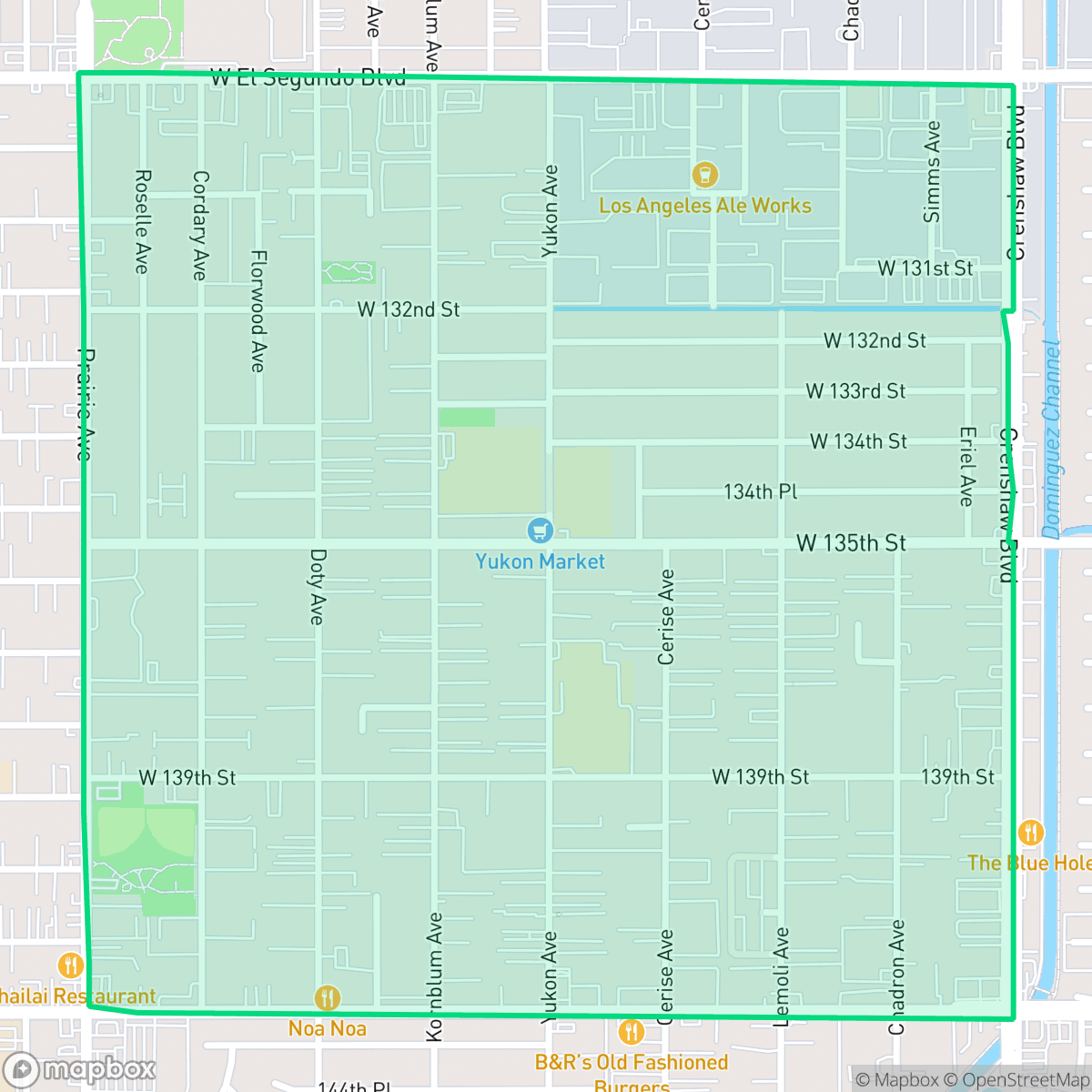
Moneta Gardens, a neighborhood in southeastern Hawthorne bounded by Prairie Avenue and Crenshaw Boulevard, transitioned from a quiet agricultural hub into a dense residential enclave. In the early 20th century, the area was dominated by Japanese truck farms and flower nurseries, including the Satow family’s flower farm established in 1913, the Rapela orchid farm, and the Bodger Seed Company. Following World War II, the rapid expansion of the South Bay’s aerospace industry fueled an insatiable demand for worker housing. During the 1960s, a series of annexations brought Moneta Gardens into Hawthorne's city limits. Developers capitalized on the neighborhood's unusually large agricultural parcels, replacing fields and nurseries with high-density apartment complexes and condominiums. Today, this transformation has left Moneta Gardens as the most densely populated residential sector in the city.
The neighborhood functions as a compact residential hub where the majority of residents live in mid-sized apartment complexes and closely situated homes. Its layout prioritizes pedestrian movement, featuring a reliable network of sidewalks that connect residents to essential services and diverse local dining options. The area maintains a calm demeanor, though the high density leads to reduced privacy between units and limited private yard space.
This environment is best suited for individuals who prioritize walkability and proximity to transit over expansive outdoor amenities. While the neighborhood lacks significant public parks, its urban design provides a functional, accessible living experience for those seeking a central location within the South Bay. Prospective residents should be prepared for moderate road noise and a high-density living arrangement typical of this sector of Hawthorne.
Neighborhood Scores Across 15 Qualities
Residential structures are positioned closely together with minimal separation between properties. This high-density layout results in a slightly lower privacy level compared to the Hawthorne average.
Continuous sidewalks and clearly marked crosswalks are available throughout the street grid. This level of pedestrian infrastructure is consistent with the average found across Hawthorne.
Uniform tract housing and dense apartment blocks characterize the area, featuring modest yards and limited private greenery. This visual landscape is consistent with the average seen throughout Hawthorne.
Public green space and park access are scarce in this area, as most greenery is restricted to private backyards. According to iHuus data, the availability of communal dog walking areas is consistent with the Hawthorne average.
Residential streets and green spaces are present in roughly equal measure to the built environment. This layout aligns with the typical suburban density found throughout Hawthorne.
A mix of residential streets and industrial pockets creates a subdued atmosphere that is less active than the Hawthorne average. While some dining options are accessible, many essential services require a car for transit.
Frequent sounds from nearby freeway and railroad activity are a primary characteristic of this area. According to iHuus data, acoustic levels are higher than the typical experience found elsewhere in Hawthorne.
Air quality in this area fluctuates between acceptable and unhealthy levels, sitting slightly below the Hawthorne average. Sensitive groups may experience occasional concern on certain days, according to iHuus data.
Residential and light commercial uses dominate the area, though some nearby logistics hubs and warehouse-style buildings are present. According to iHuus data, the level of industrial presence is slightly lower than the Hawthorne city average.
Health insurance coverage among residents is slightly above the Hawthorne average, according to iHuus data. This level of coverage represents a moderate baseline for the area.
Voting patterns and census indicators show a predominantly liberal leaning, which is slightly more pronounced than the Hawthorne city average.
Residents live alongside a balanced demographic of young adults, families, and older populations. This age distribution is consistent with the broader Hawthorne area according to iHuus data.
Flood risk is significantly higher than the Hawthorne average because this area sits within a designated floodplain. Residents should be aware that flood insurance is typically required for properties in this zone according to iHuus data.
Address-Level Insights for Moneta Gardens


iHuus Neighborhood Intelligence Insights
Get address-level neighborhood insights for Moneta Gardens
- Street-level scores — see how individual blocks compare, not just neighborhood averages
- Micro-zone boundaries — identify quiet pockets, flood boundaries, and walkable clusters before you visit
- 15 dimensions in full — walkability, noise, air quality, school quality, insurance coverage, population age profile, urban/rural index, and more
- Boundary risk alerts — know if your address sits near a block boundary where scores drop, the kind of detail no listing will ever mention
- School insights — individual school ratings and insights, not just district-level data
- Compare before you commit — side-by-side data across neighborhoods, down to block precision
No credit card required
Compare with Any Neighborhood
| Dimension | Moneta Gardens | Bodger Park |
|---|---|---|
| 🚶 Walkabilityavg 9 | ||
| 🔊 Acoustic Comfortavg 2.48 | ||
| 🤫 Privacy Indexavg 3.12 | ||
| 🎨 Visual Appealavg 5.99 | ||
| 🐕 Dog Friendlinessavg 4.3 | ||
| 🗺️ Urban-Rural Indexavg 6.05 | ||
| ✨ Neighborhood Vibeavg 5.09 | ||
| 🏥 Health Insurance Coverageavg 5.86 | ||
| 🌿 Air Qualityavg 6.35 | ||
| 🏭 Industrial Proximityavg 7.88 | ||
| 🌊 Flood Safetyavg 0.97 | ||
| 🗳️ Ideological Leanavg 9.72 | ||
| 👥 Population Age Profileavg 4.64 | ||
| 🔥 Fire Safety | ||
| 🏫 School Quality |
Moneta Gardens Rankings
School Districts Serving Moneta Gardens
School Insights for Moneta Gardens
Below average outcomes; significant attendance and academic challenges.
School Insights
See what's really behind every school rating near Moneta Gardens
- Individual school ratings — each school's own score with outcome context, not just a district average
- Enrollment & class size data — student-to-teacher ratio and how it compares to the state average
- Full demographics breakdown — ethnicity and gender composition for every school in the enrollment zone
- Every school in the district — all schools within the enrollment boundary ranked by rating, not just the closest one
- Grade levels & benchmarks — elementary through high school, with below/above state-average flags
No credit card required