Vineyard, Glendale
Updated · 8,194 residents
Vineyard is an exceptionally walkable, high-energy urban neighborhood characterized by its dense residential layout and vibrant, diverse culinary scene. While it offers convenient access to local amenities and city life, residents experience limited privacy due to the close proximity of neighboring homes and a bustling, concrete-dominant environment.
Key Highlights
About Vineyard
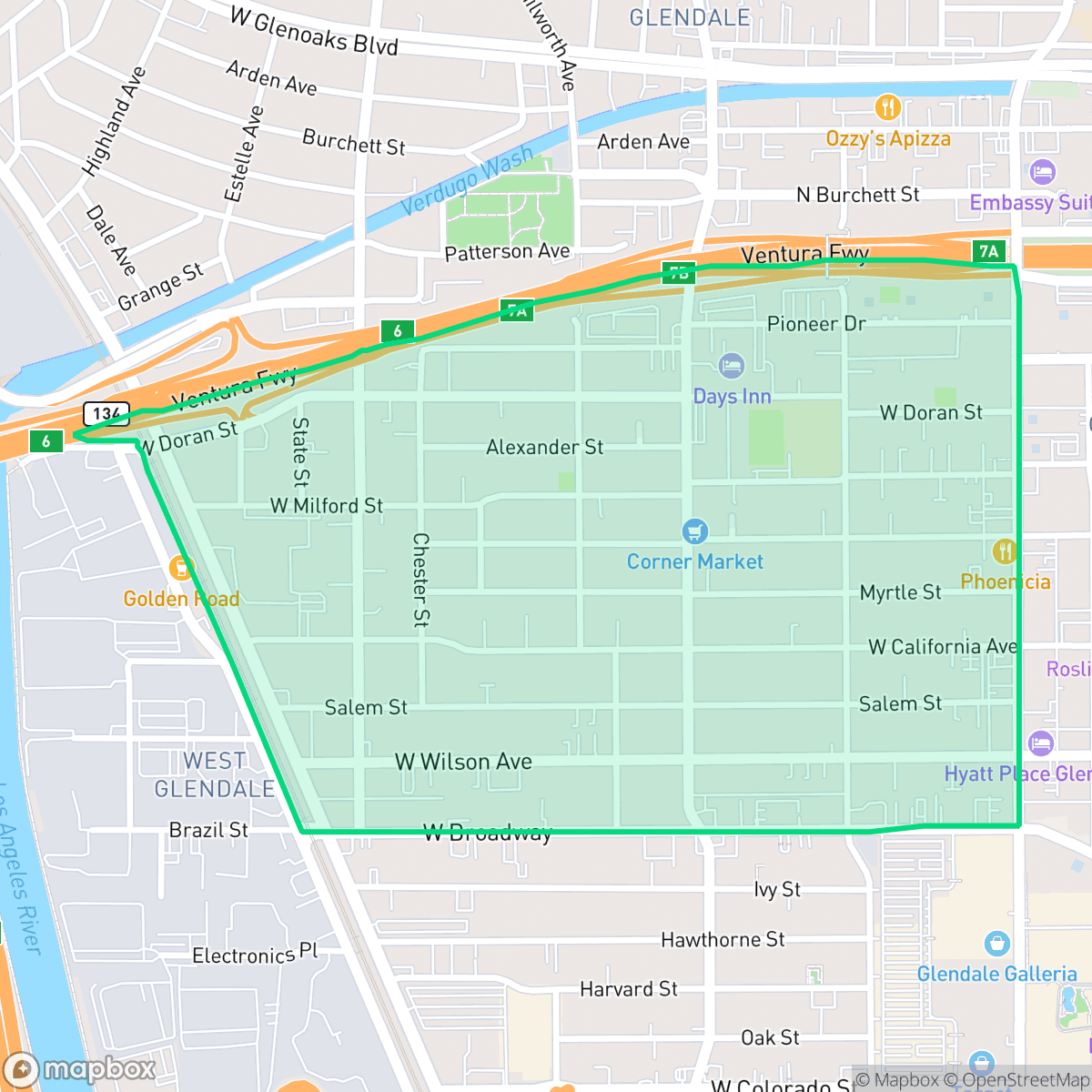
Bounded by San Fernando Road, Broadway, Central Avenue, and the Ventura (134) Freeway, the Vineyard neighborhood in Glendale, California, preserves the legacy of the area's late 19th-century winemaking history. In the 1870s, Judge Andrew Glassell established a 146-acre vineyard here, celebrated as the "show place" of the Glendale Valley. The surrounding area grew into an "Italian area" of wineries and vineyards, including the Pelanconi vineyards. In 1907, the Erkenbrecher Syndicate subdivided the Glassell tract into the Glendale Valley View Tract, accelerating residential growth west of Central Avenue. Although the neighborhood's last historic winery on San Fernando Road was demolished in 1971, its viticultural heritage lives on in its name. Today, Vineyard is a densely populated urban neighborhood home to a prominent Armenian-American community.
The neighborhood functions as a dense urban hub where the streetscape is defined by a mix of mid-rise commercial buildings and tightly packed residential blocks. It maintains a high level of activity, supported by a variety of dining options ranging from bakeries and pizzerias to international cuisine. Its grid layout and comprehensive sidewalk network make it one of the most walkable areas in Glendale, facilitating easy access to daily necessities without the need for a vehicle.
Living in this area involves significant compromises regarding space and quiet, as the high density results in minimal distance between properties and increased road noise. The neighborhood lacks substantial public green space, which may be a consideration for pet owners or those seeking outdoor recreation. While the Glendale Unified School District provides strong overall educational resources, local elementary options like Columbus Elementary currently face challenges that prospective families should investigate. This area is best suited for individuals who prioritize urban convenience and transit accessibility over private outdoor space or a quiet suburban retreat.
Neighborhood Scores Across 15 Qualities
Residential properties feature close quarters with narrow separations between buildings. According to iHuus data, this density is notably lower than the Glendale average due to shared property lines and tightly spaced homes.
Pedestrian navigation is easy due to a comprehensive sidewalk network and frequent crosswalks at major intersections. This level of walkability is notably higher than the Glendale average, according to iHuus data.
Standard tract housing and apartment complexes define the area, featuring tidy but small yards and boxy rooflines. This visual landscape is slightly less lush than the Glendale average according to iHuus data.
Limited public parks and narrow sidewalk verges make it difficult to find open areas for exercise. Most greenery is restricted to private fenced yards, making this area less dog friendly than the Glendale average.
Predominantly industrial and low-density, this area features significant warehouse distribution and freeway infrastructure. According to iHuus data, the landscape lacks the urban density found elsewhere in Glendale.
Diverse dining options and dense high-rise developments create a high-energy atmosphere that is significantly more active than the Glendale average. While some blocks near the highway offer a quieter suburban feel, much of the area functions as a lively destination for local cafes and restaurants according to iHuus data.
Frequent traffic and transit noise from nearby freeways and railroad tracks characterize the area. This level of acoustic disturbance is higher than the Glendale average, according to iHuus data.
Air quality remains consistently good with rare instances of elevated readings. According to iHuus data, the atmospheric conditions in Vineyard are on par with the city average.
Heavy industrial presence is minimal in this area, though some parts of the neighborhood sit near a large freeway and a concrete wash channel. According to iHuus data, the level of industrial proximity is slightly lower than the Glendale average due to the absence of large scale warehouses and freight hubs.
Health insurance access is slightly lower than the Glendale average, according to iHuus data. Most residents maintain coverage, though a notable portion of the population remains uninsured.
Voting patterns and census indicators reflect a predominantly liberal political leaning that is slightly more pronounced than the Glendale average.
A balanced mix of young adults, families, and older residents characterizes the local community. According to iHuus data, this age distribution is nearly identical to the average seen across Glendale.
Significant flood risk exists within this area due to its location inside a designated 100-year floodplain. According to iHuus data, this level of risk is notably higher than the Glendale average and likely necessitates flood insurance.
Fire safety conditions in Vineyard are notably lower than the Glendale average. According to iHuus data, the area presents a higher level of risk regarding fire-related hazards.
Address-Level Insights for Vineyard


iHuus Neighborhood Intelligence Insights
Get address-level neighborhood insights for Vineyard
- Street-level scores — see how individual blocks compare, not just neighborhood averages
- Micro-zone boundaries — identify quiet pockets, flood boundaries, and walkable clusters before you visit
- 15 dimensions in full — walkability, noise, air quality, school quality, insurance coverage, population age profile, urban/rural index, and more
- Boundary risk alerts — know if your address sits near a block boundary where scores drop, the kind of detail no listing will ever mention
- School insights — individual school ratings and insights, not just district-level data
- Compare before you commit — side-by-side data across neighborhoods, down to block precision
No credit card required
Compare with Any Neighborhood
| Dimension | Vineyard | Adams Hill |
|---|---|---|
| 🚶 Walkabilityavg 8.69 | ||
| 🔊 Acoustic Comfortavg 3.71 | ||
| 🤫 Privacy Indexavg 4.65 | ||
| 🎨 Visual Appealavg 6.99 | ||
| 🐕 Dog Friendlinessavg 5.3 | ||
| 🗺️ Urban-Rural Indexavg 6.32 | ||
| ✨ Neighborhood Vibeavg 5.1 | ||
| 🏥 Health Insurance Coverageavg 7.89 | ||
| 🌿 Air Qualityavg 8.01 | ||
| 🏭 Industrial Proximityavg 8.92 | ||
| 🌊 Flood Safetyavg 2.96 | ||
| 🗳️ Ideological Leanavg 8.52 | ||
| 👥 Population Age Profileavg 5.28 | ||
| 🔥 Fire Safetyavg 0.5 | ||
| 🏫 School Quality |
Vineyard Rankings
School Districts Serving Vineyard
School Insights for Vineyard
Below average outcomes; significant attendance and academic challenges.
School Insights
See what's really behind every school rating near Vineyard
- Individual school ratings — each school's own score with outcome context, not just a district average
- Enrollment & class size data — student-to-teacher ratio and how it compares to the state average
- Full demographics breakdown — ethnicity and gender composition for every school in the enrollment zone
- Every school in the district — all schools within the enrollment boundary ranked by rating, not just the closest one
- Grade levels & benchmarks — elementary through high school, with below/above state-average flags
No credit card required