Rossmoyne, Glendale
Updated · 9,238 residents
Rossmoyne is a tranquil, historic enclave in Glendale defined by its well-preserved Period Revival architecture and verdant, hilly streets. While the area offers high visual appeal and excellent health insurance coverage, it remains a quiet, car-oriented residential community with limited immediate access to commercial amenities.
Key Highlights
About Rossmoyne
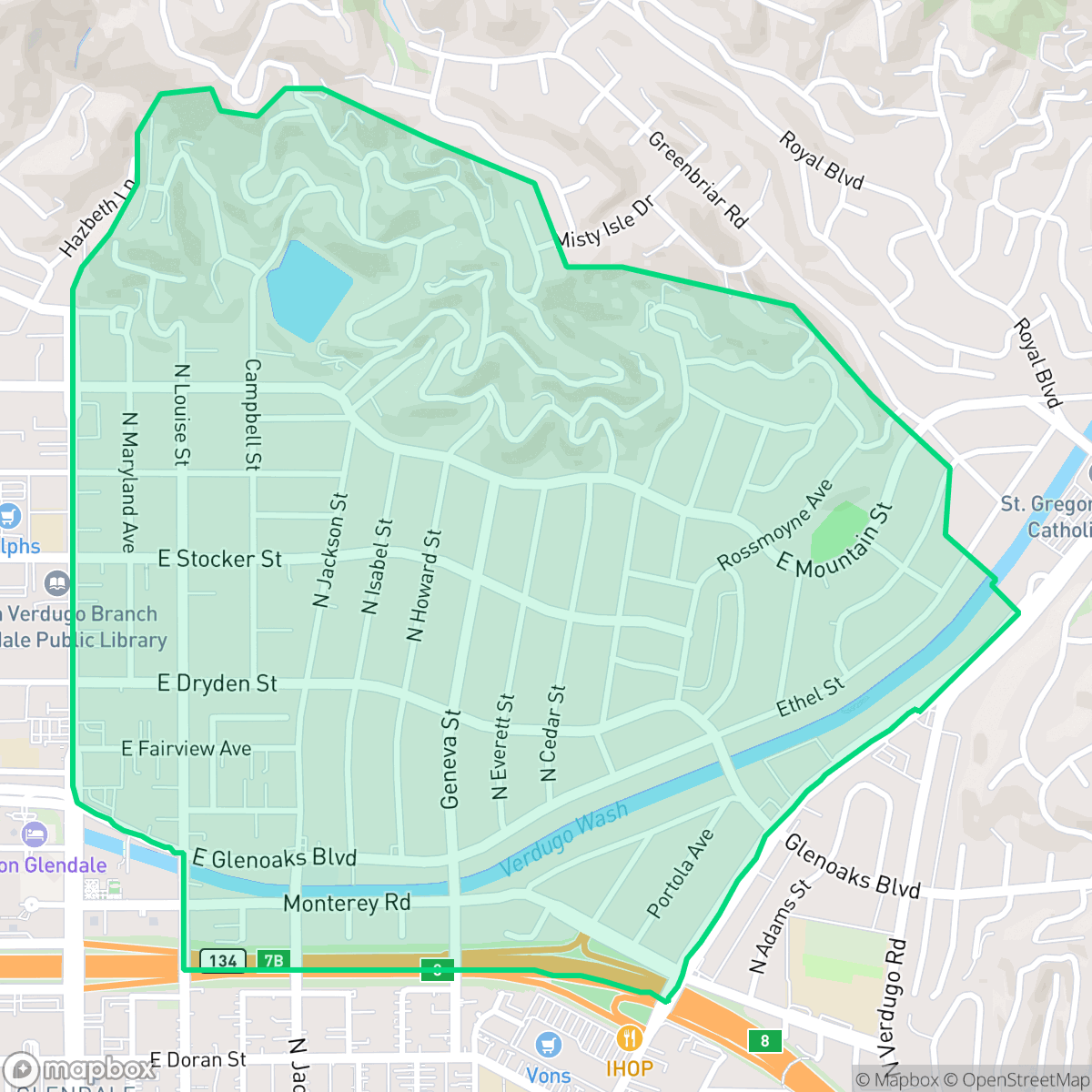
Once part of the vast Verdugo Rancho, Rossmoyne originated in 1872 when Judge Erskine Mayo Ross purchased 1,100 acres of ranch land, establishing successful citrus and olive groves. The neighborhood takes its name from the large estate Ross built on the property. In 1923, the Haddock-Nibley Company began developing the land into one of Glendale’s first master-planned suburbs, designed with curving streets, underground utilities, and decorative streetlights. Developed primarily between the 1920s and 1950s, the neighborhood features an exceptional collection of Period Revival architecture, particularly Spanish Colonial, Tudor, and French-inspired designs. In 2012, Rossmoyne was designated as Glendale’s largest historic district, preserving over 500 homes. The neighborhood also features Nibley Park, a popular community gathering spot donated by the original developers.
The neighborhood is a predominantly residential area characterized by its affluent, well-manicured landscapes and diverse architectural styles that range from Spanish Colonial to Tudor. It maintains a serene atmosphere, benefiting from high air quality and a complete absence of industrial activity. Residents enjoy a strong sense of community stability, supported by access to the high-performing Glendale Unified School District. According to iHuus data, the area is best suited for those who prioritize aesthetic charm and a quiet environment over high-density urban convenience. While the neighborhood boasts a complete sidewalk network, its hilly terrain and limited commercial density make it more car-dependent than neighboring parts of the city. Prospective residents should note the higher risk profiles for fire and flood events, as well as moderate noise levels from nearby road traffic.
Neighborhood Scores Across 15 Qualities
Residential spacing in Rossmoyne provides some buffer between neighbors, though density is slightly higher than the Glendale average. While hillside properties offer more seclusion, many flatland lots feature closely situated homes with limited side yard separation according to iHuus data.
Pedestrian infrastructure is robust throughout the area, featuring continuous sidewalks and clearly marked crossings that match the city average. While the hilly topography and a major freeway in the south can impact connectivity, many residential loops offer safe, established paths for walking.
Large homes with well-maintained landscapes and private pools characterize much of this area. According to iHuus data, the visual quality of the streetscapes is largely in line with the rest of Glendale.
Public park access and wide grass verges are sparse in this area, making it less dog friendly than the Glendale average. Most greenery is confined to private backyards or the nearby wooded hillside trails.
Residential streets and green spaces are distributed in roughly equal measure, providing a more suburban landscape than the denser urban character found in much of Glendale. According to iHuus data, this area lacks the heavy commercial density and high-rise structures typical of the city average.
Social activity and local dining options are more concentrated here than in the rest of Glendale. Residents can access various cafes and eateries, though much of the neighborhood remains a quiet, suburban environment.
Frequent noise from nearby freeways and transit corridors is a characteristic of this area. According to iHuus data, acoustic levels in Rossmoyne are consistent with the average levels found across Glendale.
Air quality remains mostly clean with only rare instances of elevated readings. According to iHuus data, these conditions are consistent with the average seen across Glendale.
Industrial activity is virtually non-existent here, as the area consists primarily of residential streets and light commercial zones. According to iHuus data, this neighborhood is notably more free of warehouses and heavy industrial hazards than the Glendale average.
Health insurance enrollment is widespread among residents here, sitting well above the Glendale average according to iHuus data.
Political leanings in Rossmoyne align closely with the broader Glendale area, characterized by a liberal majority and a modest opposing presence according to iHuus data.
A balanced distribution of young adults, families, and older residents characterizes the area. This demographic spread is very similar to the broader Glendale average, according to iHuus data.
Flood risk is significantly higher than the Glendale average due to the area's classification within a coastal high-hazard zone. Residents should anticipate elevated or potentially prohibitive insurance costs, according to iHuus data.
Fire safety conditions in this area are notably lower than the Glendale average, according to iHuus data. Residents should be aware of heightened wildfire vulnerabilities and the potential for increased emergency response requirements.
Address-Level Insights for Rossmoyne


iHuus Neighborhood Intelligence Insights
Get address-level neighborhood insights for Rossmoyne
- Street-level scores — see how individual blocks compare, not just neighborhood averages
- Micro-zone boundaries — identify quiet pockets, flood boundaries, and walkable clusters before you visit
- 15 dimensions in full — walkability, noise, air quality, school quality, insurance coverage, population age profile, urban/rural index, and more
- Boundary risk alerts — know if your address sits near a block boundary where scores drop, the kind of detail no listing will ever mention
- School insights — individual school ratings and insights, not just district-level data
- Compare before you commit — side-by-side data across neighborhoods, down to block precision
No credit card required
Compare with Any Neighborhood
| Dimension | Rossmoyne | Adams Hill |
|---|---|---|
| 🚶 Walkabilityavg 8.69 | ||
| 🔊 Acoustic Comfortavg 3.71 | ||
| 🤫 Privacy Indexavg 4.65 | ||
| 🎨 Visual Appealavg 6.99 | ||
| 🐕 Dog Friendlinessavg 5.3 | ||
| 🗺️ Urban-Rural Indexavg 6.32 | ||
| ✨ Neighborhood Vibeavg 5.1 | ||
| 🏥 Health Insurance Coverageavg 7.89 | ||
| 🌿 Air Qualityavg 8.01 | ||
| 🏭 Industrial Proximityavg 8.92 | ||
| 🌊 Flood Safetyavg 2.96 | ||
| 🗳️ Ideological Leanavg 8.52 | ||
| 👥 Population Age Profileavg 5.28 | ||
| 🔥 Fire Safetyavg 0.5 | ||
| 🏫 School Quality |
Rossmoyne Rankings
School Districts Serving Rossmoyne
School Insights for Rossmoyne
Below average outcomes; significant attendance and academic challenges.
School Insights
See what's really behind every school rating near Rossmoyne
- Individual school ratings — each school's own score with outcome context, not just a district average
- Enrollment & class size data — student-to-teacher ratio and how it compares to the state average
- Full demographics breakdown — ethnicity and gender composition for every school in the enrollment zone
- Every school in the district — all schools within the enrollment boundary ranked by rating, not just the closest one
- Grade levels & benchmarks — elementary through high school, with below/above state-average flags
No credit card required