Oakmont, Glendale
Updated · 1,886 residents
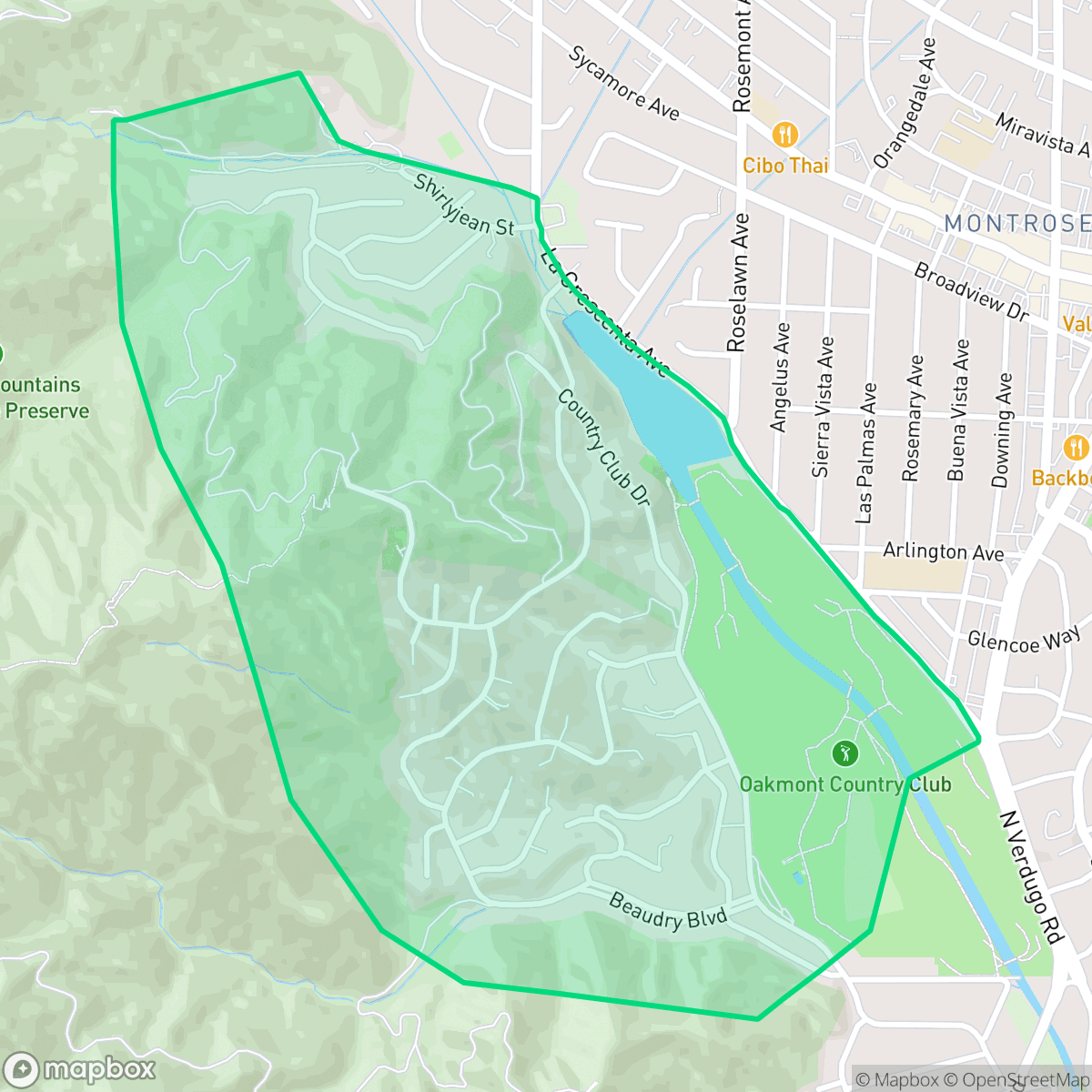
Oakmont is a scenic hillside community in Glendale, characterized by its upscale, spacious homes and a semi-rural atmosphere nestled against the Verdugo Mountains. The area offers a highly walkable street network and a vibrant local social scene, though residents must balance these benefits with the reality of high wildfire risk and occasional traffic noise from nearby transit corridors.
Key Highlights
About Oakmont
Oakmont is a residential neighborhood in the foothills of the Verdugo Mountains in Glendale, California. Its development began in the 1930s, with significant expansion occurring through the 1960s, including the 1950 establishment of Oakmont Woods. The neighborhood is anchored by the historic Oakmont Country Club, founded in 1922. The community’s character is deeply influenced by its hillside topography and a legacy of civic activism; most notably, residents led a decades-long battle against the 'Oakmont View V' development project, which sought to build hundreds of luxury homes on the adjacent ridgeline. This successful conservation effort preserved the area as open space and remains a defining element of the neighborhood's identity, emphasizing a commitment to hillside protection and environmental stewardship within its suburban setting.
Oakmont is defined by its distinct semi-rural character, featuring large, well-maintained properties that offer residents a high degree of privacy and expansive views of the surrounding foothills. The neighborhood is anchored by the historic Oakmont Country Club and benefits from an active local environment where dining spots and community parks provide consistent social engagement. With a continuous network of sidewalks, the area remains highly walkable, allowing residents to easily navigate the lush, tree-lined streets that have become a hallmark of this hillside enclave.
While the neighborhood provides an upscale and tranquil living environment, prospective residents should consider specific regional factors. The area is situated in a high-risk zone for wildfires, which requires a focus on property maintenance and community-wide emergency preparedness. Additionally, while the location is secluded from industrial activity, some parts of the neighborhood experience noticeable traffic noise due to the proximity of regional freeways and rail lines. With high rates of health insurance coverage and access to the Glendale Unified School District, the community is well-suited for families and professionals who value a blend of suburban convenience and environmental stewardship.
Neighborhood Scores Across 15 Qualities
Residential properties feature a moderate level of separation with yards providing a buffer between neighbors. This degree of spacing is notably higher than the Glendale average, according to iHuus data.
Pedestrians can navigate the area easily via a continuous sidewalk network on residential streets and main commercial arterials. This level of accessibility is slightly below the Glendale city average.
Large, well-maintained homes with private backyard pools and expansive driveways characterize the area. This level of aesthetic quality and property scale sits well above the Glendale average according to iHuus data.
Limited public park access is offset by numerous private backyards, making the area slightly more dog friendly than the Glendale average according to iHuus data.
Frequent open spaces and scattered greenery provide a more semi-rural atmosphere than the typical Glendale urban landscape. According to iHuus data, the area features a mix of woodland elements and low-density residential pockets that are more open than the city average.
Social activity is notably higher than the Glendale average, with several local dining spots and community parks providing a lively atmosphere. While some areas offer a quiet suburban feel, many blocks feature a concentrated presence of cafes, restaurants, and accessible green spaces.
Frequent noise from nearby freeways and railroad tracks characterizes the area. According to iHuus data, acoustic comfort in Oakmont is slightly lower than the Glendale average.
Air quality remains consistently good with rare instances of elevated readings, matching the typical levels found throughout Glendale.
Industrial activity is entirely absent from this area, which contains only residential, light commercial, and institutional buildings. According to iHuus data, this lack of heavy industry and hazard sites makes the neighborhood even more secluded from industrial zones than the Glendale average.
Health insurance enrollment among residents is notably higher than the Glendale average, according to iHuus data.
Political leanings in Oakmont are largely liberal, though the community shows slightly less progressive density than the Glendale city average according to iHuus data.
A balanced mix of young professionals, families, and seniors defines the community. According to iHuus data, this demographic spread is slightly more varied than the Glendale city average.
Flood safety in this area is considerably higher than the Glendale average, though some residual risk remains due to the neighborhood's location within a 500-year floodplain. According to iHuus data, properties may still be subject to occasional seasonal runoff.
Significant fire hazards exist in this area, representing a much higher risk level than the Glendale average. According to iHuus data, residents should prioritize enhanced mitigation and wildfire preparedness.
Address-Level Insights for Oakmont


iHuus Neighborhood Intelligence Insights
Get address-level neighborhood insights for Oakmont
- Street-level scores — see how individual blocks compare, not just neighborhood averages
- Micro-zone boundaries — identify quiet pockets, flood boundaries, and walkable clusters before you visit
- 15 dimensions in full — walkability, noise, air quality, school quality, insurance coverage, population age profile, urban/rural index, and more
- Boundary risk alerts — know if your address sits near a block boundary where scores drop, the kind of detail no listing will ever mention
- School insights — individual school ratings and insights, not just district-level data
- Compare before you commit — side-by-side data across neighborhoods, down to block precision
No credit card required
Compare with Any Neighborhood
| Dimension | Oakmont | Adams Hill |
|---|---|---|
| 🚶 Walkabilityavg 8.69 | ||
| 🔊 Acoustic Comfortavg 3.71 | ||
| 🤫 Privacy Indexavg 4.65 | ||
| 🎨 Visual Appealavg 6.99 | ||
| 🐕 Dog Friendlinessavg 5.3 | ||
| 🗺️ Urban-Rural Indexavg 6.32 | ||
| ✨ Neighborhood Vibeavg 5.1 | ||
| 🏥 Health Insurance Coverageavg 7.89 | ||
| 🌿 Air Qualityavg 8.01 | ||
| 🏭 Industrial Proximityavg 8.92 | ||
| 🌊 Flood Safetyavg 2.96 | ||
| 🗳️ Ideological Leanavg 8.52 | ||
| 👥 Population Age Profileavg 5.28 | ||
| 🔥 Fire Safetyavg 0.5 | ||
| 🏫 School Quality |
Oakmont Rankings
School Districts Serving Oakmont
School Insights for Oakmont
Below average outcomes; significant attendance and academic challenges.
School Insights
See what's really behind every school rating near Oakmont
- Individual school ratings — each school's own score with outcome context, not just a district average
- Enrollment & class size data — student-to-teacher ratio and how it compares to the state average
- Full demographics breakdown — ethnicity and gender composition for every school in the enrollment zone
- Every school in the district — all schools within the enrollment boundary ranked by rating, not just the closest one
- Grade levels & benchmarks — elementary through high school, with below/above state-average flags
No credit card required