Montrose Verdugo City, Glendale
Updated · 6,316 residents
Montrose Verdugo City is a vibrant, walkable neighborhood in Glendale known for its pedestrian-friendly Honolulu Avenue and a strong sense of suburban community. While the area offers high-quality schools and an affluent, well-maintained aesthetic, residents should be prepared for significant noise from local road traffic.
Key Highlights
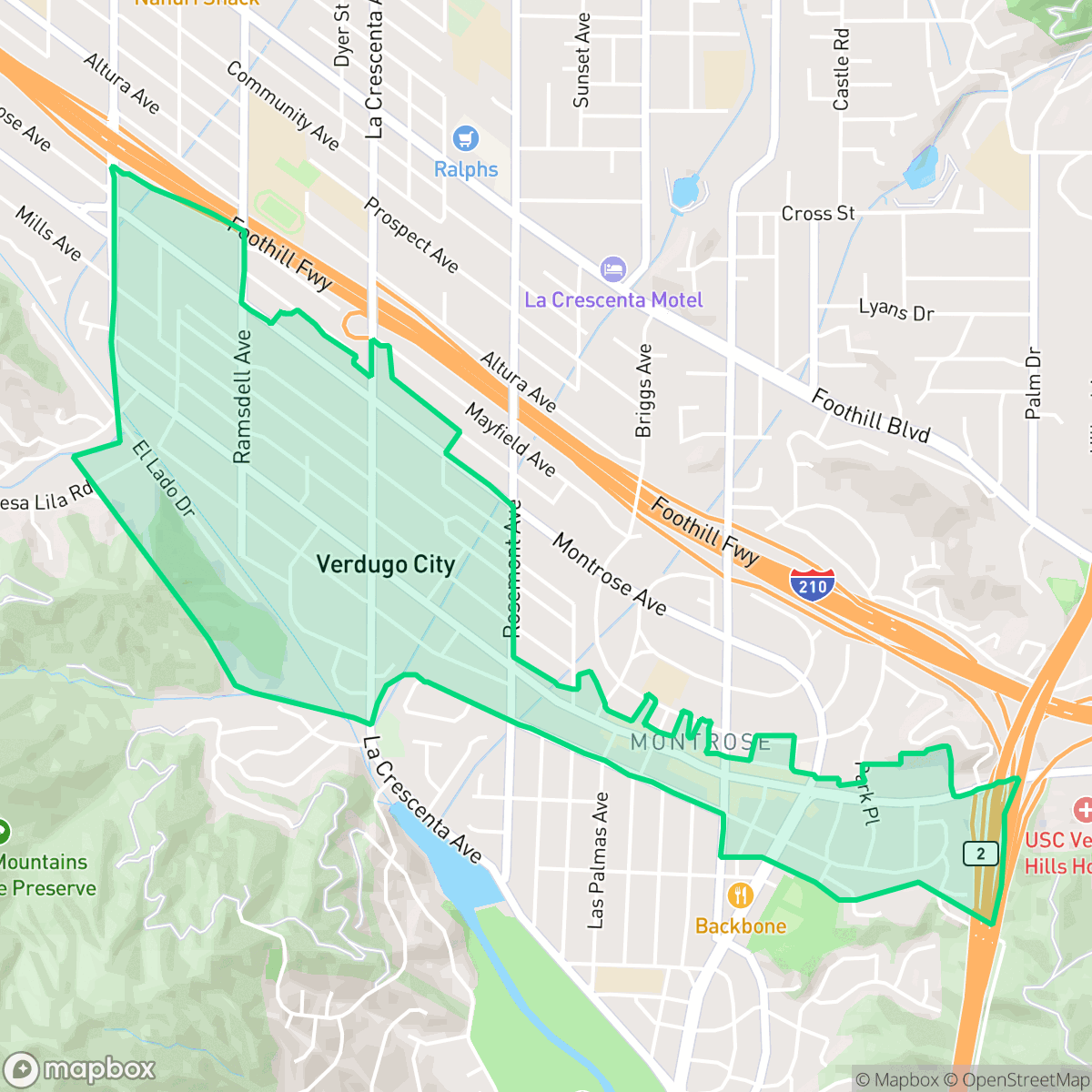
About Montrose Verdugo City
Montrose was established on February 22, 1913, when developers J. Frank Walters and Robert A. Walton auctioned off 300 acres of graded, curved streets at a public barbecue. Nearby, developer Harry Fowler founded the 10-acre Verdugo City in 1923, centering it around a post office and the prominent Fowler Building. Though Montrose Avenue was originally designed as the main business district—and constructed as the widest road in Los Angeles County—shoppers preferred level ground, prompting commercial activity to shift to Honolulu Avenue. In 1967, local merchants led by Frank Roberts transformed this business district into the Montrose Shopping Park, a pioneering, park-like pedestrian district with landscaped curbouts and benches. Annexed by Glendale in the 1950s, the combined Montrose-Verdugo City neighborhood retains its mid-century, 'Main Street, USA' character.
The area balances a dense suburban mix of single-family homes and low-rise apartments with a lively commercial core. According to iHuus data, the neighborhood maintains high visual appeal, characterized by manicured landscapes and private amenities like backyard pools. The pedestrian-oriented shopping district provides residents with convenient access to a variety of dining options and local services, fostering a tight-knit community atmosphere that remains distinct from the surrounding city.
Prospective residents should consider the trade-offs of living in this bustling environment. While the neighborhood boasts excellent health insurance coverage and access to top-tier school districts, it faces challenges such as high noise levels from vehicle traffic and a significant fire safety risk. The area is well-suited for families and professionals who prioritize school quality and walkability but are prepared to manage the acoustic and environmental realities of a busy, established suburban setting.
Neighborhood Scores Across 15 Qualities
Residential spacing is higher than the Glendale average, featuring a mix of detached homes with modest yards and more densely packed multi-unit buildings. According to iHuus data, some areas offer significant setbacks and tree buffers, while other sections consist of closely positioned houses.
Continuous sidewalk networks and safe crossings facilitate easy movement through residential blocks; however, the nearby freeway creates some significant barriers for pedestrians compared to the Glendale average.
Manicured landscapes, large homes, and frequent private backyard pools contribute to a visual environment that is more polished than the Glendale average. According to iHuus data, the area features well-maintained properties and spacious driveways throughout much of the neighborhood.
Access to large hillside green belts and vegetated sidewalk verges provides more opportunities for pet exercise than the Glendale average. While some residential pockets rely on private yards, several areas feature ample space for walking dogs near public parkland.
Open land and woodland areas provide a more relaxed, semi-rural atmosphere compared to the more densely developed parts of Glendale. According to iHuus data, this neighborhood features a higher prevalence of scattered homes and natural hillsides than the city average.
Local dining and essential services provide a sense of activity that is more vibrant than the Glendale average. While certain pockets offer lively social hubs and parks, other sections remain quiet and more car-dependent.
Frequent traffic and transit noise from nearby freeways and railroad tracks characterize this area. According to iHuus data, acoustic comfort is significantly lower than the Glendale average.
Air quality remains mostly clean with only rare instances of elevated readings, performing slightly better than the Glendale average according to iHuus data.
Residential and light commercial zones dominate the area with an absence of warehouses or hazardous industrial facilities. This makes the neighborhood cleaner and quieter than the Glendale average, according to iHuus data.
Health insurance accessibility is high for residents in this area, staying slightly above the Glendale average according to iHuus data.
Political preferences in this area align with a liberal majority, though the level of partisan lean is slightly lower than the Glendale average according to iHuus data.
A diverse range of age groups resides here, including young adults, families, and seniors. This demographic spread is roughly in line with the average seen across Glendale.
Flood risk levels remain undetermined because FEMA has not yet completed a detailed study for this area. According to iHuus data, the potential for flooding is higher than the Glendale average.
Extreme fire hazards are present in this area, representing a significantly higher risk level than the Glendale average. Residents should prioritize maximum protection measures and emergency preparedness according to iHuus data.
Address-Level Insights for Montrose Verdugo City


iHuus Neighborhood Intelligence Insights
Get address-level neighborhood insights for Montrose Verdugo City
- Street-level scores — see how individual blocks compare, not just neighborhood averages
- Micro-zone boundaries — identify quiet pockets, flood boundaries, and walkable clusters before you visit
- 15 dimensions in full — walkability, noise, air quality, school quality, insurance coverage, population age profile, urban/rural index, and more
- Boundary risk alerts — know if your address sits near a block boundary where scores drop, the kind of detail no listing will ever mention
- School insights — individual school ratings and insights, not just district-level data
- Compare before you commit — side-by-side data across neighborhoods, down to block precision
No credit card required
Compare with Any Neighborhood
| Dimension | Montrose Verdugo City | Adams Hill |
|---|---|---|
| 🚶 Walkabilityavg 8.69 | ||
| 🔊 Acoustic Comfortavg 3.71 | ||
| 🤫 Privacy Indexavg 4.65 | ||
| 🎨 Visual Appealavg 6.99 | ||
| 🐕 Dog Friendlinessavg 5.3 | ||
| 🗺️ Urban-Rural Indexavg 6.32 | ||
| ✨ Neighborhood Vibeavg 5.1 | ||
| 🏥 Health Insurance Coverageavg 7.89 | ||
| 🌿 Air Qualityavg 8.01 | ||
| 🏭 Industrial Proximityavg 8.92 | ||
| 🌊 Flood Safetyavg 2.96 | ||
| 🗳️ Ideological Leanavg 8.52 | ||
| 👥 Population Age Profileavg 5.28 | ||
| 🔥 Fire Safetyavg 0.5 | ||
| 🏫 School Quality |
Montrose Verdugo City Rankings
School Districts Serving Montrose Verdugo City
School Insights for Montrose Verdugo City
Below average outcomes; significant attendance and academic challenges.
School Insights
See what's really behind every school rating near Montrose Verdugo City
- Individual school ratings — each school's own score with outcome context, not just a district average
- Enrollment & class size data — student-to-teacher ratio and how it compares to the state average
- Full demographics breakdown — ethnicity and gender composition for every school in the enrollment zone
- Every school in the district — all schools within the enrollment boundary ranked by rating, not just the closest one
- Grade levels & benchmarks — elementary through high school, with below/above state-average flags
No credit card required